Parents are most concerned with the cost. The degree length complicates cost estimation. Many websites provide a total cost range of "₹20-35 lakh" without elaboration.
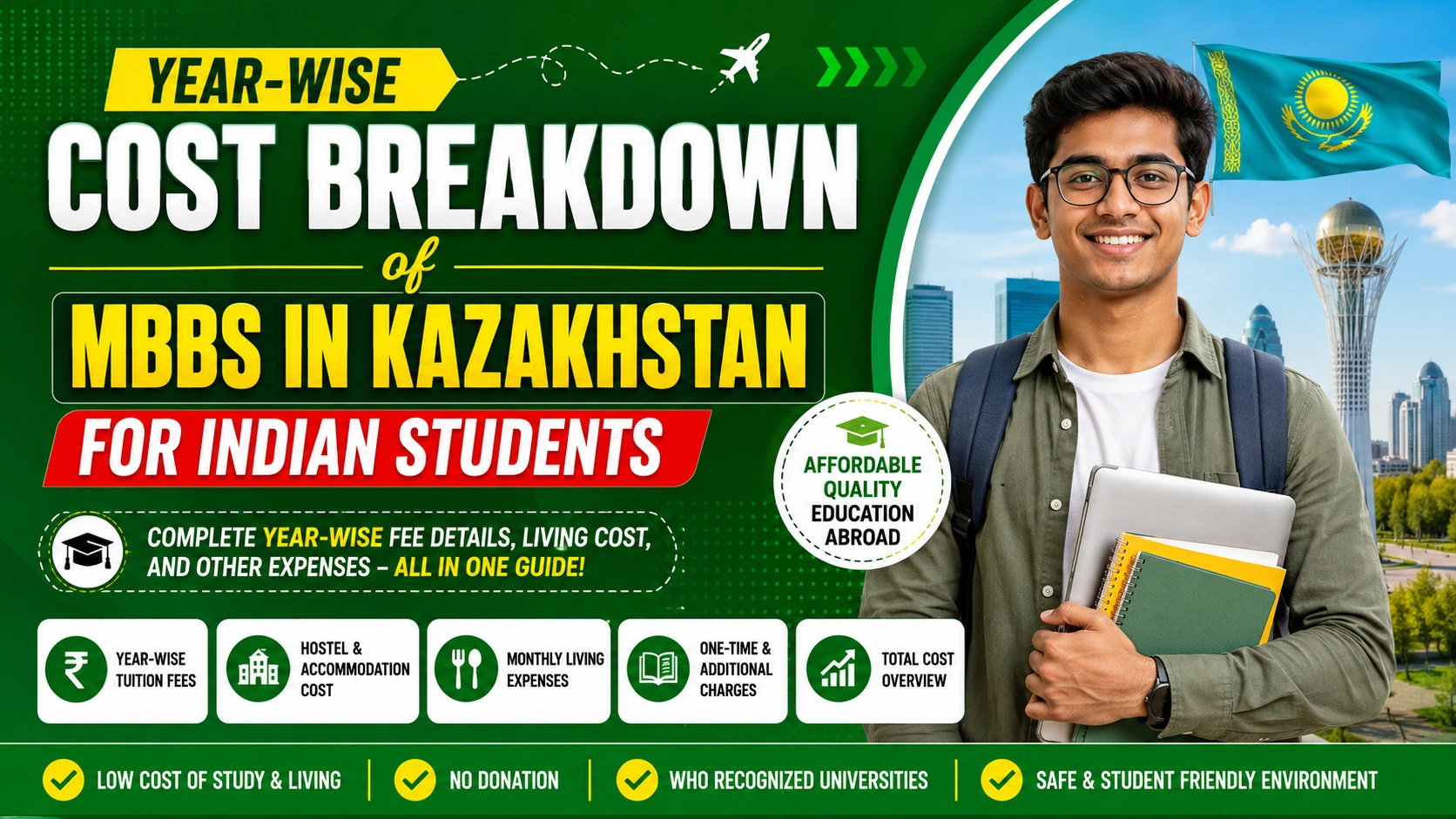
This blog provides a year wise breakdown of MBBS costs in Kazakhstan so that you can budget for the heavy initial set up costs in the first year and the steadier costs in the following years.
Why a Year Wise Cost Breakdown is Better than a Single Total Amount
The total cost of "₹28-36 lakh for 6 years" is helpful for a broad comparison of countries, but does not inform your family financial planning. The costs are structured in the following way:
- Year 1 is the most costly due to one-time costs, including visa costs, flights, Indian Mess charges, and tuition and hostel fees.
- Years 2-5 are typically the same and the costs of tuition and hostel fees dominate.
- Year 6 is the internship, and costs are different since there are clinical rotations that govern the need for a hostel and mess.
This information helps parents prepare loans or fixed deposits for the first year and helps them avoid the shock of the first year costs.
Overview: What is the Total Course Cost?
At most NMC-approved universities in Kazakhstan, the approximate total cost for an Indian student to pursue a 6-year MBBS program is between ₹20 to ₹36 Lakhs. This cost estimate includes tuition, housing, insurance, and living expenses. NMC-approved universities that are considered to be in the budget range for MBBS in Kazakhstan will have an average cost closer to ₹19 to ₹22 Lakhs. For more popular universities in Almaty, tuition costs will be closer to ₹40 to ₹45 Lakhs, particularly for students that choose to not stay in hostels and arrange for their own private housing.
Cost by Year
Please see the next table for a cost estimate by year for studying at the various NMC-approved universities. These should be viewed as approximate costs only, as actual costs may be different. For exact costs for tuition, please see the university's website.
Year 1 - The Heaviest Year
|
Cost Element |
Approximate Range (INR) |
|
Tuition |
₹2.7 lakh - ₹4.5 lakh |
|
Accommodation |
₹50,000 - ₹85,000 |
|
Indian Mess (Year 1) |
₹1 lakh - ₹1.25 lakh |
|
Visa fee & processing |
₹15,000 - ₹25,000 |
|
Medical Insurance (annual) |
₹15,000 - ₹18,000 |
|
Flights (one-time) |
₹25,000 - ₹40,000 |
|
Admission processing/miscellaneous charges |
₹20,000 - ₹40,000 |
|
Approximate Year 1 total |
₹5.5 lakh - ₹7.5 lakh |
Year 1 is the heaviest because several costs, including visa processing, flights, and registration, are one-time costs. Most universities also make Indian Mess facilities compulsory in the first year, to help students settle in without having to worry about sourcing groceries or cooking, in an unfamiliar and new city.
Year 2 - Settling in
|
Cost Element |
Approximate Range (INR) |
|
Tuition |
₹2.7 lakh - ₹4.5 lakh |
|
Accommodation |
₹50,000 - ₹85,000 |
|
Food/Mess (optional after Year 1) |
₹70,000 - ₹1 lakh |
|
Medical Insurance (annual) |
₹15,000 - ₹18,000 |
|
Visa extension |
₹8,000 - ₹15,000 |
|
Personal/Miscellaneous Expenses |
₹60,000 - ₹90,000 |
|
Approximate Year 2 total |
₹4.7 lakh - ₹7 lakh |
Most students are able to settle in by the second year, and most either continue with the Mess/Accommodation, or start cooking for themselves. This can lead to a decrease in costs depending on the choices being made.
Years 3 and 4: The Stable Middle Years
|
Cost Component |
Approximate Range (INR) |
|
Tuition fee |
₹2.7 – 4.5 lakh |
|
Hostel accommodation |
₹50,000 – 85,000 |
|
Food & living expenses |
₹70,000 – 1 lakh |
|
Insurance & visa renewal |
₹25,000 – 35,000 |
|
Books, lab, and clinical material |
₹15,000 – 30,000 |
|
Approximate annual total (each year) |
₹4.3 lakh – 6.4 lakh |
In general, the middle years tend to be the easiest to budget for, since costs tend to stabilize and one-time expenses disappear. The core subjects of pathology, pharmacology, and microbiology begin during these years. The costs for lab/clinical materials increase slightly after the foundation years.
Year 5: Clinical Rotations Begin
|
Cost Component |
Approximate Range (INR) |
|
Tuition fee |
₹2.7 – 4.5 lakh |
|
Hostel accommodation |
₹50,000 – 85,000 |
|
Food & living expenses |
₹70,000 – 1 lakh |
|
Insurance & visa renewal |
₹25,000 – 35,000 |
|
Clinical training/hospital-related costs |
₹20,000 – 35,000 |
|
Approximate Year 5 total |
₹4.35 lakh – 6.45 lakh |
This is where the hands-on clinical training truly begins, and students also typically start to consider the FMGE/NExT more seriously, so it's worth considering this even if the costs for the formal training fall later.
Year 6: Internship Year
|
Cost Component |
Approximate Range (INR) |
|
Tuition/internship fee |
₹1.5 lakh – ₹3.5 lakh |
|
Hostel/accommodation (if applicable) |
₹40,000 – ₹70,000 |
|
Food & living expenses |
₹70,000 – ₹1 lakh |
|
Insurance |
₹15,000 – ₹18,000 |
|
Approximate Year 6 total |
₹2.75 lakh – ₹5.4 lakh |
Cost for an internship year is generally less, as students do not spend much time in the classroom. Year 6 is mainly for clinical rotations. As this can vary greatly from university to university, check the specific details while shortlisting universities for MBBS in Kazakhstan 2026.
Total Estimated Six-Year Cost
Considering the above, a fair hostel-oriented budget for the full course would be in the range of:
- ₹24 lakh to ₹36 lakh for tuition, hostel, food, insurance, and living expenses. This would be more in the range of ₹40–45 lakh for students planning on staying in private hostels or choosing higher fee, premium universities in larger cities like Almaty.
What's NOT Usually Included in Advertised Fee Structures
This is where a lot of families see costs they did not expect. Here are some examples of costs listed in the "total cost" that are typically missing from the advertised fee structures.
- Costs to prepare for the FMGE/NExT after returning to India. This cost is for coaching.
- Costs for degree document attestation and apostille.
- Costs for flights to India during the semester are not included, yet most students plan a budget to fly home at least once.
- Unincluded are the costs of winter clothing and winter gear. Kazakhstan has a continental climate and students are left to their own devices on clothing.
- Costs of winter gear are also left out along with extra medical insurance costs. The coverage is very basic.
Since all costs are listed in USD, the fluctuating currency will likely mean the Indian Rupee will have to pay more each year. A 10% to 15% buffer should be included.
Indian Families Budgeting Suggestions
- Expect no range and a complete breakup. A total listed by some university or consulting houses really means hidden payments. You should be given an itemized list with breakdowns for each year, not just summaries.
- Memorize what is required. Indian meals, for example, are required for the entire first year but are really optional for the rest.
- Consider what costs will be. A small buffer should be included because fees are listed in USD. Do not assume a constant conversion.
- Hostel and mess fees are of equal consideration. A university with lower overall tuition might be a more expensive university.
- Evaluate eligibility for education loans early. To study MBBS in Kazakhstan, several Indian banks provide education loans if the university is recognized. This brings us to the most crucial consideration.
Cost Should Never Be the Only Consideration
It's easy to assume the least expensive option is the best choice. However, the real 'cost' of studying at an unrecognized or poorly ranked university will be the years spent unable to practice. Make sure you check the following before you excuse total costs of studying at a specific university:
- The university is listed in the World Directory of Medical Schools (WDOMS), the worldwide directory of medical school recognition.
- The medical school's curriculum follows the standards set by the World Health Organization.
- The university maintains recognition with India's National Medical Commission (NMC), as you need this in order to take the licensing exam in India.
- Your admission is supported by the applicable NEET qualification as mandated by the NTA, as no amount of cost-saving will allow you to practice in India.
- Saving ₹3 lakh on tuition is irrelevant if you attend an unrecognized medical school with poor FMGE/NExT outcomes.
Conclusion
Costing year by year as opposed to one total amount provides Indian families with a clearer and more realistic prediction of what an MBBS in Kazakhstan is likely to cost. The first year is predicted to be the most expensive due to one-time setup costs. Years 2 to 5 are predicted to be more or less the same in terms of costs, with a lesser expensive Year 6 due to the internship. Students are predicted to spend between ₹24 lakh and ₹36 lakh across the entire course, with a margin for fluctuations in currency and costs that are not listed in the official fee list.