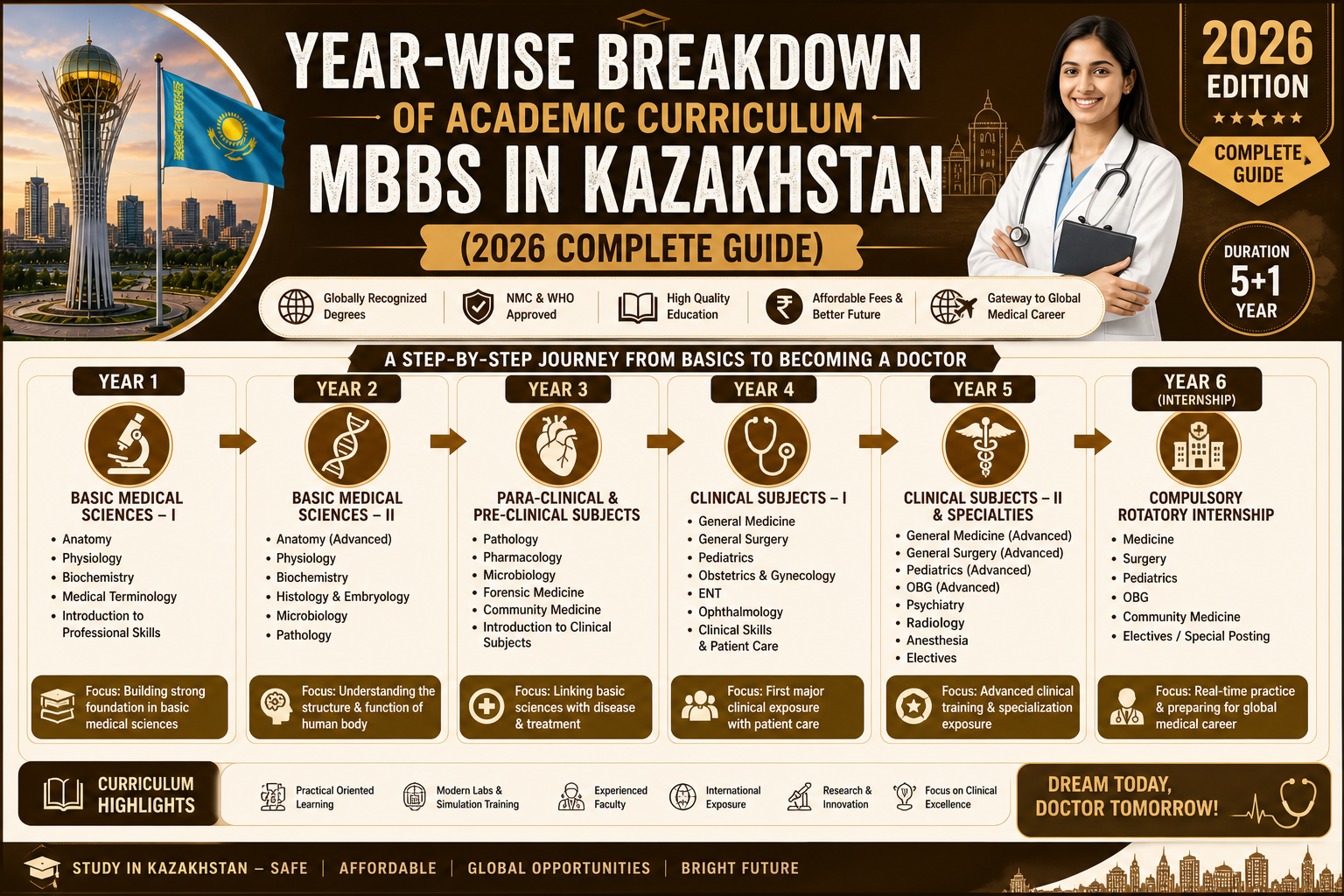
The course structure for MBBS in Kazakhstan is based on the new 21st century medical education system. It is a 6 year course with internship training & follows international standards of medical education.
For information on admissions and university assistance, see: MBBS in Kazakhstan.
Homeland of MBBS Structure in Kazakhstan
The curriculum is divided into three primary phases.
- Pre-Clinical Phase (Year 1–2)
- Para-Clinical Phase (Year 3)
- Clinical Phase (Year 4–5)
- Internship (Year 6)
Each stage is specifically designed to establish incremental clinical knowledge and skills.
The First Year: Foundation of Medical Sciences
The initial year is spent studying basic medical sciences and introductory concepts.
Subjects:
- Anatomy
- Physiology
- Biochemistry
- Histology
- Medical Terminology
Learning Approach:
- Theoretical lectures
- Laboratory work
- Basic dissection (in some universities)
Objective:
In order to facilitate a solid ground on human body structure and function.
Year 2: Strengthening Basic Sciences
The second year varies only by an additional degree of depth in pre-clinical education.
Subjects:
- Microbiology
- Pathology (introductory level)
- Pharmacology (basic concepts)
- Immunology
- Genetics
Learning Approach:
- Lab-based experiments
- Case-based discussions (basic level)
- Written assessments and viva exams
Objective:
In order to understand disease mechanisms & drug interactions.
Third Year: Clinical Learning transition
The first stage of clinical exposure for students.
Subjects:
- Pathology (advanced)
- Pharmacology (clinical application)
- Forensic Medicine
- Community Medicine
- Introduction to Clinical Medicine
Learning Approach:
- Hospital visits
- Basic patient interaction
- Case presentations
Objective:
To connect basic sciences with clinical practice.
Year 4: We will begin Core Clinical Training
Students start their full hospital clinical training.
Subjects:
- General Medicine
- General Surgery
- Pediatrics
- Obstetrics & Gynecology
- Orthopedics
Learning Approach:
- Bedside teaching
- Ward rounds
- Clinical case discussions
Objective:
In order to cultivate the capacity for diagnosis and patient handling.
Year 5: Advanced Clinical Practice
Year 3: Specialization exposure and advanced clinical training
Subjects:
- Cardiology
- Neurology
- Psychiatry
- Dermatology
- Emergency Medicine
Learning Approach:
- Active participation in hospital cases
- Surgery observations
- Independent case handling under supervision
Objective:
To strengthen clinical decision-making skills.
You are in your 6th year - internship (practical training years)
Each of these final years is purely training on the ground.
Training Areas:
- Medicine wards
- Surgery departments
- Emergency units
- ICU exposure
- Rural/urban hospital rotations
Learning Approach:
- Full-time hospital duties
- Supervised patient management
- Clinical reporting and documentation
Objective:
To prepare students for independent practice in medicine.
Teaching Methodology in Kazakhstan MBBS
The curriculum is delivered through:
- Lectures and seminars
- Laboratory-based learning
- Problem-based learning (PBL)
- Clinical rotations in hospitals
- Case presentations and viva exams
Medium of instruction shall generally be English, but local (indigenous) language(s) may be used for clinical communication.
Importance for Indian Students
In the case of Indian students, this curriculum should meet the demands of the National Medical Commission. Students do so because they are required to sit the NEET (and later FMGE/NExT pathway) after graduation in order to be awarded a license to practice medicine in India.
Global recognition via WHO and listing in WDOMS also supports international career pathways.
Key Strengths of the Curriculum
- Sequential transitioning from theory into practice
- Strong emphasis on hospital-based learning
- Internationally aligned syllabus
- Early clinical exposure compared to many countries
Final Conclusion
Kazakhstan MBBS curriculum is a highly structured 6-year program that increases students in increments from basic sciences learning to becoming full clinical competent doctors.
More active hospital training and steady self-study help prepare students for licensing exams and to practice medicine internationally.
When students comprehend this yearly organization, it becomes easier for them to pursue their studies and see how they can relate it back to future career aspirations.