Almaty, the former capital and the largest city in Kazakhstan, is home to some prominent medical universities popular among Indian students. With its advanced infrastructure and ranked medical programs, study MBBS in Kazakhstan, establish Almaty as one of the top destinations. Almaty also has a huge international student population. But before committing to a program that lasts six years, families want to know what the costs will really be. Vague numbers that say the tuition costs starts from are not good enough. Families want numbers and details.
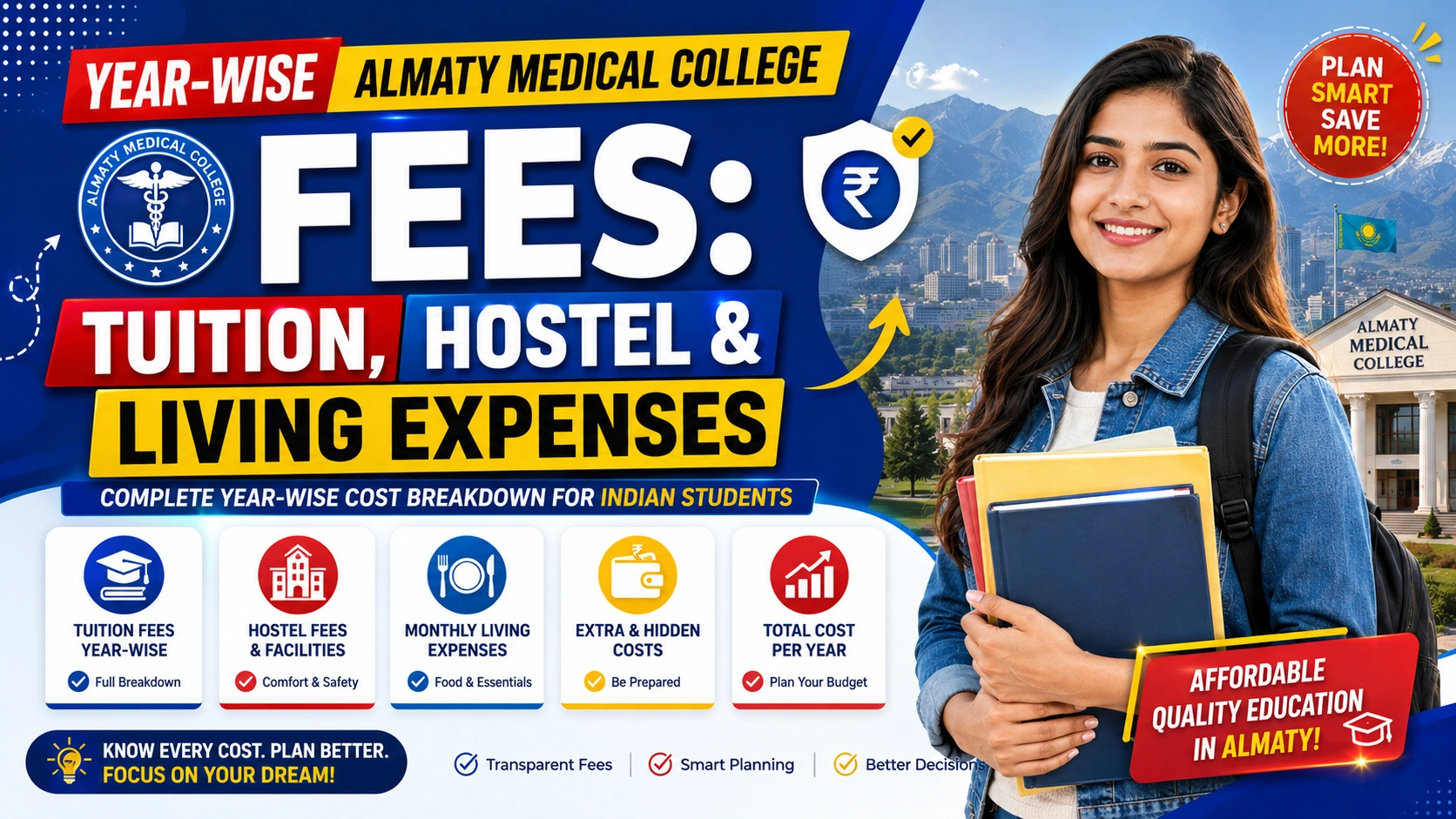
This guide provides the annual breakdown of the costs associated with tuition, hostels, and living expenses. The information provided will help families plan their budget, so they do not have to plan with expenses that are uncertain, especially with living expenses.
Why Almaty Is a Preferred City for Medical Studies
Before discussing the costs, it is important to understand why a large number of Indian students apply to the medical colleges in Almaty.
For any Indian student hoping to practice medicine after graduation, listed medical universities in Almaty on the World Directory of Medical Schools (WDOMS) and acknowledged by the World Health Organization (WHO) is the baseline requirement. The degrees from these universities are accepted by India's National Medical Commission (NMC). Therefore, graduates can take India's licensing exams and can practice in India. This is the same recognition chain of MBBS in Kazakhstan for Indian students that makes the program viable and credible, rather than saying it's a "cheaper alternative".
Almaty has an infrastructure dedicated to international students including hostels, English Medium Teaching (EMT) tracks, Teaching hospitals for clinical rotations, and a significant Indian student population, which eases the transition in the first year.
Understanding MBBS Fees in Almaty
Almaty Medical Colleges provide the following breakdown of the fees:
- Tuition Fee: Annually Charged usually in US $
- Hostel/accommodation Fee: Annually or Semester-wise
- One-time Admission/Application Fee: Paid upon enrollment
- Medical insurance: Annually Mandatory for International Students
- Living expenses: Not part of the university fee structure
Personal expenses, food, and transport are not included in the Medical Colleges fee structure in Almaty. Tuition Fees are generally the same in early years of Pre/Clinical studies. However, a few universities have a small, annual (3-5%) increase to address inflation. Always ask for this in writing as it's the biggest source of "surprise" costs that families report after enrolling.
Year-Wise Fee Breakdown: What to Anticipate
While fees fluctuate from university to university and cohort to cohort, here is the rough fee structure Almaty medical colleges could charge Indian students, along with the activities involved in each year.
Year 1: Foundation Year
The first year includes introductory courses in anatomy, physiology, biochemistry, the medical basics in the Kazakh/Russian language, and a course in general orientation. The first year usually has the highest one-time fee since it contains:
- All tuition fees
- The hostel fee for the whole year
- A one-time admission/application fee
- Health insurance for the whole year
- The airfare cost for the whole year (initial travel)
- Visa application fees and other initial document processing fees
Year 1 is typically the costliest year of the program due to the added one-time fees and a recurring admission fee, even though the tuition does not increase significantly.
Year 2 and Year 3: Pre-Clinical and Early Clinical Years
These years consist of courses in pathology, pharmacology, microbiology, and other courses, along with the beginning of clinical exposure. The costs balance out, since there are no one-time admission fees. You will pay:
- The hostel fee (usually the same as or slightly higher than Year 1)
- Annual tuition fees
- The fee for the renewing health insurance
The usual living expenses (which are slightly higher, since students are likely to be more independent and socially active)
Year 4 and Year 5: Clinical Rotations
Since students are in hospital-based clinical rotations, some universities raise fees slightly due to access to teaching hospitals. Living expenses are likely to rise because posting to the hospitals may require additional transport.
Year 6: Internship and the Final Year
In the final year of medical studies, students undertake an internship and prepare for finals. Tuition is normally the same as in previous years. Some universities charge a separate and lower fee for the coordination of internships or preparation for the final licensing exam.
Practical Tip: Always ask for the full fee breakdown for all six years (not only the first year) in writing from the university or consultancy before paying. A good admissions partner, who helps students get admission to medical universities in Kazakhstan, will provide this fee breakdown. If the consultant is not willing to provide a 6-year fee breakdown for the medical studies, see this as a red flag.
Almaty Accommodation: Hostels
Medical universities in Almaty usually provide two accommodation options:
Their Own Hostels
University hostels are attractive during the first one or two years for most Indian students for the following reasons:
- They are on or near the university campus.
- They have been vetted for safety and included in the official fee structure.
- They are good hosts for international students, making early cultural integration easier.
- They are often good enough for basic amenities, such as beds and storage, as well as bathrooms.
Hostel fees are paid yearly. They are usually paid for shared rooms that can be shared with 2 or 3 people, but there are single occupancy options for a higher fee.
Private Accommodation
Starting in the second or third year of study, students may wish to live in rented apartments near the campus. This is most popular among students that study in groups. This can be more affordable as long as the apartment is livable with 3 to 4 people. However, compared to university hostels, students need to manage apartments more independently, as you need to manage utility bills, rent agreements, and upkeep for the apartment.
When you decide your accommodation, do prepare for the refundable security deposit. Most of the time, the security deposit is refunded after the occupant leaves and is only kept if there are damages.
Monthly Living Expenses
Most families underestimate the monthly living expenses when budgeting for a student. The following list should help you create a realistic monthly budget for a student living in Almaty.
- Meals - depends on whether you plan to eat at the cafeteria or mess or cook for yourself.
- Transportation - students often use the bus or metro, which are both affordable.
- Mobile and internet - inexpensive prepaid plans.
- Personal expenses - toiletries, clothing, and entertainment.
- Books and supplies - reference textbooks and those needed for dissection, and lab coats and stethoscopes (especially during the earlier years)
Many families benefit from coming up with a monthly transfer plan (forex card or bank transfer) to maintain a Rupee budget, rather than sending irregular, ad hoc amounts, which are often harder to budget for.
Other Potential Costs
- In addition to the annual and monthly costs you'll be paying, consider these irregular costs that might occur during the six years:
- Most likely, visa renewal and registration costs will be due annually.
- Health insurance will be a yearly mandatory expense.
- You will incur costs for one or two round trips to your home country every year.
- You will have costs that stem from examinations and certifications, such as costs for the verification of your NEET score for Indian licensing and for the Foreign Medical Graduate Examination (FMGE)/NExT after you graduate.
- Casts of Uniforms and Learning Materials (or Supplies) will be incurred during the last year for clinicals or your internship.
Why NEET and NMC Recognition is Important for Fee Planning
- Although a high NEET score is not required to be admitted to Almaty medical universities, in order for Indian students to practice MBBS in India after studying in Kazakhstan, Indian students must have a qualifying NEET score. This is important for fee planning in two ways.
- When you apply for a student loan, the bank will require you to present your NEET score along with evidence that the university is compliant with NMC regulations and is listed in WDOMS. Having these documents will affect how quickly your loan is approved.
- You must also plan to incur costs for the FMGE/NExT exam and preparation in India. This expense is easily forgotten because you are focused on the six years you will be studying abroad.
- The best option when looking for an MBBS in Kazakhstan 2026, when evaluating potential universities and their admission representatives, is to consider those who:
- Provide a written six-year fee schedule, rather than just providing a one-year fee for Year 1 Indicate if and how much the tuition grows year by year, and to what extent Distinguish necessary costs (tuition, hostel, insurance, etc.) from optional costs (private accommodation, extra tutoring, etc.)
- Provide a written confirmation regarding their WHO/WDOMS, NMC compliance Are upfront regarding the types of hostel rooms and their prices, instead of assigning rooms after payment.
Conclusion
Almaty offers a genuinely strong combination of recognised medical education, an established international student environment, and costs that remain significantly lower than private MBBS seats in India — but only careful, year-wise planning turns that affordability into real financial peace of mind. Map out tuition, hostel, insurance, and living costs for all six years before you commit, build in a currency buffer, and keep your NEET and NMC documentation organized from day one.