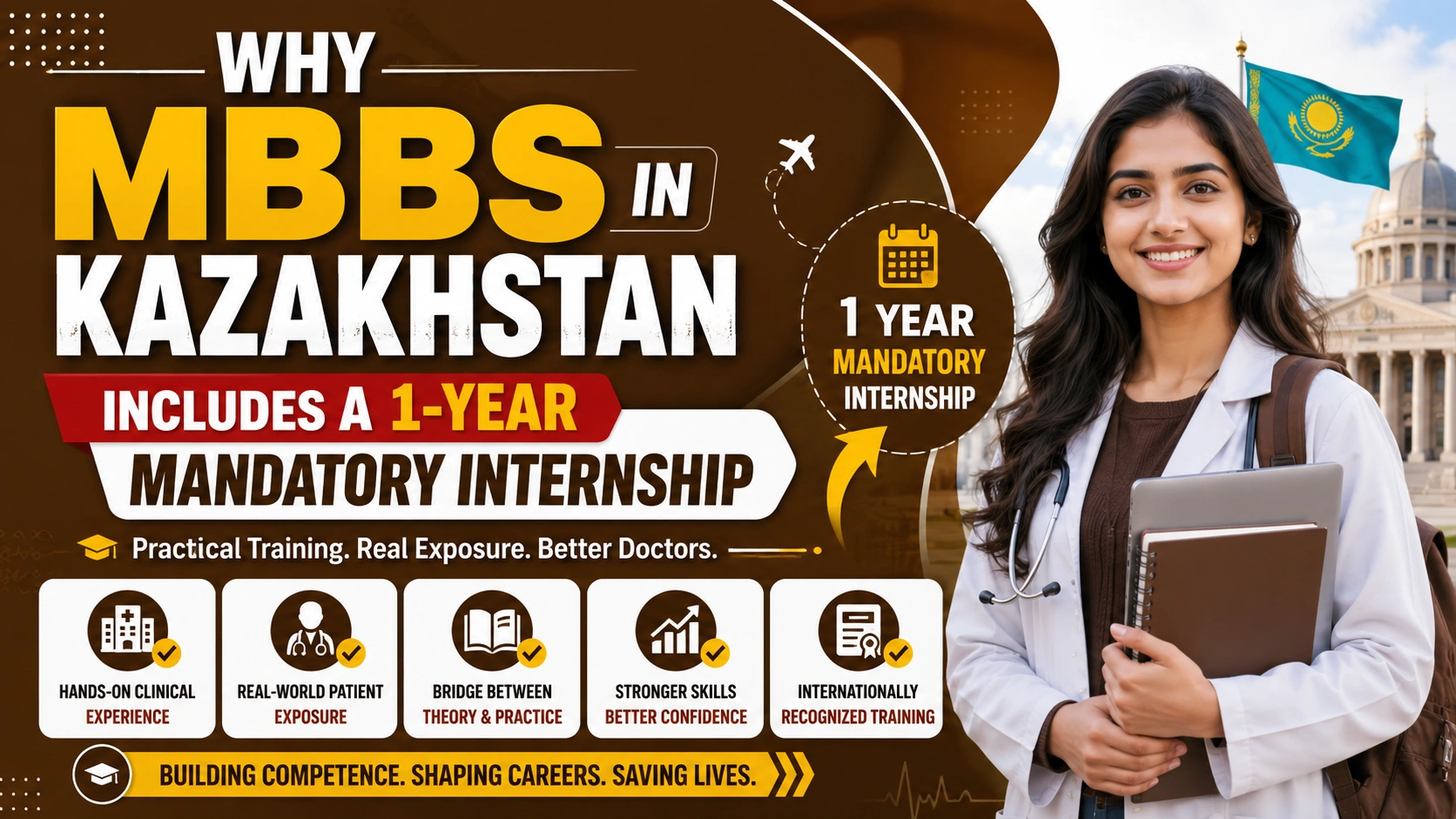
When looking for MBBS in Kazakhstan, you might have come across the course listed as "5+1 years" or "6 years including internship." The 1 extra year is not a formality, as it includes a mandatory clinical internship that is critical in preparing a student to become a practicing doctor. A large percentage of Indian students and parents do not understand the reasoning behind the inclusion of this year, what it is, and the impact it has on the time taken to practice and the eligibility to practice in India.
This article aims at covering the reasoning behind the inclusion of a 1-year internship in the MBBS course in Kazakhstan, the content that is taught during this year, and the licensing framework for Indian medical practitioners.
What is the MBBS Structure in Kazakhstan?
Medical courses in Kazakhstan, like most countries across the globe, are divided into 2 parts: the first 5 years focus on the theoretical and clinical aspects of medicine; and the last year is a compulsory rotating internship. 5 year of medical school is divided into multiple disciplines like anatomy, physiology, biochemistry, pathology, and pharmacology, to name a few. clinical specialties, as the name suggests, involve clinical practice and are usually taught in conjunction with the theory.
This framework is similar to the MBBS structure provided by the most reputed medical education systems, including India. In India, a compulsory rotating internship is a prerequisite for registration as a medical practitioner.
When looking for MBBS in Kazakhstan for Indian students, it is important to know that most universities include the mandatory final internship year in their quoted 6-year course length. The final internship year is not an extension of the program.
What Happens in the Internship Year?
The final internship year is different from the previous 5 years spent in the classroom and the labs. During the final internship year students:
- Work as an intern under the supervision of doctors.
- Work in different medical specialties, including Medicine, Surgery, Pediatrics, Obstetrics and Gynecology, and Emergency Medicine.
- Learn to integrate medical theory with practice by working with real patients.
- Develop skills like taking a patient’s medical history and performing physical examinations, lab tests, minor surgical procedures, and emergency medical interventions.
- Develop skills for ethical patient contact and effective record keeping.
This final internship year is important to make a student who can memorize medical theory into a medical professional who can work in the field.
Why is this Internship Year Important?
Narrowing the Gap Between Theory and Practice
The medical theory that is learned in the classroom and simulation labs becomes useful only when it is applied to patients in the real world. The internship year helps to narrow the gap and ensures that medical graduates do not enter a real world hospital for the first time after earning their degree.
Global Medical Education Standards
Many medical education systems require their graduates to undertake fully supervised clinical training. Evidence for this can be found in the systems referenced by the World Health Organization (WHO) and in entries in the World Directory of Medical Schools (WDOMS). By including a mandatory internship year, Kazakhstan aligns its medical education system to the broader international standards. It is one of the reasons why many of its universities are listed in these directories.
Patient Safety
In the absence of an internship year, a medical graduate's first patients would be the patients that he/she/they encountered on their first day of practice, fully unsupervised. The internship year is structured as a safety net, as the responsibility of ensuring the safety of patients and the quality of the service shifts, and as an opportunity for the system to provide additional safeguards by ensuring that errors and unprofessional conduct are identified and rectified by a supervisor.
Regulatory Alignment with Home Countries
India, among other countries, requires all of its overseas citizens, who are studying medicine and are using overseas training to obtain the MBBS qualification, to undergo a prescribed amount of supervised clinical training in the medicine and surgery component of the MBBS degree in order for the degree to be eligible for licensing in India. By incorporating an internship year into its medical graduate training, Kazakhstan allows its graduates to fulfill this requirement.
How This Relates to the Licensing Requirements in India
For Indian students, it is extremely important to understand the significance of this internship year. Practicing medicine in India does not begin and end with obtaining the Kazakhstan MBBS. Here are the connecting elements:
NEET Eligibility at Admission: The current rules put in place by the National Medical Commission (NMC) state that Indian students that go abroad to study MBBS — to Kazakhstan, for example — must have a qualifying NEET score at the time of their admission to the abroad program in order for that degree to be recognized in India.
Completion of Kazakhstan's Internship Year: The one year clinical internship completed in Kazakhstan is one of the components of the clinical training requirement for the medical program.
Licensing Exam in India: On their return to India, it is mandatory for all foreign medical graduates to take and qualify the licensing exam in order to be registered to practice the profession.
NMC Registration: After qualifying this licensing process, the medical graduate will be able to register with the NMC and commence the practice of the profession in India.
Since regulations can be modified at any time and without notice, it is critical that students check the official NMC website for updated information throughout the duration of their studies, rather than depending on the stale information provided by agents and forums.
Where does the Internship Take Place: Kazakhstan or India?
This tends to be confusing. As part of the core academic program, this 1-year internship in the Kazakhstan MBBS program is usually done within Kazakhstan at the university's associated teaching hospitals.
This does not include an additional internship or "compulsory rotational internship" required by particular Indian states or the NMC, which may be stipulated after the student has returned to India, based on the particular licensing route in operation at the time. As these post-return regulations are subject to change, the most reliable way to determine what will be expected of you after you complete your MBBS and internship in Kazakhstan is to check the NMC regulations.
Kazakhstan Internship Advantages
Real Clinical Exposure within an Organized System
Teaching hospitals in Kazakhstan, especially those linked to prominent medical universities, provide organized rotations through main medical departments, which facilitates exposure to all medical fields for interns.
International Faculty with Work Experience
Having faculty that has experience working abroad and training international students means that MBBS programs in Kazakhstan generally have flexible internship training to encourage and support international students in building the important skills to work in the area.
Gain Practical Knowledge and Skills before You Go Back Home
Students who do internships abroad usually have an advantage over others who are doing an exam and who have not had the opportunity to practice. This is due to the opportunity they have had to build their skills within a healthcare environment that is diverse and full of different cases.
Smoother Transition into India's Licensing Process
Since the internship is embedded into the core program and not viewed as an optional module, students completing their MBBS in Kazakhstan are able to complete their clinical training within the 6-year period. This helps streamline the process for students when they are pursuing NMC registration.
What Should Students Check Before Choosing a University?
Since the internship is a crucial component of medical education and subsequent licensing, please take the below factors into account when selecting any program for study MBBS in Kazakhstan 2026:
- Does the university have a teaching hospital affiliated with the university and/or partner with other hospitals for the internship?
- What hospitals and/or other institutions are partnered with the university for internship rotations, and what specialty departments are available?
- Is the university a current member of the WDOMS?
- Does the university have a course structure aligned with the NMC guidelines for foreign medical graduates?
- Are there physicians and/or other medical staff who are dedicated to the supervision and/or mentorship of international interns?
- What is the success rate of former Indian medical graduates in passing the Indian medical licensing examination?
Completing this assessment allows students to anticipate potential major issues with the recognition of degree and license in India.
Year at a Glance: Longitudinal Overview
|
Year |
Focus Area |
|
Year 1–2 |
Pre-clinical subjects: Anatomy, Physiology, Biochemistry |
|
Year 3–4 |
Para-clinical and early clinical subjects: Pathology, Pharmacology, Microbiology, introductory clinical rotations |
|
Year 5 |
Core clinical subjects: Medicine, Surgery, Pediatrics, Obstetrics & Gynecology |
|
Year 6 (Internship) |
Full-time supervised clinical internship across major hospital departments |
The theory first, progressive clinical exposure, and full immersion internship model adopted by Kazakhstan Medical Schools is one of the main reasons this country is considered a credible and comprehensive option to study MBBS in Kazakhstan.
Conclusion
The one year mandatory internship in Kazakhstan's MBBS program is not an additional year of training. It is by far the most important year of the program. It is the year that the medical student comes face to face with real clinical work, real patients, and real medical decisions in the clinical setting and under supervision. The program structure of the Kazakhstan Medical School is in line with the requirements of international medical schools and provides the graduates a better opportunity to seamlessly transition into the medical licensing system of India.