The white coat dream can live on after poor NEET results. For countless Indian students, the reality of being unable to secure a government medical seat is reflected in the competition at the annual National Eligibility cum Entrance Test. Coupled with extortionate fees for private medical colleges that can buy a home, families are looking for alternatives.
This search often leads to the single most asked question: what is the cheapest country to study MBBS that accommodates students with poor NEET scores, or even no NEET at all?
The answer to this question is complex, especially with the amount of fake news around this issue. So as part of this report, we aim to address this question truthfully to say what MBBS without NEET actually means, which countries are not expensive, and why MBBS from Kazakhstan is a better and popular option for Indian students.
Let's first clarify the Without NEET situation
Many foreign universities do not require applicants to sit for NEET. Admission can be based on 10+2 scores, some other internal assessments, or can be purely based on the application. So, yes — it is possible to gain admission to some foreign medical universities without sitting for NEET.
But this is what you should know:
If you are returning to India and want to practice medicine, you NEED to sit for NEET. The National Medical Commission (NMC) does not give you the option of not clearing NEET. You will NOT be permitted to sit for the screening exam in India after you complete your studies, and thus your medical degree from any foreign university will have no value to you in India.
Most of the Indians searching for "MBBS abroad without NEET" are probably thinking — will I get to do MBBS abroad without having to score highly in NEET? The answer to that, is yes.
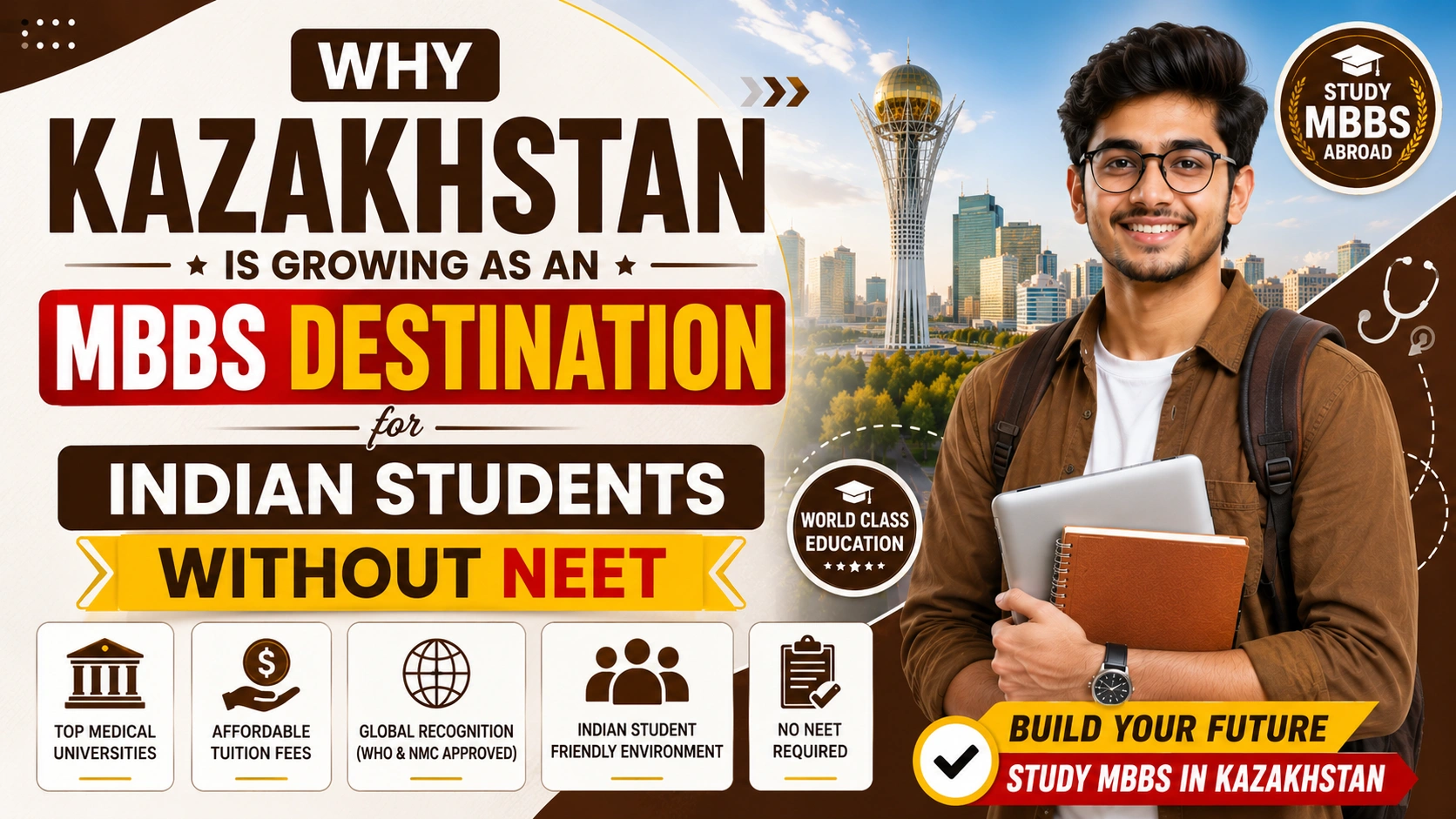
Kazakhstan, Russia, Georgia, Kyrgyzstan, and Uzbekistan have MBBS programs that are internationally recognized, far cheaper than Indian private medical colleges, and admit Indian students with only the basic qualifying NEET score. The qualifying score is much easier to achieve than the score required for securing an Indian government medical seat.
Who is Eligible for Studying MBBS Abroad?
This option is truly right for students that have these situations:
- Scored in NEET and got an opportunity to join medical school, but could not get admission in a government medical school
- Cannot spend the tuition fees of ₹50 lakhs to ₹1.2 crores of Indian private medical colleges
- Want to avoid donation and capitation fees altogether
- Want a medical degree that is internationally recognized and at least offered in English
- Want to do MBBS in a country which offers a 6-year medical program that is in a similar time frame to that of India
If this is the case for you, pursuing MBBS from abroad (Kazakhstan in this case), should be taken into serious consideration.
What Makes Kazakhstan Better Than Other Countries?
Kazakhstan has developed a reputation for being one of the most consistent, affordable, and student-friendly places for pursuing MBBS. This is not a new phenomenon - this is a choice substantiated for thousands of Indian Medical Graduates who have gone back to India after graduating, cleared the licensing exams and are practicing in India.
Here are some more reasons why MBBS in Kazakhstan for Indian students is becoming more and more popular with each admission season that passes.
Low Tuition Fees that Really Matter
The total cost of pursuing MBBS in Kazakhstan (which includes 6 years worth of tuition, lodging, and living expenses) is generally in the range of ₹18 lakhs to ₹35 lakhs. This is the cost for the entire course and is not a yearly cost.
Families with limited budgets see the opportunity to spend on international education and not be saddled with decades of loan repayment if they send their students to Kazakhstan instead of a private Indian medical college, where the fees are in the range of ₹15–25 Lakhs annually. The cumulative savings over 6 years can easily be over ₹60 Lakhs.
Additionally, the medical schools in smaller cities in Kazakhstan like Aktobe, Semey, and Shymkent can offer even better savings over the more populous Almaty and Astana, both in tuition and living costs.
No Capitation. No Donation. No Hidden Fees.
An additional burden for aspiring medical students in India is the unofficial capitation fees or donations in addition to the already exorbitant tuition fees and what is referred to as management quota. Admission in the NMC approved medical schools of Kazakhstan is much simpler, as students are not required to pay to secure admission, there is no backdoor quota, and you do not need to rely on a middleman to pay ₹20 Lakhs for your seat to be confirmed.
Additionally, there are no hidden fees in the medical schools of Kazakhstan, as you are charged what is mentioned, and this has significantly more value to Indian families.
Only a Qualifying NEET Score — Not a Competitive One
This is probably the most crucial practical aspect. Kazakh universities set neither a minimum NEET rank nor a NEET higher score threshold. What they care about is that students have qualified NEET, which means they have taken the exam and surpassed the basic qualifying percentile. A student who has scored 250 or 300 in NEET and who has no hopes of securing a government seat in India can easily get admission to a well-reputed medical university in Kazakhstan and can have an equally robust medical career there.
This potentially opens the door for a lot more students who have probably put in a lot of effort but who simply can't compete on the basis of merit against the massive numbers of NEET aspirants that are pursuing a select number of government seats available in India.
Full Recognition from Relevant Authorities
Degrees that claim to be recognized when they are not are nothing more than a scam. There is none of that in Kazakhstan. The recognition of the leading medical universities in Kazakhstan comes from the three main bodies that are most concerned with the Indian Medical Graduates who wish to go back to India.
- The National Medical Commission (NMC) which controls the legitimacy of the foreign medical degree in India.
- The World Health Organization (WHO) which holds global relevance in recognition and is considered by those with aspirations for a global career.
- The World Directory of Medical Schools (WDOMS) which is the global database of medical schools.
Students should check the status of the recognition of medical schools on the NMC/WDOMS databases as these lists are updated periodically.
English Medium Instruction Without IELTS/TOEFL
Language is never a barrier for pursuing your medical education in Kazakhstan. The entire MBBS program is delivered in English to all International students. There is no requirement for an IELTS/TOEFL score.
Usually, the first year curriculum includes basic courses in the Kazakh and Russian languages. This helps students to communicate with the local patients during clinical rotations. All other academic activities, textbooks, and examinations are continued in English.
A Six-Year Curriculum That Reflects India's MBBS Structure
Most students leaving India to take the NExT licensing exam will benefit from alignment of the curriculum. Six year MBBS programs are common in Kazakhstan. Their programs are structured in a way to make sure that education is comparable to the Indian medical education system. Their programs have five years of education and one year of mandatory internship.
Kazakhstan's clinical education and exam preparation structures are comparable to the treatment and licensing structures in India. Due to these factors, Kazakh medical school graduates clear Indian screening exams and practice in India.
An Overview of Popular Affordable MBBS Programs
|
Country |
Total Cost Estimate |
NEET to Practice in India |
Language |
|
Kazakhstan |
₹18 – ₹35 Lakhs |
Yes — qualifying score |
English |
|
Kyrgyzstan |
₹17 – ₹28 Lakhs |
Yes — qualifying score |
English |
|
Russia |
₹22 – ₹38 Lakhs |
Yes — qualifying score |
English |
|
Georgia |
₹25 – ₹40 Lakhs |
Yes — qualifying score |
English |
|
Uzbekistan |
₹20 – ₹33 Lakhs |
Yes — qualifying score |
English |
|
Bangladesh |
₹20 – ₹32 Lakhs |
Yes — qualifying score |
English |
None of the countries listed require students to pass the NEET to gain admission to a college. However, the NEET qualifier will fulfill the NEET practice requirement as mandated by the NMC for students intending to practice in India.
Kazakhstan becomes a balanced choice for seeking MBBS, not merely because it is the cheapest option for prospective Indian students, but for several other reasons including low fees, a strong established Indian community, and reliable NMC alignment.
Kazakhstan MBBS Eligibility Criteria 2026
The Eligibility Criteria for students seeking to study MBBS in Kazakhstan 2026, are as follows:
- Must be at least 17 years of age by 31st December of the year of admission.
- Must have completed 10+2 with PCB.
- Students must have a minimum of 50% in the PCB aggregate for the general category (40% for the reserved category).
- Must have a qualifying and valid NEET score. NEET score is valid for 3 years after the result is declared.
- Must possess a valid Indian passport.
No IELTS, TOEFL or any other university entrance exam is applicable. Admission is based on the submission of documents, and students are required to apply for a student visa after receiving the invitation/admission letter from the university.
The Journey Back to Practice in India after Completing MBBS
NExT Exam
NExT has replaced the former FMGE as the licensing exam for Medical Graduates in India. NExT must be passed to practice medicine in India.
Complete Your Internship
You have to complete a 12-month internship. This can be done at the affiliated hospital of the university in Kazakhstan or, in some circumstances, in an NMC-accredited hospital in India after you have returned — subject to the current NMC guidelines at the time of your graduation.
Register With NMC
After clearing NExT and completing the internship, graduates can apply for provisional or permanent registration with the National Medical Commission or State Medical Council, after which they will be eligible to practice in India.
What to Check Before You Finalize Any University
- Because of the popularity of MBBS abroad, there are now dishonest agents who offer opportunities in foreign universities which are not recognized as medical schools. Protect yourself from such agents:
- Check the status of the university directly at nmc.org.in in the foreign medical graduates section.
- Check the university listing in the World Directory of Medical Schools at wdoms.org.
- Check WHO recognition at who.int.
- Make sure your NEET qualification is valid and are still in the 3-year period before you apply.
- Get a complete year-wise fee breakdown in writing before you pay any money to any agent or university.
- If possible, directly speak to current Indian students at the university.
Conclusion
The most frequent search among Indian students is for the cheapest MBBS abroad courses as a means to avoid NEET. The most important conclusion to be drawn is that if you want to practice medicine in India, you must complete the NEET.
Once the criteria has been established, the priority is to search for the best value country which has recognition of medical education and is a good option for international students. Kazakhstan ticks most of those options.
The costs for medical studies in Kazakhstan are affordable for most families. With recognition of universities by NMC, WHO, and WDOMS, English programs are available without a language proficiency test, and a blossoming Indian students community, getting an MBBS in Kazakhstan is not a plan B for students failing to get admission in India. The success of former students returning and passing their licensing exams and entering the medical profession is proof that this is a great first option.
If you are considering this option, do your work, check the universities for yourself and make an informed choice based on facts, not assumptions. The impact of your decision will be with you for the next 30 years of your life.