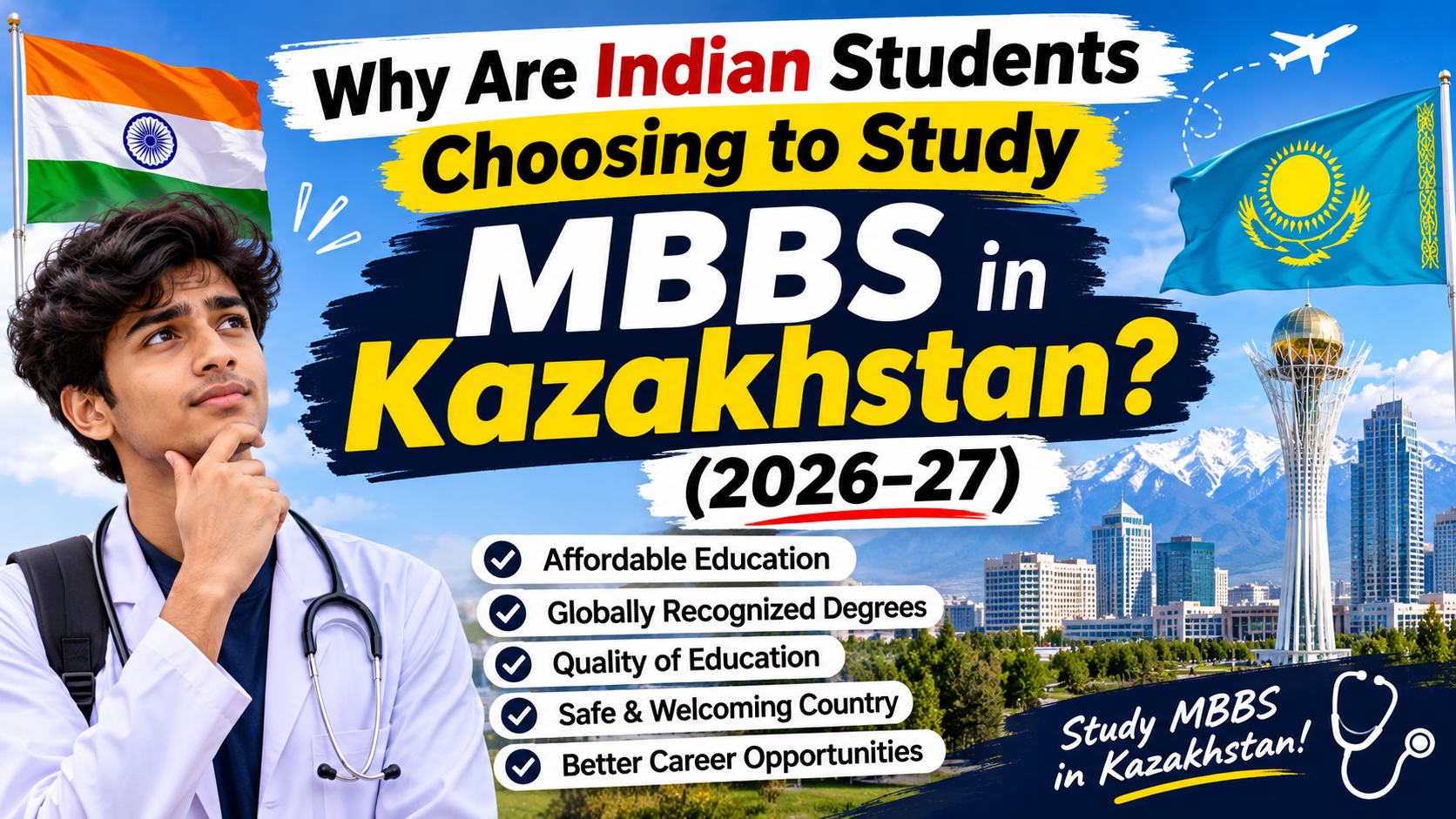
Why Are Indian Students Choosing to Study MBBS in Kazakhstan? (2026–27)
More and more Indian students are considering studying medicine abroad. Thousands of students prepare for the NEET-UG examination every year and explore opportunities to pursue medical education outside India. Due to limited government medical college seats, intense competition and the high cost of private medical colleges, many students and parents are considering international options.
Kazakhstan provides an opportunity to study at medical universities with comparatively affordable fees, English-medium programmes at selected institutions and an international student environment.
When choosing a country for MBBS abroad, Indian students must consider several factors, including educational quality, clinical training, university facilities, accommodation, safety, language, internships and future medical licensing requirements.
Kazakhstan offers several opportunities for Indian students and parents. However, careful research is essential to ensure that the selected university and medical programme meet the applicable requirements of the National Medical Commission (NMC).
This article discusses why Indian students are choosing to study MBBS in Kazakhstan in 2026–27, covering affordable fees, medical universities, admission requirements, student life, clinical training and important factors to consider before taking admission.
1. Affordable MBBS Fees in Kazakhstan
One of the main reasons Indian students are considering MBBS in Kazakhstan is the comparatively affordable cost of medical education.
Many private medical colleges in India involve substantial tuition expenses. Students who are unable to secure admission to government medical colleges may explore studying abroad as another option, particularly when their families have a limited education budget.
Several medical universities in Kazakhstan offer different tuition fee structures.
Students should compare their options by considering:
- Annual tuition fees.
- Overall cost of the complete medical course.
- University hostel fees.
- Food and transportation expenses.
- Medical insurance.
- Visa and documentation charges.
- Examination and registration fees.
However, students should calculate the complete course expenditure rather than focusing only on tuition fees.
The total budget should include accommodation, food, transportation, insurance, university charges and emergency expenses. This will help families understand whether studying in Kazakhstan is financially manageable throughout the programme.
Students can explore MBBS in Kazakhstan for additional information about medical universities, admission procedures and education opportunities.
2. Availability of English-Medium Medical Programmes
Language is an important factor when students consider studying abroad. Many Indian students feel more comfortable studying medical subjects in English because their previous education has generally been in English or a combination of English and regional languages.
Certain medical universities in Kazakhstan provide English-medium medical programmes for international students.
This can help students understand subjects such as:
- Human Anatomy.
- Physiology.
- Biochemistry.
- Pathology.
- Pharmacology.
- Microbiology.
- General Medicine.
- Community Medicine.
English-medium instruction can make academic learning more accessible for international students. However, students must ensure that the complete programme meets the applicable NMC requirements.
It is also important to consider the local language. Even if classroom teaching is conducted in English, students may need to learn basic Kazakh or Russian to communicate with patients, hospital staff and local residents during clinical training.
3. Medical Universities in Kazakhstan
There are several medical universities in Kazakhstan that Indian students can research while exploring international medical education.
Some institutions include:
- Kazakh National Medical University – Almaty: An established medical institution located in Almaty.
- Astana Medical University – Astana: Offers medical education programmes in Kazakhstan's capital.
- Karaganda Medical University – Karaganda: Provides medical education with academic and clinical learning opportunities.
- Semey Medical University – Semey: Another institution Indian students can investigate when comparing medical programmes.
When choosing a university, students should research its academic curriculum, facilities, teaching staff and clinical training arrangements.
Never rely only on a university's reputation or promotional claims. Conduct independent research and obtain official information before making an admission decision.
4. International Student Community
Another reason Indian students may consider studying in Kazakhstan is its international student population. Medical universities in major cities welcome students from different countries.
Students may feel more comfortable when they have Indian classmates and access to international student communities.
Some benefits of an international student environment include:
- Interacting with students from different countries.
- Sharing accommodation and everyday experiences with classmates.
- Participating in university events and cultural activities.
- Discussing academic subjects through group study.
- Building friendships and professional connections.
International student communities can help newcomers understand local transportation, shopping facilities, accommodation arrangements and university procedures. However, students should independently research whether their chosen university provides suitable international student support, student welfare services and accommodation facilities.
5. Practical and Clinical Training Opportunities
Studying medicine is not limited to theoretical education. Students must develop practical knowledge, understand medical procedures and learn how to interact with patients. Medical universities in Kazakhstan generally include theoretical subjects, laboratory work, simulation-based learning and clinical training in their medical programmes.
During medical education, students may study and practise:
- Human Anatomy and Physiology.
- Clinical Examination Techniques.
- Basic Medical Procedures.
- Internal Medicine.
- General Surgery.
- Paediatrics.
- Obstetrics and Gynaecology.
- Community Medicine.
Not all universities provide the same level of hospital exposure. Before applying, students should ask about affiliated hospitals, patient interaction, clinical training hours, practical sessions and supervision by qualified medical professionals.
Important: The Embassy of India has raised concerns regarding clinical exposure and teaching quality at some medical institutions in Kazakhstan. Students should investigate the actual training arrangements instead of relying entirely on university advertisements.
6. Medical Universities in Different Cities of Kazakhstan
Kazakhstan has several cities offering medical education opportunities. Each location has different educational facilities, accommodation options, transportation arrangements and living conditions.
Almaty
Almaty is one of the major educational and cultural centres in Kazakhstan. It is home to Kazakh National Medical University and other educational institutions.
Students can research academic opportunities, transportation facilities and international student communities. However, accommodation and living expenses should also be compared before selecting a university.
Astana
Astana is the capital city of Kazakhstan. It offers modern infrastructure, educational institutions and healthcare facilities.
Students can explore Astana Medical University while researching medical education opportunities. However, they should consider winter weather conditions and the availability of affordable accommodation.
Karaganda
Karaganda is another option for Indian medical aspirants. It provides medical education through Karaganda Medical University.
Students should research the official tuition fees, clinical training facilities, academic arrangements and hostel options.
Semey
Semey is another educational destination for international students. It provides medical education through Semey Medical University. Students should investigate the curriculum, international admission requirements and student facilities before applying. The right city should be selected according to educational quality, overall expenses, clinical training opportunities and student support.
7. Affordable Living Expenses in Kazakhstan
Another reason Indian students are considering Kazakhstan is the comparatively manageable cost of living. Students need to calculate their monthly expenses for accommodation, food, shopping, transportation, mobile services and personal requirements. These costs can vary depending on the city and individual lifestyle. The official Study in Kazakhstan platform provides a general estimate of approximately USD 300–600 per month for international student living expenses. This is a broad planning estimate and may not represent the exact expenditure of every medical student.
How Can Indian Students Save Money?
Cook Indian Food: Students can purchase rice, vegetables, lentils, spices and other groceries and prepare their own meals.
Choose University Accommodation: A university hostel can help reduce rental expenses if a suitable room is available.
Use Public Transportation: Regularly using buses and other public transportation options can help students save money.
Share Accommodation: Sharing a private apartment with other students can reduce individual rental expenses.
Prepare a Monthly Budget: Plan expenses for food, transportation, personal requirements and emergencies.
Avoid Unnecessary Purchases: Try to limit spending on expensive clothes, electronic gadgets and entertainment.
Before travelling, students should obtain written confirmation of hostel availability and accommodation charges. The Embassy of India has also issued advisories regarding accommodation arrangements for Indian students in Kazakhstan.
8. Admission Requirements for Indian Students
Medical universities in Kazakhstan accept international applications, including applications from Indian students who meet the relevant admission requirements. Generally, students need to submit their academic documents, complete the university application process and obtain the required admission and visa documentation.
General Eligibility Requirements
Indian students generally need to:
- Complete Class 12 or an equivalent qualification.
- Study Physics, Chemistry and Biology as required subjects.
- Study English as a subject in the qualifying examination.
- Qualify NEET-UG as applicable for Indian students seeking medical registration in India.
- Hold a valid passport.
- Meet the admission requirements of the selected university.
Documents Required for Admission
Students may need to provide:
- Class 10 marksheet and certificate.
- Class 12 marksheet and certificate.
- NEET scorecard.
- Valid passport.
- Passport-size photographs.
- Medical fitness certificate.
- Birth certificate, if required.
- University application documents.
For official examination information, eligibility details and notifications, visit the National Testing Agency NEET website.
9. Medical Education and NMC Requirements
One of the most important considerations for Indian students is whether their selected medical programme meets the requirements for medical registration in India. The National Medical Commission regulates medical education and registration requirements for Indian medical graduates, including students who obtain their primary medical qualification abroad. Before applying, students should carefully research the Foreign Medical Graduate Licentiate (FMGL) Regulations, 2021, along with subsequent amendments, notices and official clarifications.
Important Factors to Research
- Duration of the medical course.
- Medium of instruction.
- Theoretical and practical education.
- Clinical training facilities.
- Internship arrangements.
- Eligibility for medical registration in the country of study.
- Requirements for medical registration in India.
Students should visit the official National Medical Commission (NMC) website to understand the applicable regulations.
They can also search the World Directory of Medical Schools (WDOMS) to investigate medical school listings and institutional information.
The World Health Organization (WHO) provides international health information and resources. However, WHO information or WDOMS listing should not be treated as an automatic guarantee of NMC approval or eligibility to practise medicine in India.
Important Note for the 2026–27 Academic Session
Indian students planning admission for 2026–27 should pay particular attention to Kazakhstan's medical education policy. According to the Embassy of India in Astana's advisory dated 1 October 2026, the standard medical course duration in Kazakhstan has changed to seven years. International students may have an opportunity to complete the programme in six years through an accelerated pathway, subject to specified conditions. The Embassy has also indicated that clear confirmation regarding the issuance of a licence to practise medicine in Kazakhstan to international students completing the accelerated six-year programme was not available at the time of its advisory. Therefore, students should verify the applicable requirements directly with their chosen university and the relevant Kazakh authorities before enrolling. This is important because Indian students must ensure that their medical programme meets both Kazakhstan's applicable requirements and India's foreign medical graduate regulations. for Continuous Integrated Medical Education (CIME), based on information updated on 11 December 2025. Students should consult the latest available list and confirm the exact programme and campus for which they are applying.
10. Scholarships and Financial Assistance
Some Indian students may consider Kazakhstan because scholarship opportunities and financial assistance may be available for eligible international students. Scholarship availability depends on the university, academic performance, nationality, course and selection requirements.
Students can investigate:
- University Scholarships: Merit-based financial assistance.
- Academic Discounts: Tuition fee concessions based on academic performance.
- Government Scholarships: Financial assistance programmes for eligible international students.
- Other Financial Support: Additional institutional funding opportunities, where available.
However, not all medical universities provide scholarships for Indian MBBS students. Before including a scholarship in your financial budget, confirm the eligibility criteria, application deadlines, amount of assistance and renewal conditions directly with the university or scholarship authority.
11. Cultural Exposure and Personal Development
Studying abroad gives students an opportunity to experience a different culture and educational environment. Indian students in Kazakhstan can interact with people from different backgrounds, experience local traditions and develop greater independence.
Some personal development opportunities include:
- Learning to manage daily responsibilities independently.
- Improving communication skills.
- Understanding different cultures.
- Making friends with international students.
- Learning basic Kazakh or Russian.
- Becoming more adaptable to unfamiliar environments.
Knowing the local language can be particularly helpful during clinical training, hospital visits, shopping and everyday communication. Students should also understand local laws, university rules and cultural expectations before travelling.
12. What Should Indian Students Consider Before Choosing Kazakhstan?
Although Kazakhstan provides several medical education opportunities, students must conduct proper research before selecting a university. The university and medical programme should be evaluated independently rather than relying entirely on advertisements or consultancy recommendations.
Before paying any admission fees, consider the following factors:
|
Factor |
What to Consider |
|
Accreditation |
Verify institutional accreditation and licensing. |
|
Course duration |
Confirm the official programme duration for 2026–27. |
|
Language |
Check the actual medium of instruction. |
|
Clinical training |
Verify affiliated hospitals and patient interaction. |
|
Internship |
Check duration, location and licensing arrangements. |
|
NMC compliance |
Review eligibility under applicable FMGL regulations. |
|
Accommodation |
Confirm hostel availability and charges. |
|
Tuition fees |
Obtain the official written fee structure. |
|
Student support |
Check international student assistance. |
|
Safety |
Research local conditions and university support services. |
The Embassy of India in Kazakhstan also provides useful information and advisories for Indian students planning to study medicine. Students and parents should review these notices before applying to make informed decisions.
Conclusion
Kazakhstan has become an option for Indian students exploring MBBS abroad because of its comparatively affordable fees, international student community, English-medium programmes at selected institutions and medical education opportunities across different cities. There are several medical universities to research in Almaty, Astana, Karaganda and Semey. Students can compare these institutions according to their academic facilities, tuition fees, clinical exposure and accommodation arrangements. However, students must consider more than tuition fees when choosing a medical university. Clinical training, accreditation, course duration, internship arrangements, accommodation and compliance with Indian medical education requirements are equally important. Due to Kazakhstan's new seven-year standard medical course policy for the 2026–27 academic session, students must carefully verify the programme duration and applicable licensing requirements. Not all international students can automatically complete their course in six years, and an accelerated programme does not automatically guarantee eligibility for medical registration. Ultimately, Indian students should make their decisions based on verified university information, transparent financial arrangements and long-term professional requirements. Proper research and planning can help students make an informed decision about pursuing MBBS in Kazakhstan.