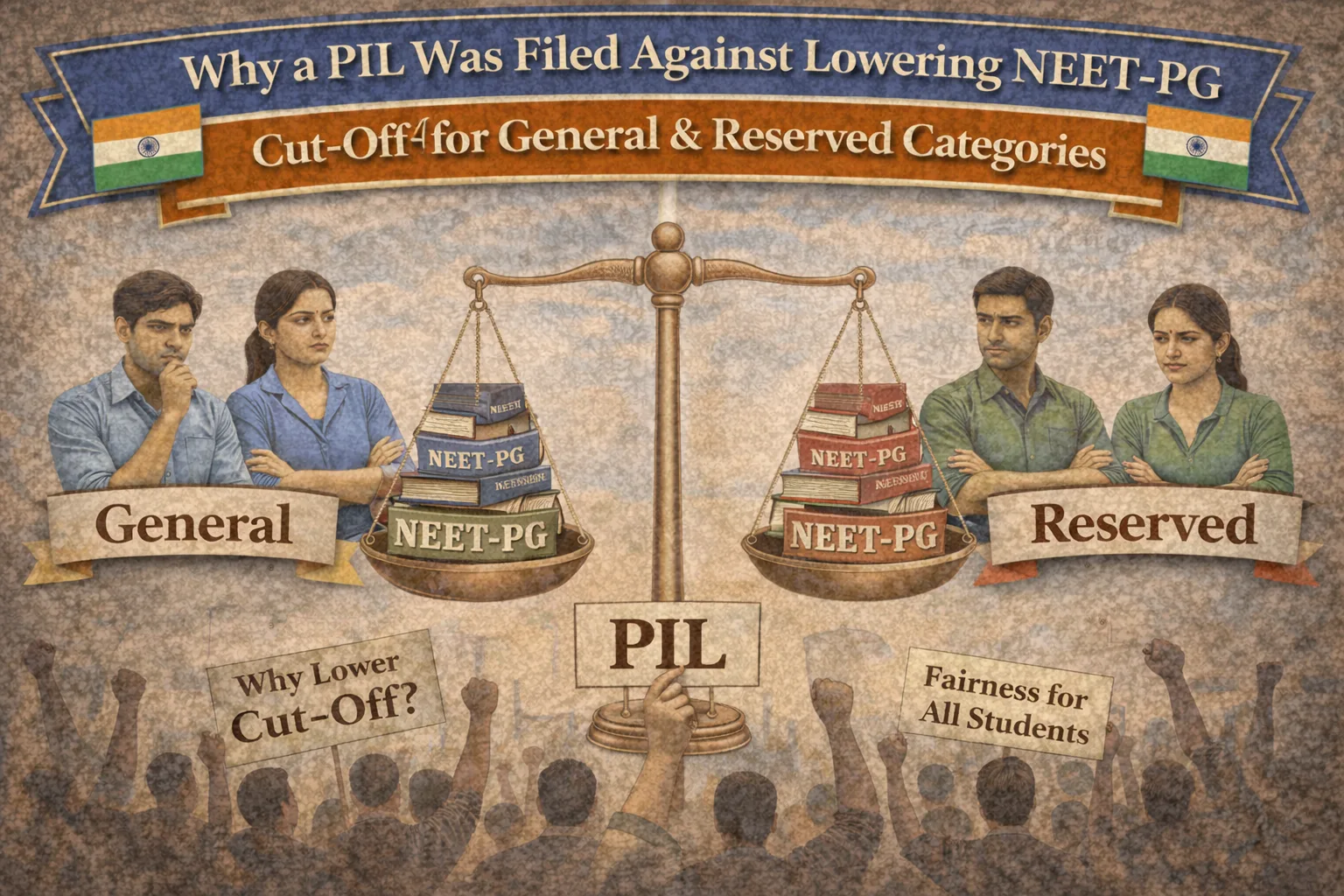
The Supreme Court of India recently issued notice on a Public Interest Litigation (PIL) challenging the National Board of Examinations in Medical Sciences (NBEMS) decision to slash NEET-PG 2025-26 qualifying cut-offs to unprecedented lows—down to zero percentile for general category (103 marks, 7th percentile) and negative scores like -40/800 for reserved categories ahead of Round 3 counselling. Filed by advocate Satyam Singh Rajput and backed by groups like United Doctors Front (UDF), the PIL argues this drastic dilution threatens patient safety, erodes merit, and violates constitutional rights—sparking outrage among doctors fearing compromised healthcare standards.
NEET-PG, the gateway for over 2.24 lakh MBBS grads to 70,000+ PG seats, saw thousands vacant post-Round 2, prompting NBEMS's January 13, 2026 notice on Ministry of Health advice to curb "seat wastage." But petitioners say it's arbitrary, not a fix. While Allahabad HC dismissed a similar PIL, SC's hearing (set for Feb 6) probes deeper. For UG NEET aspirants eyeing MBBS in Kazakhstan, this underscores PG chaos—fueling interest in abroad paths with clearer FMGE routes.
Background: The Cut-Off Controversy Unfolds
NEET-PG isn't a basic competency test—MBBS already certifies that—but ranks candidates for competitive PG spots like surgery or radiology. Traditionally, cut-offs hovered 50th percentile (general), scaling down for SC/ST/OBC.
2025-26 flipped norms: General to 7th percentile, reserved to negative amid exam glitches and vacancies. NBEMS defended it as administrative—merit still rules counselling, no quality drop since inter-se ranking holds. Critics cry foul: How does negative scoring signal PG readiness?
Vacancies piled despite 2+ lakh takers—Round 2 left thousands empty, even in government colleges funded by taxpayers. Centre argues leaving seats vacant hurts public access to specialists; PIL counters with long-term health risks.
Core Grounds of the PIL: Merit Under Siege
Petitioners invoke Articles 14 (equality) and 21 (life/liberty), claiming the move is "arbitrary and unconstitutional." Key beef: Lowering to zero/negative bypasses merit, letting underperformers into high-stakes PG training.
They warn of "diluted specialist quality," directly impacting patients—imagine a surgeon with negative exam scores handling operations. Public trust in doctors erodes; profession's integrity tanks. It's not anti-reserved—concerns span categories—but against blanket drops ignoring competence benchmarks.
UDF highlights: Exam's negative marking means -40 signals more wrongs than rights. Allowing such into Round 3 mocks NEET-PG's purpose.
Patient Safety and Public Health at Stake
PIL's heart: PG doctors treat critically ill unsupervised. Subpar entry risks misdiagnoses, botched procedures. "Healthcare isn't commerce," it states—dilution prioritizes seat-filling over standards.
Echoing Delhi HC debates, petitioners ask: Public interest in vacant seats or risky specialists? Centre retorts clinical skills from MBBS/internship suffice; NEET-PG just ranks.
Impact on General vs. Reserved Categories
General: 50th to 7th percentile—mass influx. Reserved: Negative thresholds open floodgates, but PIL says it undermines even affirmative action's merit base.
No favoritism alleged; across-board drop harms all. Ties to broader medical woes: FMGE for abroad grads already low-pass (20-30%), now PG loosens too?
Legal Precedents and Judicial Scrutiny
SC has grilled entrances before—NEET leaks, OBC quotas. Here, bench (Justices Narasimha, Aradhe) questions drastic cuts' quality hit despite MBBS baseline.
Allahabad HC rejected parallel PIL, prioritizing seats over "perfection." Delhi HC echoed: Better fill than waste? SC may set national tone.
Government and NBEMS Defense
Affidavit insists: Percentile relative, not absolute—negative doesn't mean incompetent post-MBBS. Past years saw similar tweaks sans backlash. Seat loss burdens public; merit via choices preserved.
NMC/MoHFW recommended—avoids private college windfalls.
Broader Ramifications for Medical Education
PIL spotlights rot: Exam glitches, opaque counselling. For UG NEET takers failing ranks, MBBS in Kazakhstan beckons—NMC-approved, affordable (15-25 lakhs), FMGE-focused sans PG chaos.
Negative PG signals erode faith; patients suffer. Petitioners urge quashal, restore norms.
Why Now? Timing and Doctor Backlash
Post-Round 2 vacancies triggered notice amid protests. UDF/IMA fury: "Threatens credibility." Instagram reels blast "game plan for privates."
Possible Outcomes and Next Steps
SC hearing Feb 6: Stay cut-offs? Interim norms? Restore percentiles? Could reshape counselling.
Implications for Aspirants
General/reserved: More qualify, fiercer Round 3. But stigma lingers—future employers query scores?
Abroad angle: Kazakhstan MBBS grads eye FMGE, then this PG mess. Stable foreign paths shine brighter.
Conclusion
PIL fights not seats, but standards—zero/negative cut-offs risk lives via diluted PG docs. SC's verdict looms; till then, aspirants beware chaos. For UG dreams strained by NEET, MBBS in Kazakhstan offers clarity. Watch courts; choose wisely.