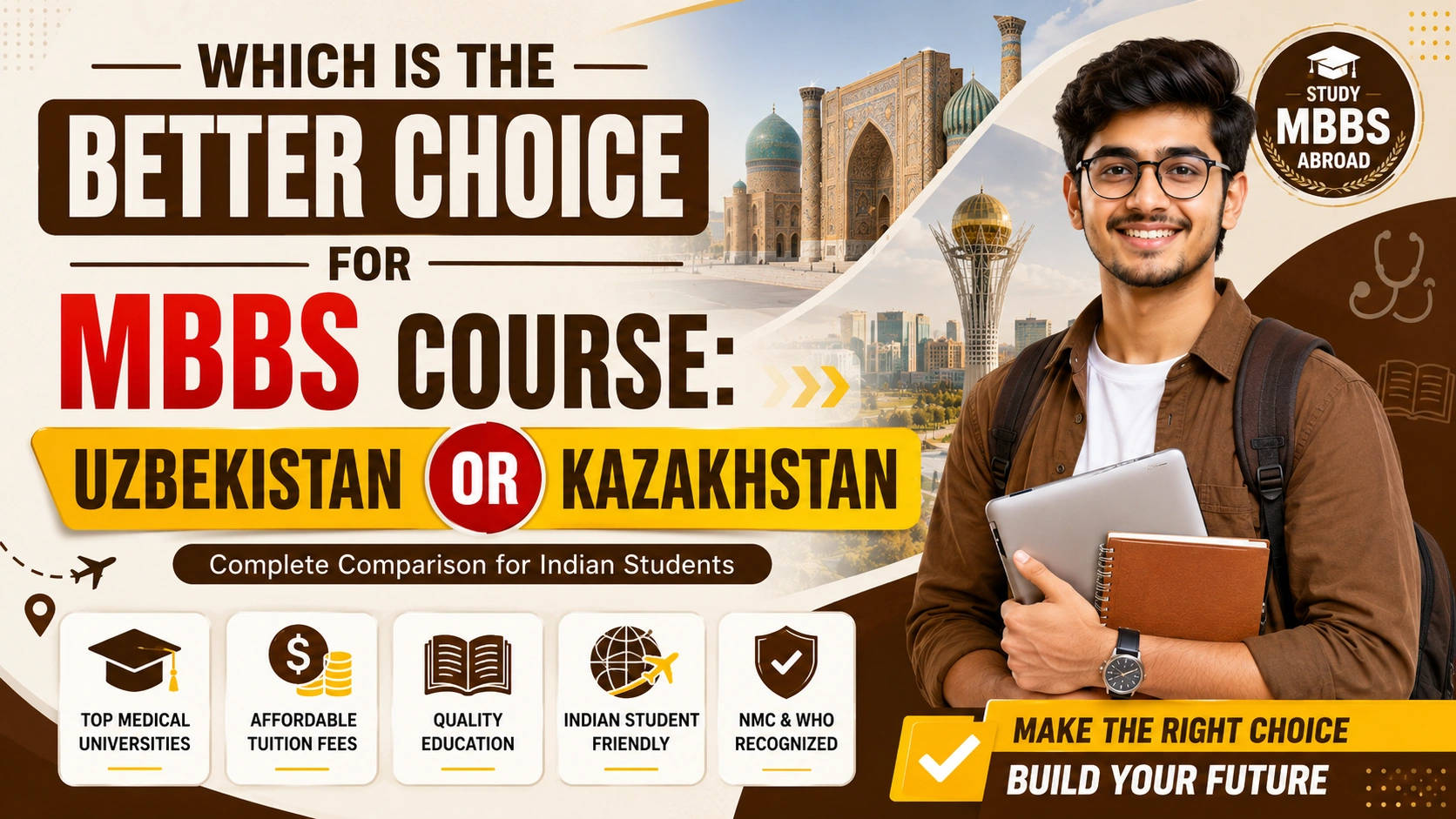
After taking NEET, a significant number of Indian students are left without opportunities to pursue MBBS in India. High fees of private medical colleges and the limited number of seats forces many students to look for alternatives outside India. Among the Central Asian countries, Uzbekistan and Kazakhstan attract the most Indian students. Choosing between the two is difficult, as both countries charge low fees, provide medical courses in English, and offer globally recognized degrees.
In this article, both countries are evaluated based on the most important parameters: cost, recognition, quality of education, safety, and opportunities after graduation. This is intended to help the readers choose between MBBS in Kazakhstan or MBBS in Uzbekistan.
Reasons for Looking Outside of India for MBBS
Every year, nearly 20 lakh students appear for the NEET exam. At the same time, there are only about 1 lakh MBBS seats available in India. There is extreme competition to secure a seat in government colleges. The fees to pursue MBBS in private colleges can easily exceed ₹1 crore.
These factors push students to look for alternatives in other countries, such as Kazakhstan and Uzbekistan. Both countries provide:
Recognition and Accreditation: Kazakhstan vs Uzbekistan
Recognition should be the first consideration when choosing a country for MBBS abroad, not the last. Both countries have universities in the World Directory of Medical Schools (WDOMS). This is the world's database of medical schools that confirms the legitimacy and recognition of a medical school.
Kazakhstan has a number of public medical universities that have a longer history of admitting international students and more of them have WDOMS listings.
In the last decade, Uzbekistan has improved its medical education system and established new universities that have gained recognition in the WDOMS. However, compared to Kazakhstan, the medical education system in Uzbekistan is younger.
For Indian students, in order to practice in India, your degree also has to comply with the National Medical Commission (NMC) regulations. Both Kazakhstan and Uzbekistan have medical schools that Indian students use to clear the licensing exam in India. However, you will have to verify the status of the medical school on the NMC and WDOMS official websites as recognition is not permanent.
The World Health Organization (WHO) medical school directory is another trustworthy source. WHO does not approve medical schools, however, they have a medical school directory that references the WDOMS database that is maintained by FAIMER.
Cost Comparison: Which Country is Cheaper?
Cost is a major concern for most Indian families. Let's look at the approximate costs for both countries.
Kazakhstan MBBS Cost Estimates
Tuition: ₹2.5 lakh - ₹4.5 lakh
Hostel: ₹1 lakh - ₹1.5 lakh
Living: ₹1.5 lakh - ₹2 lakh
Total for 6 years: ₹18 lakh - ₹28 lakh
Uzbekistan MBBS Cost Estimates
Tuition: ₹2 lakh - ₹4 lakh
Hostel: ₹80,000 - ₹1.3 lakh
Living: ₹1.2 lakh - ₹1.8 lakh
Total for 6 years: ₹16 lakh - ₹25 lakh
Uzbekistan is, on average, around ₹30,000 cheaper in tuition. However, once you factor in hostel conditions, living standards, and university-specific expenses the difference is negligible. In general, Kazakhstan public universities, being older, often have better-lab-equipped hospitals, which makes the slightly higher fee more justifiable.
Medical Education Quality
Infrastructure and Clinical Exposure
Medical universities in Kazakhstan have a structured system for clinical rotations. Simulation labs are also well designed and established. This is in large part due to the fact that Kazakhstan has hosted medical students for a longer time. Several universities that offer MBBS programs in Kazakhstan for Indian students have international departments where experienced faculty teach English language students.
The medical universities of Uzbekistan are in the process of rapid infrastructural development. This is especially the case in the cities of Tashkent and Samarkand. Uzbekistan's overall environment for medical students is not as developed as in Kazakhstan.
Faculty and Curriculum
Both countries create a curriculum with the preclinical, paraclinical, and clinical years of medical education within the framework of the international medical education standards. For the most part, Kazakhstan's medical curriculum puts more emphasis on earlier clinical exposure. Uzbekistan's medical curriculum is being revised with a focus toward meeting global standards.
NEET Requirement: Does It Apply to Both Countries?
These countries particularly confuse people with the NEET requirement. Neither Kazakhstan nor Uzbekistan has a NEET requirement to get into university, as both countries use class 12 marks in the core science subjects and other eligibility documents to admit students to their medical programs.
However, as an Indian citizen planning to practice in India after obtaining the MBBS degree from either country, you will be required to appear for NEET and obtain the qualifying marks as per current NMC regulations concerning foreign medical graduates. This is applicable to both Kazakhstan and Uzbekistan since NEET is not a country-specific requirement but an India-specific requirement considering your citizenship and anticipated licensing. Always check the NMC eligibility requirements before applying.
Climate and Living Conditions
Kazakhstan has a continental climate, with cold and harsh winters in cities like Almaty and Astana. Most of the universities and hostels are well prepared for the cold, but new students should consider bringing adequate warm clothing.
Uzbekistan has a milder climate, especially in cities like Tashkent, with warm summers and relatively milder and less extreme winters compared to most of Kazakhstan.
Uzbekistan might be the best option for those with climate adaptability as a primary concern, though with the right planning, both are good options.
Safety and Indian Student Community
Both countries are relatively safe for international students, with low crime in university cities. Kazakhstan has a longer history with Indian medical students, meaning:
- More and larger established Indian student associations
- More Indian food and messes around universities
- More upperclassmen for mentorship and guidance
Uzbekistan has a growing Indian student community. Compared to Kazakhstan, support networks in Uzbekistan are still less established.
Visa Process and Ease of Admission
The student visa process for Indian students in both countries is simple and involves:
- Submitting academic documents and passport details
- Receiving an invitation letter from the university
- Applying for a student visa at the consulate
- Travel and enroll prior to the start of the school year
Requirements and processing times differ based on the university and the admission season. It's best to consult a qualified admission consultant and/or the international office of the university to explore placement options in both Kazakhstan and Uzbekistan.
Post-Graduation Options: Returning to Work in India
Indian students completing MBBS in Kazakhstan and Uzbekistan must complete India's licensing process to practice medicine in India. This process includes:
- Meeting the NMC's requirement of holding a valid NEET score during the MBBS course.
- Passing the designated licensing exam for foreign medical graduates per the NMC's exam structure.
- Obtaining membership in NMC as a registered medical practitioner.
This process is the same for those who study in Kazakhstan and Uzbekistan. The primary consideration is the recognition of your university and the fulfillment of NMC requirements. Since the exam structures and regulations change frequently, be sure to check the official NMC website to ensure you have the up to date requirements before making a decision.
Kazakhstan vs Uzbekistan: A Quick Comparison
|
Factor |
Kazakhstan |
Uzbekistan |
|
Average Total Course Cost |
₹18-28 Lakh |
₹16-25 Lakh |
|
University Ecosystem Maturity |
More Established |
Rapid Growth |
|
Climate |
Cold Winters |
Milder, Overall |
|
Indian Student Community |
Larger, Established |
Increasing |
|
Infrastructure & Hospitals |
Generally More Developed |
Rapid Improvement |
|
NEET Requirement (for Indian Licensing) |
Required |
Required |
|
WDOMS/NMC Recognition |
Available (Verify Per University) |
Available (Verify Per University) |
What's the Final Decision?
There is no clear "right" answer to this question since it genuinely depends on your priorities:
Choose Kazakhstan if: if you prefer a more established university ecosystem, stronger Indian student support networks, and are ok with cold winters. If you are looking to study MBBS in Kazakhstan for the 2026 intake, this is a good time to start your research on universities.
Choose Uzbekistan for lower costs and a milder climate. It has a developing university infrastructure compared to Kazakhstan. Consider both countries if the university is recognized via WDOMs and NMC, and you have a NEET score to safeguard your future practice in India.
Conclusion
Both Kazakhstan and Uzbekistan have no capitation fees or donation requirements for students and offer real pathways for medical education. Kazakhstan is a favorite option, since they have better developed infrastructure and a higher Indian student population. Uzbekistan is a better option for lower costs and better climate.