For Indian students thinking about an MBBS program in Kazakhstan, the salary one can expect to earn upon completing their studies plays a role in their decision. During initial deliberations, the cost of the program, food, and other living expenses, recognition of the university, clinical training, and licensing procedure come up. However, it is good to research the job market for medical practice after one's studies to know where and how one can make the most of studying medicine abroad.
The salary of a doctor of the MBBS program in Kazakhstan is dependent upon several factors. These include the experience of the doctor, the specialty, the place of work, the area, the qualifications, whether the doctor practices in the public or private sector, etc. Kazakhstan does not set a specific national salary for each doctor.
According to the available official statistics of Kazakhstan, the average monthly nominal salary across all sectors was 461,486 KZT during the first quarter of 2026, and the median salary was 331,527 KZT. During this period, wages in the health care and social services sectors increased by 7 percent compared to the same period of the previous year. These statistics are for the complete workforce and reflect the salary of a doctor.
During their research for the MBBS program in Kazakhstan, students need to know that the salary of a doctor can be significantly different from the general statistics of wages.
Approximate Salary of an MBBS Doctor in Kazakhstan
There is no single salary amount of the Kazakhstan government for all doctors employed in various government hospitals, private hospitals, clinics, diagnostic centers, emergency services, and other specialty institutions.
Figuring out the salary of an MBBS Doctor in Kazakhstan
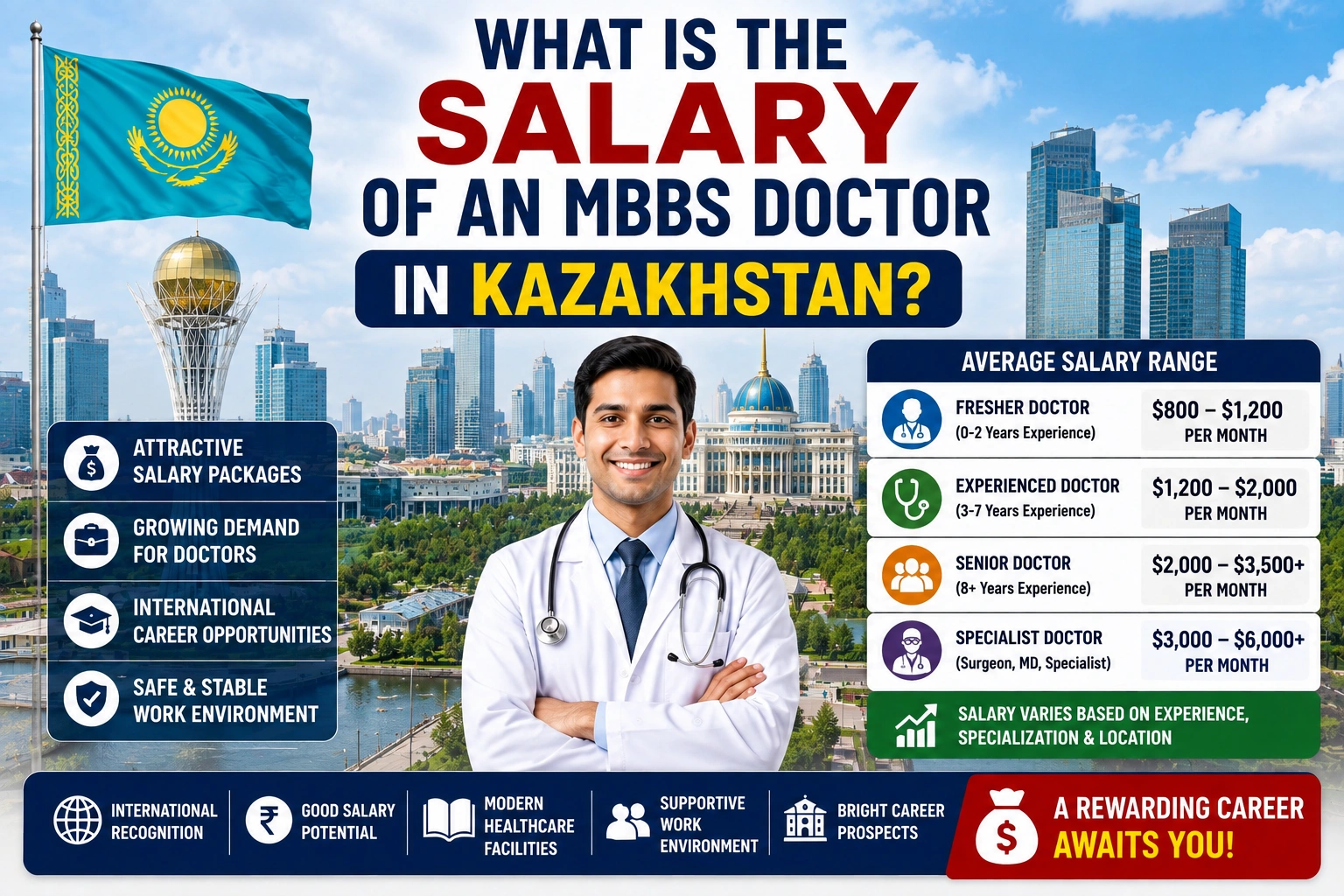
As a low ball estimate, junior doctors starting out earn 300,000 to 500,000 Kazakhstani Tenge (KZT) per month. Mid to senior level doctors with a few extra qualifications earn 500,000 to 800,000 KZT or more per month. Specialists at the senior level, doctors practicing privately, and other doctors with even more specialization can earn a lot more.
Assuming an exchange rate of around 1 Indian Rupee (INR) to 4.79 KZT on August 24, 2026, the following converts to:
|
Monthly Salary |
Approximate Salary in INR |
|
300,000 KZT |
₹62,600 |
|
400,000 KZT |
₹83,500 |
|
500,000 KZT |
₹1.04 lakh |
|
600,000 KZT |
₹1.25 lakh |
|
800,000 KZT |
₹1.67 lakh |
|
1,000,000 KZT |
₹2.09 lakh |
Since the currency exchange rate is volatile, please treat these figures as estimates.
MBBS Doctor Salary in Kazakhstan: Experience-Wise
Experience has a huge impact on how much a doctor earns. A newly qualified doctor gets paid less than a doctor who is a clinician and has specialization or training many years into his profession.
1. Newly Qualified MBBS Doctor Salary
An MBBS doctor who is starting work for the first time can expect to be paid at the lower end of the salary range. Taking into consideration the employer, location, department and terms of employment, an entry-level doctor can expect to earn around 300,000 to 400,000 KZT per month.
At the rate of exchange above, this converts to ₹63,000 to ₹84,000.
Entrant level doctors must remember that the main objective of their first job should be to gain work experience. Salary can be improved with time as the doctor gains more responsibilities and experience and is trained as a postgraduate doctor or specialist.
2. Doctor With 3–5 Years of Experience
Doctors with a few years of experience may enter a higher salary bracket. Specialty and workplace can affect income. Some specialties earn between 400,000 to 600,000 KZT and beyond.
Private hospitals and clinics have incentives such as a variety of compensation structures, performance-based payment, additional shifts, consultation fees, and other benefits.
3. Experienced and Senior Doctors
Some specialties have the potential to earn 600,000 to 800 KZT or more per month, particularly if the specialized physician has employment with a higher paying institution.
Senior Clinical doctors have the opportunity to earn through clinical work combined with teaching and or administrative duties as well as Private Practices and specialized clinical work.
These salary ranges should not be understood as a potential salary. Income will be based on the offered employment contract and the Kazakhstan job market.
Salary by Medical Specialization
Specialization has a large impact on salary. General practitioners and junior doctors typically earn at a lower salary level. Highly specialized physicians command higher salaries.
Some of the specialties that offer a higher salary include:
- Surgery
- Anesthesiology
- Cardiology
- Radiology
- Clinical Dentistry and Dentistry
- Gynecology and Obstetrics
- Neurology
- Oncology
- Orthopedics
- Emergency Medicine
However, specialization should not be based solely on salary. Indian students should consider the opportunities for post-graduate training, specialty demand, licensing, language abilities, and personal interests.
Public vs Private Hospital Salary in Kazakhstan
The workplace also affects income.
Public Healthcare Sector
Most healthcare services in Kazakhstan are provided by government hospitals and public healthcare institutions. Compensation packages in the public sector are based on the position, qualifications, experience and workload of the employee, and applicable institutional or government arrangements.
Work in the public sector is good for a doctor's early career for the clinical and professional experience.
Private Healthcare Sector
Some private institutions are willing to pay well and employ “recruiting specialists.” Specialists, especially, are paid more if they have a ready patient base.
Private practice allows doctors to generate more income via consultations and procedures within the confines of the law.
Therefore, an MBBS graduate must consider the full compensation package, as opposed to only the salary quoted.
Does Location Affect a Doctor's Salary in Kazakhstan?
Salaries vary in different locations.
Almaty and Astana are the largest cities, and they contain the most opportunities and health care services, while the largest urban healthcare markets also tend to have the most specialized practices and highest living costs.
According to official figures, the largest regional discrepancies in wages occur in Kazakhstan. Compared to Almaty, wages in many regional cities grew by more than 10% in 2026.
Doctors should consider living costs when comparing salaries.
What Issues Influence the Salary of an MBBS Doctor in Kazakhstan?
Different things can affect the salary of a doctor.
Educational Degree
Doctors who have postgraduate qualifications or specializations can get better jobs and salaries than doctors who have just completed their general practice.
Work Experience
Experience is really important for doctors. Potential employers can offer a higher salary to doctors who can work on their own with patients, do procedures, manage emergencies, and take on the duties of a specialist.
Medical Specialty
The specialty that a doctor has can also affect how much money they make. A specialty that is in demand can earn a doctor a higher salary, especially if there are private hospitals and specialized centers available.
Language Skills
Doctors who have Russian and/or Kazakh can help them when working with patients since Russian and Kazakh are the languages that are likely to be spoken in hospitals.
Potential Employers
Different employers have different salary structures. Some employers are private hospitals, and some employers are public hospitals. Specialist centers, diagnostics, and clinical service providers can be other types of employers.
Working Schedule
How much one makes can be determined by how much they work, and if they work late or take on emergency duties or additional duties and consultations.
Can Indian MBBS Graduates Work as Doctors in Kazakhstan?
An Indian student should understand the difference between graduating from medical school and having the right to practice medicine in Kazakhstan.
When planning a medical career in Kazakhstan, one must consider their medical qualification, the status of the university, the local licensing requisites, and the employment regulations.
For Indian Students, the university needs to be verified to ensure that the university meets the requirements pertaining to foreign medical graduates in India. The National Medical Commission (NMC) has the Foreign Medical Graduate Licentiate Regulations and other supporting regulations and guidelines.
The information on the NMC's website for students pursuing medicine abroad states that Indian citizens and Overseas Citizens of India who are planning to obtain their primary medical qualification in a country external to India are required to clear the NEET.
As such, students are required to check the latest and updated requirements for admission that are published by the concerned medical / dental universities rather than relying on the old counselling information.
Importance of NEET for Indian Students
NEET's relevance is not limited to the medical admissions within India. It is also an important requirement for the primary medical education of those Indian students who wish to pursue their studies abroad in medical universities.
The official NEET website explains that NEET (UG) is the common medical entrance exam for various undergraduate medical/dental education and also gives information and notifications for NEET UG 2026.
Before joining a medical university in Kazakhstan, Indian students should check:
- NEET Qualification
- Eligibility for foreign medical education
- Current status of the university
- Course duration and curriculum
- Clinical training
- Internalship
- Licensing requirements
- NMC's applicable FMG regulations
Importance of WDOMS and University Verification
Students must understand that an “international medical university” that is “recognized” as per an agent is not sufficient.
The World Directory of Medical Schools (WDOMS) has a searchable directory of medical schools. WDOMS, however, clarifies that lists do not mean recognition, accreditation, or endorsement of WDOMS or its publishers.
An example is WDOMS, which currently has Astana Medical University listed, along with program information, duration, language, accreditation and admission for foreign students.
This makes university-level verification essential for Indian students.
Role of WHO in Choosing a Medical University
Students also consult the WHO when they are researching medical education and health care systems.
However, students should not think that a university is recognized simply because its name is on an international directory or because an education consultant says “WHO approved”.
Rather, check the university on your own, and confirm the requirements of the country where you wish to practice.
Can an Indian Doctor Return to India After MBBS in Kazakhstan?
Yes, an Indian student can return to India, after completion of a foreign medical degree, but obtaining a degree does not ensure a right to practice medicine in India.
The doctor must fulfill the requirements of NMC foreign medical graduate regulations and the licensing regulations applicable at the time. The NMC currently has published the Foreign Medical Graduate Licentiate Regulations, 2021, along with other regulatory documents and FAQs.
So, Indian students should be considering their career destinations when they choose Kazakhstan MBBS programs.
If your goal is to practice medicine in India, then the question should be “How will my education meet those requirements?” and not “What is the salary of an MBBS doctor in Kazakhstan?”
Is Kazakhstan a Good Option For Indian Students?
Kazakhstan is a good medical education option for Indian students, but it cannot be the only reason for MBBS in Kazakhstan, since it is the most affordable option.
Before applying to a particular university, students will need to keep the following in mind:
- The current status of the university and program
- The requirements of the medical council of Nigeria
- NEET qualification
- If a university is on WDOMS and what information is available
- The length of the course
- Opportunities for clinical exposure
- The language of teaching and communication with patients
- Arrangements for internships
- The cost of education and living
- The pathway for a postgraduate license
As much as it matters to consider the cost, it has to be mentioned that a low education cost does not guarantee a better career in medicine. The quality and regulatory compliance of the medical program also deserve consideration in the context of long-term professional goals.
Conclusion
Like in most other countries, the salary of an MBBS doctor in Kazakhstan also depends on many factors such as experience, specialization, location, employer, qualifications, and workload. Based on a general consideration, the salary of a fresh doctor may be in the range of 300,000-400,000 KZT, whereas experienced doctors and specialists may earn in the range of 500,000-800,000 KZT or even more, based on their profile and workplace.
Regarding official statistics, Kazakhstan’s average monthly wage in Q1 2026 was 461,486 KZT with a median wage of 331,527 KZT. Healthcare and social service wages rose by 7% from the previous year.
For Indian NEET aspirants, salary is one of many factors, while the others include program quality, clinical training, NMC compliance, NEET compliance, WDOMS info, the pathway to a postgraduate license, and the total cost of education.
How much does an MBBS doctor earn in Kazakhstan?
The salary of an MBBS doctor in Kazakhstan is usually dependent on a number of factors including location, experience, specialization, qualifications, employer, workload, etc. However, as a very rough estimate, a junior Doctor can expect to earn 300,000-400,000 KZT.
Can a doctor in Kazakhstan earn KZT 600,000 or more from an already established career?
Potentially. Those who have more experience, who work in private clinics, and those who have more specializations may expect 600,000 KZT or more a month, depending on the work contract.
Is an MBBS degree in Kazakhstan valid in India?
A medical degree from a Kazakhstan university will not automatically earn an Indian graduate the right to exercise the profession in India. Indian graduates need to meet the NMC's foreign medical graduate and registration requirements.
Do Indian students need to take NEET to study MBBS in Kazakhstan?
Yes. Indian citizens and OCI candidates are required to take NEET if they want to study MBBS in Kazakhstan. Students must confirm the latest NMC and NEET directives before taking admission.
Does WDOMS provide automatic acceptance?
No. WDOMS clearly states that the listing of a medical school does not mean a recognition, accreditation, or acknowledgment of the medical school.
Is Kazakhstan an adequate country for pursuing an MBBS degree?
Yes, Kazakhstan is an option for Indian students, but a decision must not be based on salary or fees only, but rather based on the quality of the universities, training, consistency and clarity of regulations, clinical training, language, and the intended pathway after graduation.