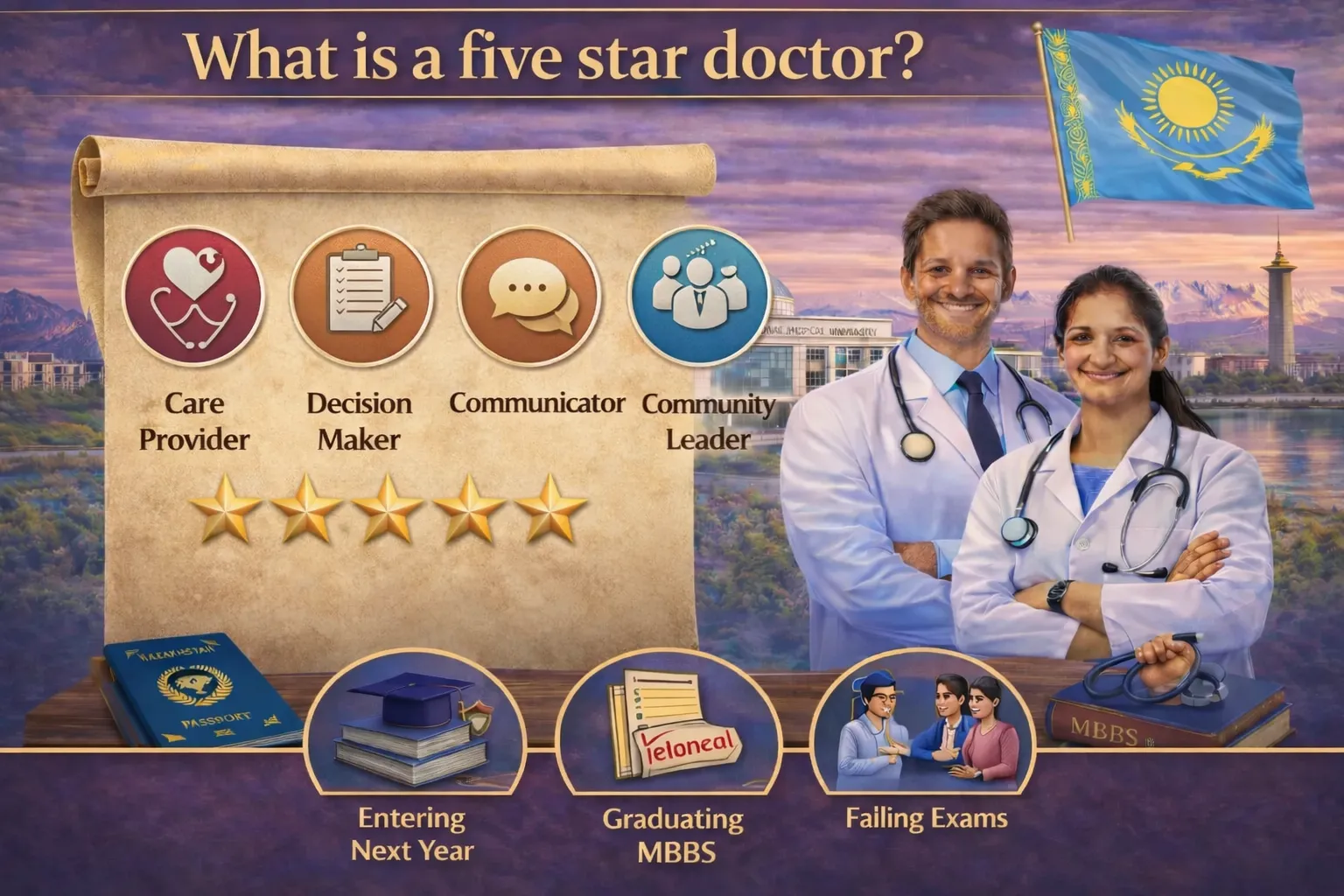
The term “five-star doctor” is common in students intending to do MBBS in Kazakhstan or preparing for NEET. There’s a perception that it has something to do with ratings or popularity, but in actuality, the term five-star doctor is one based on a professional concept first proposed by the World Health Organization (WHO) which describes the ideal characteristics all modern doctors should have.
We promote the five-star doctor concept, which is widely used for medical education internationally. Medical schools recognized by NMC, listed in WDOMS and meeting WHO standards promote these five pillars skills for medical students. Global standards of medical education form the basis for MBBS in Kazakhstan accorded to the students there as well, ensuring that they emerge ready and capable to become responsible health professionals.
The five-star doctor is a concept that was born out of an understanding of what it takes to thrive in the future of medicine, and aspiring medical students need to cultivate this mindset from day one.
The Five-Star Doctor Concept: Where It Comes From
In 2000, the World Health Organization published a report using the five star doctor model to outline the five key roles all doctors must play to address society's healthcare needs in today's world.
The World Health Organization defines a five-star doctor, not just by their medical expertise, but also pro-activity skills, effective communication ability and leadership qualities as well as the commitment to maintaining community health.
As a result, medical education programs around the globe–including those followed by universities offering MBBS in Kazakhstan–are structured to nurture these five roles at a gradual pace over the period of course.
FIVE ROLES OF A FIVE STAR DOCTOR
They say a five-star doctor is supposed to do 5 vital roles in health-care. These roles set the professional standards for contemporary doctors.
Care Provider
The primary function of a five-star doctor is to serve as a care provider.
A care provider may also provide advice on clinical disease, treatment, and healthcare outcomes. It calls for not only sound theoretical knowledge but also good practical skills.
In Kazakhstan, MBBS covers subjects like:
- Anatomy
- Physiology
- Pathology
- Medicine
- Surgery
These subjects help students to understand the diseases and cure them.
To develop this role universities such as Karaganda State Medical University, Kazakh National Medical University South Kazakhstan Medical Academy Semey State Medical University West Kazakhstan Marat Ospanov State Medical Frbody Fitzhugh Mullan aBRect1331 Memberww.
NMC Recognition, WDOMS Listing and WHO Aligned Curriculum guarantees globally accepted training for students.
Decision Maker
The five-star doctor’s second role is to be a decision maker.
In emergencies doctors have to make snap decisions and need them to be right. Sample Decision-making refers to analyzing a patient’s symptoms, medical history, and diagnostic results.
MBBS students in Kazakhstan learn about viewing medical conditions and selecting treatments.
Decision-making skills are developed during:
- Clinical rotations
- Hospital training
- Emergency simulations
When it comes to life-threatening conditions, this role is truly essential.
Communicator
A five-star physician is an effective communicator.
One thing is for certain, in vulture medicine communication is the key. Doctors have to explain medical conditions clearly to patients and families.
Good communication helps:
- Build patient trust
- Improve treatment outcomes
- Reduce misunderstandings
- Provide emotional support
Students pursuing MBBS in Kazakhstan come into contact with patients during their clinical training that teaches them effective communication skills.
This job is critical since medicine isn’t just scientific, it’s personal.
Community Leader
The fourth role out of five of a doctor is being community leader.
Treating individuals is but one of the roles physicians play; working to improve public health is another. This involves disease promotion and awareness.
Responsibilities may include:
- Conducting health awareness programs
- Promoting vaccination campaigns
- Educating communities about hygiene
- Preventing disease outbreaks
Medical programs based on WHO guidelines prepare doctors whose purpose is higher than making individual sick patients better, but considering the entire community's well-being as a whole.
In Kazakhstan, MBBS students learn about public health systems and preventive medicine.
Manager
The fifth and final role of the five-star doctor is that of a manager.
In modern healthcare systems, doctors must manage resources efficiently. These include the management of hospital staff, medical equipment and patient records.
Management skills help doctors:
- Organize patient care
- Use medical resources effectively
- Improve healthcare delivery
- Reduce operational errors
Healthcare administration and hospital management principles are introduced during MBBS in Kazakhstan.
These abilities help doctors to operate successfully in contemporary healthcare settings.
Relevance of Five-Star Doctor System to Medical Education
The five-star doctor, in other words, has become a global model for measuring medical competence;
NMC-approved (listed in WDOMS) medical education systems are designed to produce doctors with appropriate competency for all five roles, as advocated by WHO.
The MBBS in Kazakhstan program is structured for students providing training that aids to build:
- Clinical knowledge
- Professional behavior
- Leadership skills
- Ethical responsibility
This holistic structure allows graduates sufficiently primed for challenges in health care.
NEET: Beginning The Journey for a Five-Star Doctor
NEET is a compulsory examination for Indian students who want to study medicine overseas also, so students must qualify NEET before starting their medical education.
Students frequently ask:
- How long is the neet score valid?
- net validity
- neet score validity
- validity of neet exam
The neet score is valid for how many years for studying abroad. It is common for three years.
Meeting NMC eligibility is the first step for aspiring medical students towards pursuing their dreams of studying medicine in recognized institutions.
This is the first step in your journey of becoming a five-star doctor.
MBBS in Kazakhstan, the nature of Environment during Training
The students studying MBBS in Kazakhstan are provided practical exposure as well as clinical training to nurture five-star doctor attributes.
Formal learning environments are provided by Universities such as:
- Astana Medical University
- Semey Medical University
- Kazakh Russian Medical University
- North Kazakhstan State University
- International Medical School
- Nazarbayev university
Students participate in:
- Clinical training
- Laboratory sessions
- Community health programs
- Hospital rotations
Such experiences contribute to confidence in the office.
The Professional Benefits of Being a Five-Star Doctor
Physician career outcomes for those that meet five-star model standards are often found to be better than the alternative.
Well-grown career opportunities in 2.5 countries are available for those graduating from WHO standard universities approved by NMC and listed in WDOMS.
Students often research the average MBBS salary abroad per month Indian rupees, as it gives them an idea of the long-term financial perspective.
Doctors may have pivoting careers in: …with great clinical skills and leadership.
- Hospitals
- Research institutions
- Public health departments
- Medical education centers
These career paths illustrate the long-term return on investment of a medical education.
How Following the Five-Star Model Can Lend Personal Development
Following the five-star doctor guiding principles stimulates personal growth.
The programme teaches MBBS student in Kazakhstan:
- Discipline
- Responsibility
- Critical thinking
- Compassion
It also increases independence and adaptability.
The question students type before departure is how warm Kazakhstan temperature in May?
Kazakhstan also has natural features like Lake Balkhash, making it a good place to unwind between academic endeavors.
Such experiences foster personal development as well as advancement in academia.
How the Five-Star Doctor Concept Can Shape the Future of Medicine
The healthcare systems around the world are growing increasingly complicated. Doctors face rising patient volumes, novel diseases and cutting-edge technologies.
The five-star medical doctor model guarantees that physicians are equipped to confront these challenges head-on.
Kazakhstani medical institutions are conducted on the basis of various healthcare standards all over the world, which can be beneficial for students pursuing MBBS there.
Meeting WHO standards, getting recognized by NMC and listed in WDOMS provides competitive edge to the graduates across international platform of medical field.
Conclusion: What Is a Five-Star Doctor?
A five-star doctor is a health professional who meets five basic WHO roles:
- care provider
- decision maker
- communicator
- community leader
- manager
The ideal modern standard which clinical encounters gage with the medical profession.
The MBBS degree in Kazakhstan meets the standards set by NMC, WDOMS, WHO who helps students become-trained doctors.
The concept of a five-star doctor helps future medicos to not just prepare for an entrance exam like the NEET, but also to build long-term careers that are all about improving patient health and what works best for their communities.