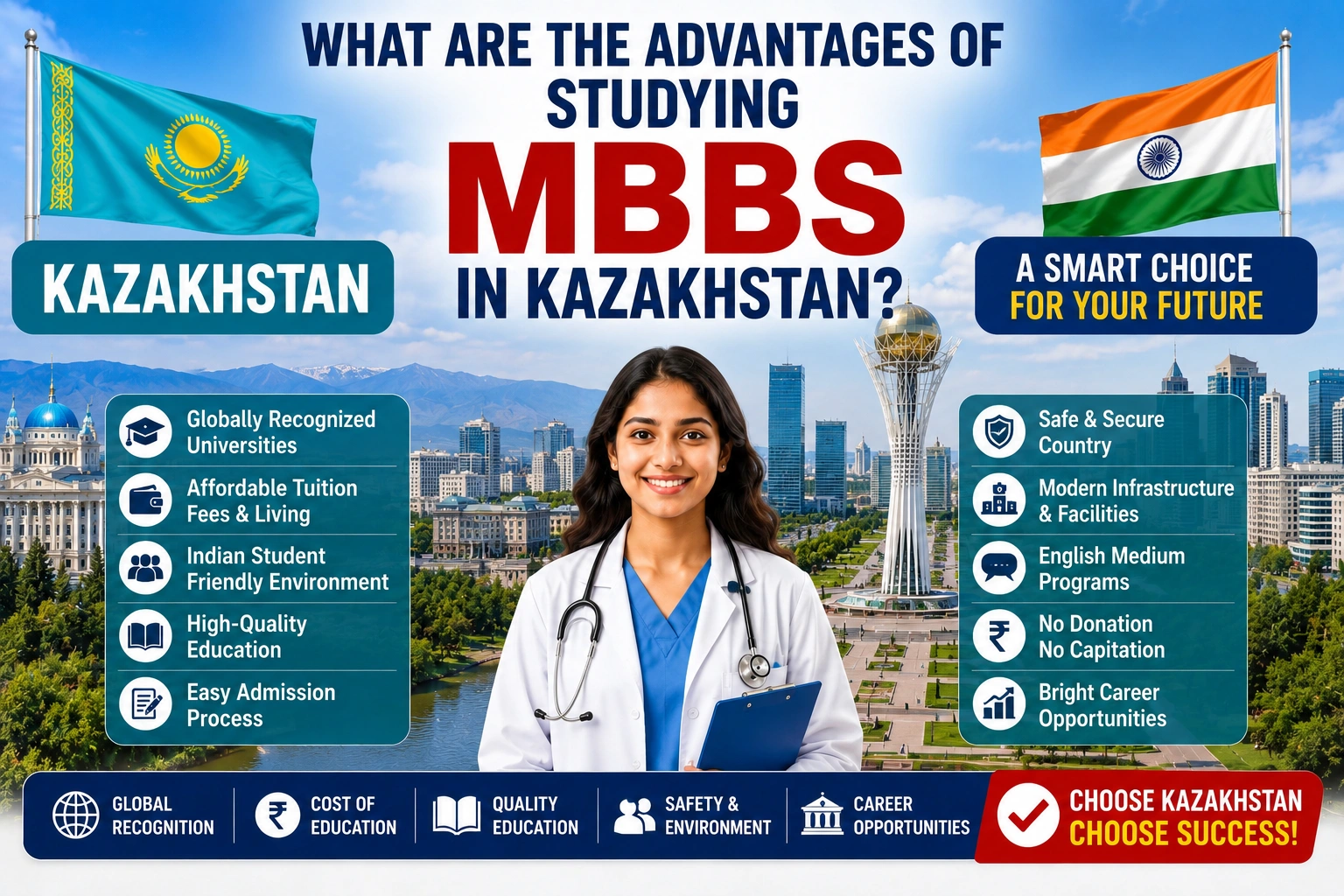
Students who want to study MBBS in Kazakhstan should know its pros and cons. Although Kazakhstan is an up and coming country for MBBS, there are many more pros than cons, especially when compared to other countries.
One advantage is cost. tuition fees for medicine studies in Kazakhstan are relatively low compared to India's private medical colleges or colleges in many other countries. Something to consider is that studying in Kazakhstan is not just about tuition. You also need to look at costs for accommodation, food, transport, health insurance, visa, study materials, etc., which all will factor into the cost of studying in Kazakhstan.
Another advantage of choosing Kazakhstan is the variety of reputable medical institutions. Unlike many up and coming countries for medical studies, Kazakhstan has a wide variety of universities that are recognized and have good medical programs.
Because of its affordability, Kazakhstan medical programs attract families seeking low-cost international opportunities.
However, prospective students must remember that the most economic option does not always equate to the best option. Before deciding on a university, students must confirm all the costs that the university charges for the program, including the tuition, accommodations, clinical training costs, exam costs, and any other costs that may be required.
2. English-Medium Medical Programs
Additionally, several medical programs in Kazakhstan have the option to study medicine in the English language.
Studying medicine in India comes with many challenges, and studying in an English-medium program can make the challenge of understanding medicine less daunting. Communication in classes, textbooks, and exams becomes easier.
WDOMS reports that several medical programs in Kazakhstan are offered in English. Other universities offer programs in English, Russian, and Kazakh.
Students must keep in mind that studying in an English-medium program does not guarantee that all interactions during clinical training will be in English. Basic knowledge of Russian and Kazakh can be beneficial during clinical training.
3. Established Medical Universities
Kazakhstan has a long history of medical education and established universities.
For example, WDOMS places Astana Medical University in the category of public medical universities and indicates that the university was established in 1964. WDOMS also indicates that Astana Medical University has facilities for clinical teaching, and international student admission is available for these programs.
Similarly, the Kazakh Russian Medical University has been operational since 1992 and offers General Medicine programs for international students.
Having an established base has its privileges, especially for students seeking universities with well developed academic and clinical infrastructure, rather than a new medical school.
4. Clinical Exposure During Medical Education
Medical education is not confined to the four walls of the classroom. To become a full-fledged doctor, one needs to learn the ropes by undertaking various training and exposure to the clinical world.
In Kazakhstan, many medical schools have access to clinical training facilities which WDOMS has recorded as clinical teaching facilities and clinical training for some programs at the Astana Medical University.
Clinical exposure teaches the students the intricate details of patient examination, the process of diagnosis, medical case procedures, hospital work, and the professional etiquette of interface with members of the health team.
However, the clinical exposure may differ greatly among different universities. Hence, one needs to know the clinical exposure, the structure of the curriculum and the clinical training of the university selected.
5. International Student-Friendly Environment
Kazakhstan has an attractive environment for international students. Indian students have an opportunity for a great enhancer of communication skills and cross-cultural experience.
In Kazakhstan, a diverse student community also helps international students adapt to and overcome any issues in adjusting to a foreign country during the period while they are pursuing their studies.
6. Eligibility for Indian Students Subject to NMC Requirements
Indian students wishing to study in Kazakhstan must also comply with NMC requirements.
The NMC has its own distinctive regulations on foreign medical education and foreign medical graduates. The Foreign Medical Graduate Licentiate Regulations, 2021, and subsequent advisories and FAQs can all be found on the official regulations page.
Studying in Kazakhstan should not be considered as acquiring an overseas medical degree. Indian students should select a program that meets the requirements of the NMC and comply with the licensing pathway when they intend to practice medicine in India.
The NMC's regulations also include the location and continuity of medical education, training, and internship for foreign medical graduates.
Though rules and regulations are of great importance, students are also expected to check the latest requirements on the NMC website before finalizing admission.
7. NEET Qualification Is Required for Indian Students
Students need to also appreciate how NEET is relevant for Indians seeking to pursue an overseas medical degree.
NEET is the national level undergraduate entrance examination for medical admissions in India and Indians intending to pursue primary medical qualification abroad need to fulfill the applicable requirements.
Alone qualifying NEET does not make a foreign medical university eligible for practice in India. Students have to gauge the university and the program on the applicable NMC guidelines.
This differentiation is of great importance
8. WDOMS Provides Verification of Kazakhstan Universities
One benefit of students focusing on Kazakhstan is the availability of institutional information on the WDOMS (World Directory of Medical Schools).
WDOMS lists school-level information, such as institutional status, program duration, qualification titles, languages of instruction, clinical training, and others.
WDOMS lists different medical programs in Kazakhstan and lists their information on program duration and the language of instruction.
WDOMS must be a vital source for verification by students, but WDOMS listing should not be considered a right to practice medicine in India. Indian students must check the program against the latest NMC standards.
9. Internationally Oriented Medical Education
Medical Universities in Kazakhstan have started to create opportunities for international students by developing medical programs in English and other languages.
The presence of international students often compels universities to enact academic support, offer international services and offices, and provide English resources.
For Indian students, studying in Kazakhstan can be a less expensive and safer alternative, but still quite international, compared to other western countries.
10. Exposure to Different Healthcare Systems
Studying abroad are good opportunities to study different countries’ organizing of healthcare.
International medical students are able to see different hospitals, practices and customs of healthcare, patients, medical training, and professional awareness, all of which are important to one’s medical practice and education.
Studying abroad in Kazakhstan can encourage Indian students to be more flexible and independent in their medical education and practice.
Even with the different healthcare systems and disease patterns in Kazakhstan and India, medical students must have background medical knowledge and be fully prepared to practice medicine in India upon completing their studies.
11. Opportunity to Learn Russian or Kazakh
Although many international programs are available in English, students living in Kazakhstan have the chance to learn Russian or Kazakh.
This can be most useful during clinical rotations. Having a little of the local language helps students communicate with patients and hospital staff.
Learning another language can be another professional skill for students wanting to pursue a career in International health care.
12. Modern Academic and Clinical Infrastructure at Selected Universities
The quality of the infrastructure varies between universities, but some have lecture halls, labs, simulation centers, libraries, hospitals, and clinical departments.
For example, in WDOMS data for Astana Medical University, clinical teaching and practice are mentioned as well as a considerable clinical training in some programs.
Students must check personally the university of their choice and cannot assume that all Kazakhstan medical colleges have the same facilities.
13. A Growing Option for International Medical Education
Kazakhstan is among the countries more students are looking at for their medical education abroad.
Cost, established medical universities, intake of international medical students, English medium programs, and location make it an excellent area for further study.
But popularity should never be the only reason for choosing a university. The quality and regulatory conformity of the individual medical program are of more concern than the popularity of the country.
14.Opportunity to Develop Independence and Professional Skills
Living abroad challenges students to adapt to a new culture, climate, diet, language, educational and health systems. Living abroad requires a student to manage the academic and other activities of daily living.
Living abroad can help develop a range of soft skills like independence, time management, adaptability and communication.
These skills can particularly aid medical students. Doctors’ role in communication spans patients, communities and health workers on numerous levels.
What Should Indian Students Check Before Taking Up MBBS in Kazakhstan?
As the challenges of living abroad can help students, it is also important to conduct a thorough examination of the possibilities to avoid drawbacks. Indian Students considering studying MBBS in Kazakhstan should be sure to verify the following.
- The Kazakhstani University is currently functioning and is on the official list of recognized universities of Kazakhstan.
- Whether the specialty of Medicine is listed in WDOMS.
- Document Title
- Length of study for specialization.
- The medium of instruction for the study program.
- The clinical clerkships and internship placement.
- The hospitals and affiliated clinics.
- Current costs of the university and the hostel.
- Specific criteria for Indian students.
- NEET requirements.
- The current standards of the NMC for Foreign Medical Graduates.
- If the study program meets the requirements for future medical practice in India.
- Visa and other compulsory costs.
- Structure of exams and assessment.
- Clinical attendance policy.
Students are more advised to contact the university and other official bodies on their own than to just rely on education consultants or the websites which promote the universities.
Is Kazakhstan a Safe Bet for MBBS for Indian Students?
Kazakhstan should be on the list of Indian students when considering options for studying medicine abroad because of its reputation for quality medicine, low cost, English-medium instruction, international exposure, and well-developed medical schools.
Kazakhstan offers affordable healthcare, English-language instruction, top medical schools, clinical exposure, exposure to students of various nationalities, international exposure, and a chance to cross-culture and cross-develop skill exercises.
Great, but Kazakhstan is not the be-all and end-all. A student must pick a medical school that will support their professional development.
Indian students must confirm the requirements of the NMC, confirm the university through WDOMS, satisfy the requirements of NEET, and examine the medical school's curriculum, clinical training, accreditation, and internship position.
Students also must understand that the WHO is a public health organization, internationally, and shouldn't be considered as an organization that "endorses" foreign medical schools. Students should rely on the acceptable national regulatory body and accreditation when evaluating a medical school.
Conclusion
The positives of studying medicine in Kazakhstan make it a destination that Indian students should think strongly about when pursuing their studies in medicine. Quality and affordable medical education, exposure to clinical training, international exposure, and an opportunity to study in a different medical school with international exposure are some of the positives.
Selecting a medical school abroad needs more depth than just checking the tuition costs. A student needs to look into the medical school's standing, the medical school's teaching, the clinical exposure, the structure of degrees, the medium of instruction, the availability of internships, and the medical school’s compliance with the latest NMC standards.
For an Indian NEET candidate, it is wise to consider Kazakhstan while keeping an open mind. Designing a career through obtaining a medical degree should include applying for Indian licensing, compliance with Indian law, and a considered choice of university. An overseas medical degree should be a long term career, not an afterthought.