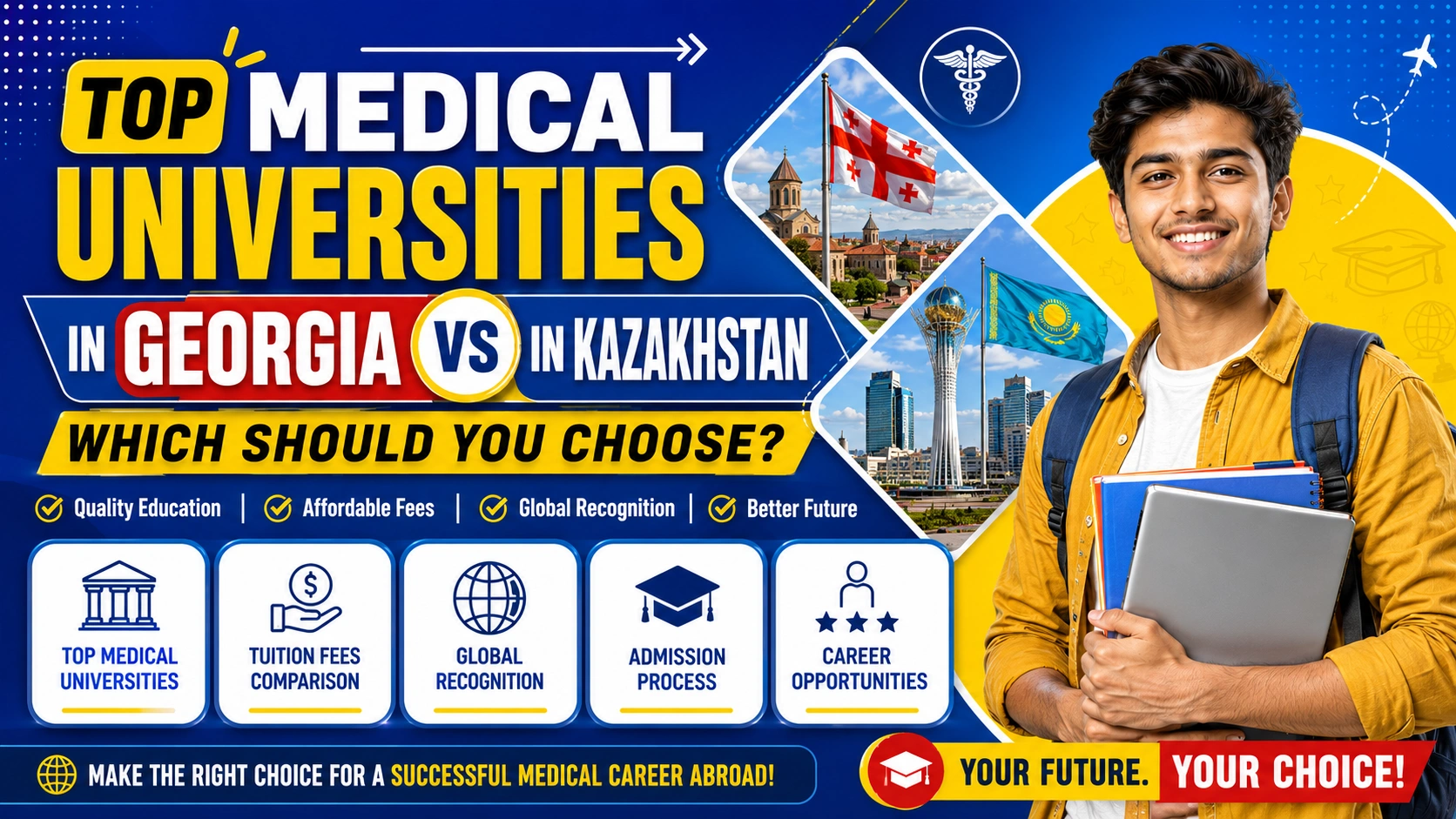
When Indian students begin to explore the possibility of completing their MBBS degree abroad, Georgia and Kazakhstan typically rank as the top two countries on their lists. This is not without good reason. Both countries participate in the NMC recognition scheme, provide English-Medium instruction, and offer admission based on NEET without capitation fees. However, based on these anecdotal observations, one can not easily come to a conclusion. Throughout the two countries, there are massive differences in cost, college, visa, and the availability of international students.
In this scenario, choosing between the two countries can be made easier by looking at the real differences amongst the two: cost and recognition, along with clinical training and the everyday experience differences, coupled with the admission formalities.
Why Georgia and Kazakhstan are the Top Two MBBS Destinations
There are many reasons why Indian students tend to procure admission to medical universities in these two countries. Primarily, this can be attributed to:
- NEET as the sole admission criteria for most medical colleges in Georgia and Kazakhstan
- No additional entrance examinations
- English medium instruction (MBBS)
- No donation or capitation fees
- 6-year MBBS course (5 years of study + 1 year of internship) that is congruent with the MBBS structure in India
- NMC approval and WDOMS listed medical colleges
- Established Indian student community
Fee Comparison: Georgia v Kazakhstan
Looking first at the cost, the gap between the two is striking.
- For a 6 year course, Study MBBS in Kazakhstan is around ₹20 to 36 lakhs for everything including tuition, hostel, and living expenses. It is $3,500 to $5,500 per year, which offers budget value for students looking to do MBBS abroad.
- MBBS in Georgia is more expensive. For the entire 6 year course, the fees may be anywhere from 22 to 55 lakhs depending on if the university is a public or private one. Tuition per year in a Georgian university is about $3,500 to $8,500, with some private universities touching $15,000.
The cost difference for a family with a fixed budget is about ₹10 to 20 lakhs in favor of Kazakhstan during the entire course.
Important 2026 Update: Georgia Public Universities Closed to New International Students
As of 2026, new changes have started to come into effect that will be a critical point for research into the MBBS in Georgia. Multiple offers are being made from public and state universities of Georgia to focus on local Georgian students and protect their spaces in their studies (to include Tbilisi State Medical University). Therefore, they will no longer be accepting international students.
What this means is that Indian students trying to gain admission in this current cycle will are left, most of the time, with the option of Private Medical Universities in Georgia that charge higher Fees than the Public Medical Universities that were popular among the International Students. Due to the reasons cited above, the Effective Cost for the New Applicants in Georgia, in particular K, is estimated to be in the range of ₹35 – 55 Lakh at some Private Institutions.
Referrals to Kazakhstan indicate that similar restrictions have not yet been instituted there. Both Public and Private Medical Universities there still actively enroll International Students and Indian Students for the year 2026.
Clinical Training and Quality of Education
Both these Countries have a system for Clinical Training which is affixed to Hospitals. Once again, there are differences.
- Kazakhstan's Major Medical Universities have Clinical Training systems which are built on the Indian Model of Training and have hospital exposure which is built on a step basis for students over the years of the course.
- Private Universities in Georgia also have Clinical Clerkships from the first semester in a majority of the cases, and have modern infrastructure as well as a Curriculum that is in sync with the European Bologna Process. Georgian Universities are affixed with WFME (World Federation for Medical Education) Accreditation, which graduates to sit for not only the FMGE/NEXT India, but the USMLE, PLAB and other Licensing Exams for the Gulf.
If your long-term goals involve practicing outside of India — namely in the US, UK, or Gulf countries — then Georgia's WFME accreditation might provide a marginally wider range of future opportunities. Assuming you wish to practice solely in India after your studies, then the NMC-recognized universities in either country are equivalent, and the cost and clinical exposure determine your choice, not the country.
Necessary Verification and Compliance
No matter which country you prefer, these four checks must be applied, and you can never skip them:
1. Approval from the National Medical Commission (NMC)
Every medical university in Georgia or Kazakhstan must have recognition from the NMC in order for students to be eligible to take the licensing exam in India. You will not have the opportunity to take the licensing exam in India, regardless of how appealing the university may look from the outside.
2. Listing in the World Directory of Medical Schools (WDOMS)
Ensure that the university you choose is listed in the WDOMS. It is the official listing of medical schools and is recognized worldwide, and is the reference of regulatory agencies, licensing, and exam authorities.
3. Alignment with the World Health Organization (WHO)
The WHO does not accredit universities. However, their global standards of medical education do inform the assessment of degree quality. Often, universities in Georgia and Kazakhstan frame their curricula in WHO-aligned standards. Ask your counselors how each university integrates the standards in their curriculum.
4. NEET Qualification
To practice medicine in India after MBBS, all Indian students must qualify the NEET (National Eligibility cum Entrance Test). Some Georgian universities claim to admit international students without a NEET scorecard. However, Indian students need this scorecard to qualify for the FMGE/NEXT. We recommend you do not skip this scorecard despite what the agents suggest.
Admission Process and Visa Comparison
Although the admission steps followed in India and Georgia are broadly similar, there are a few practical differences which are important.
- While applying to Georgia, Indian applicants must obtain a D3 Category Student Visa. The required documents include an apostilled 10th/12th certificate from India's Ministry of External Affairs, a university invitation letter, and proof of funds for at least one year's fees and living expenses. Visa processing takes 15-30 days.
- On the other hand, the C9 Category Student Visa of Kazakhstan has a simpler process for most applicants. Moreover, Indian citizens are offered visa-free entry for short stays of up to 14 days in Kazakhstan. This large time period makes pre-admission counseling visits very convenient in comparison to Georgia. Because a full visa application is required for even a short visit to Georgia.
If you would like to visit and inspect a university before deciding, many families find this valuable as Kazakhstan is visa free.
Safety, Culture, and Living Conditions
Both countries have growing Indian communities, as well as positive and affordable support and service systems for international students.
- Georgia is known as one of the safest countries for international students. Plus, it has an impressive tourist and student infrastructure, especially in Tbilisi, Batumi, and Kutaisi. Transport and living costs, especially food, are very affordable and extend a European quality of life.
- Kazakhstan, on the other hand, is home to large, modern cities like Almaty and Astana. They also have an impressive infrastructure, a large established Indian student population, and, compared to Georgia, lower living and daily expenses.
Kazakhstan and Georgia have cold winters, and students from tropical regions of India will have to adjust for the weather.
Georgia vs Kazakhstan Compare
|
Factor |
Georgia |
Kazakhstan |
|
Total 6-year cost |
₹22–55 lakh |
₹20–36 lakh |
|
Public university access (2026) |
Largely closed to new international students |
Fully open, government and private |
|
Visa for short counseling visit |
Requires visa |
Visa free (up to 14 days) |
|
Accreditation |
NMC, WDOMS, WHO aligned, WFME |
NMC, WDOMS, WHO aligned |
|
Global licensing exams coverage |
FMGE/NEXT + USMLE, PLAB, Gulf exams |
FMGE/NEXT only |
|
Best suited for |
Students focused on global (non-India) career options |
Students focused on cost and logistics |
So, Which One Is the Better Option?
Nothing makes one option the clear best — it depends on what's prioritized.
- Choose Kazakhstan for cost (within ₹36 lakh) and the ability to visit the university before potentially finalizing. Indian citizens can travel without a visa, making it a popular choice among students who want to pursue MBBS in a cost effective manner with flexible logistics.
- Choose Georgia if the plan is to work outside of India, as WFME accreditation allows graduates to take multiple international licensing exams — and the total budget can increase, particularly since there are no more public options for international students.
Regardless of your choice, the most important step remains the same, and that is to verify the specific university's status with NMC and WDOMS, rather than relying solely on an agent — both are publicly accessible and take no longer than a few minutes to verify.
If Kazakhstan is your destination of choice, has comprehensive up-to-date information on universities, fee structures, and eligibility criteria for MBBS in Kazakhstan — an important reference point as you make your decision.
Things to consider before making your decision
- Do a full 6-year cost analysis, not just a tuition comparison. The total cost varies in each country with additional expenses such as accommodation, food, insurance, visa, and travel.
- Confirm the admission status of the university as public universities in Georgia, for instance, have recently limited international students.
- Do not rely on agent claims for NMC and WDOMS registries. Both are publicly available.
- When considering FMGE/NEXT passing statistics, ask for the specific university, not the country's statistics.
- Consider the time and cost of getting a visa if you are planning to visit the university prior to making your decision. For Kazakhstan, the visa free policy makes this easy.
- Consider your place of future practice. If you are planning to practice somewhere other than India, the WFME accreditation in Georgia and its exam pathways may influence your decision.
Conclusion
Both Georgia and Kazakhstan are NMC, NEET compliant, and friendly destinations for MBBS abroad for Indian students. Both have positives, however, when comparing, Kazakhstan comes out on top for cost and ease of access to both public and private universities with visa free entry for counseling. Georgia, at a higher cost, has WFME accreditation and a greater range of post-graduate pathways, but has limited access to public universities.
In the end, what matters is which specific school you choose to apply to. For a decision based on schools, you must consider NMC approval, WDOMS listing, clinical infrastructure and FMGE/NEXT performance. Do the necessary research, and you can start your medical career in either country.