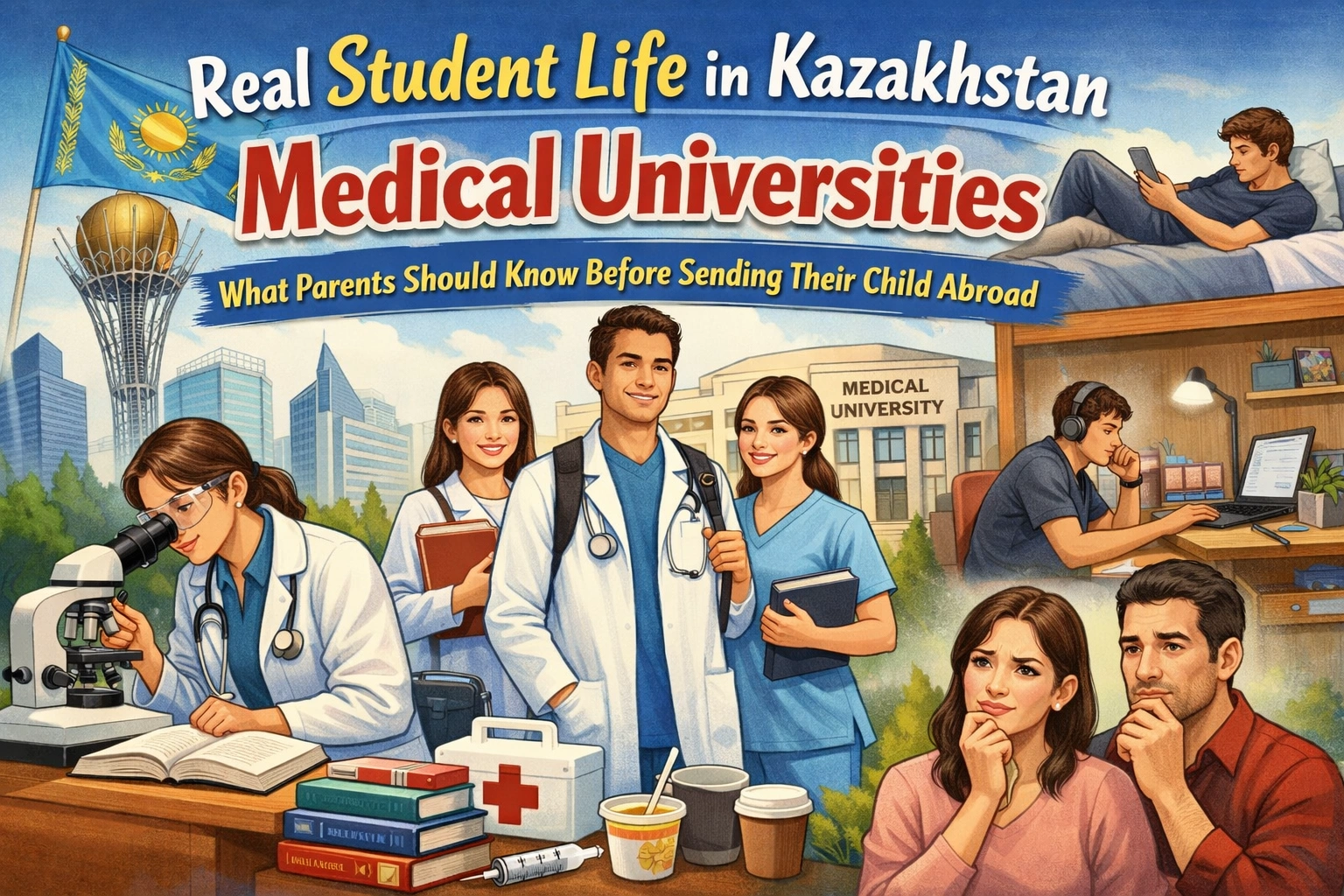
For parents, sending a son or daughter overseas to pursue formal education in medicine is never merely an academic decision — it’s deeply personal. Beyond fees, privilege and admissions process, the real question you should ask needs to be: What will life actually be like for my child there?
Increasing the number of the MBBS In Kazakhstan, a large number of families are choosing this path for 2023. But, real student life—daily routine, safety, food, studies and environment—is the understanding you should have before finalizing your decision.
This post gives a concise, prima facie and hand-on aspect of what students go through in Kazakhstan medical colleges.
Importance of Understanding Student Life
Parents are often concerned, primarily about admission and fees, but student life has a direct effect:
- Academic performance
- Mental health
- Safety and comfort
- Long-term career success
It is obvious that a student who adapts themselves to their environment does better academically and professionally.
Everyday Life of Kazakhstani Medical Students
Like any other medical education system, student life in Kazakhstan is strict and disciplined.
A typical day includes:
- Morning lectures (theory classes)
- Practical sessions in laboratories
- Clinical exposure in hospitals - when they were older
- Self-study with revision in the evening
Most universities are on a more or less consistent schedule, and it helps students stay in the groove of studying.
This kind of structured routine is good for Indian students because it teaches them discipline and time management.
Academic Environment and Teaching Style
English-Medium Education
The majority of the universities for MBBS In Kazakhstan provide lectures in English. This helps Indian students get into subjects through academics without language barriers.
But students are encouraged to learn some basic local language that will be useful in communicating with patients while on the hospital training.
Faculty Support and Class Size
Class sizes are moderate compared to many institutions in India. This allows:
- Better interaction with teachers
- Easier doubt clarification
- More personalized attention
Overall most professors are very accommodating and supportive, particularly of international students.
Focus on Practical Learning
Kazakhstan places a heavy emphasis on practical exposure in medical education.
Students benefit from:
- Laboratory sessions
- Early clinical exposure
- Hospital training in later years
It is this method that helps in becoming a real doctor not just a theorist.
Hostel Life and Accommodation
Living Conditions
Hostel Facilities: Most universities offer on-campus or nearby hostels.
Hostels typically include:
- Furnished rooms
- Heating systems (important during winter)
- Electricity, water, internet and other basic facilities
Boys and girls are provided accommodation separately.
Safety in Hostels
Student accommodation focuses on safety extremely.
Hostels usually have:
- Security personnel
- CCTV monitoring
- Restricted entry for outsiders
Ensuring that students are in a institutional environment.
Food and Daily Living
Availability of Indian Food
Food Food is one of parents' biggest worries.
In Kazakhstan:
- Hostel or mess provide Indian food
- Dozens of students also prepare their own meals
- Basic groceries are easily accessible
It becomes easier for the students to stick to their eating habits.
Cost of Living
Cost of living in Kazakhstan is fairly low.
Students spend on:
- Food
- Transport
- Personal expenses
In comparison to Western countries, the overall cost is reasonable.
Social Life and Environment
Indian Student Community
Kazakhstan is home to a lot of Indian students.
Students benefit from:
- Peer support
- Cultural celebrations
- Group study and activities
Which eliminates home sickness and adjustment more quickly.
Cultural Exposure
Studying abroad opens students up to the following cultural experiences:
- New cultures
- Different lifestyles
- International exposure
Adding, which helps one grow and mature as an individual.
Climate and Adaptation
Kazakhstan has cold winters that can be challenging at first.
However:
- Hostels and classrooms have central heating
- Within a couple of weeks or months, students adjust
The transition can be more manageable with the right clothing and preparation.
Be Safe and Secure in Daily Life
Kazakhstan is usually safe for international students.
Students experience:
- Safe public spaces
- Reliable transport systems
- Supportive university environment
Simply avoiding sleeping in a remote area or following local rules for staying safe is enough.
Academic Pressure and Challenges
Study Load
Irrespective of the country, medical education is all-encompassing.
Students must:
- Attend regular classes
- Prepare for internal exams
- Complete practical training
One of the most important things to keep under control during a possible time of pressure is consistency — and for this, you must engage in regular practice.
Language Barrier in Hospitals
Patients may speak some local languages during clinical training.
According to the information, students begin acquiring basic communication skills slowly in order to realize those abilities before applying them in real life.
Preparation for Licensing Exams
Eligibility criteria for MBBS In Kazakhstan Students need to score the following:
- Qualify NEET before admission
- You will prepare and pass the NEXT exam after your graduation
That takes long-term thinking and sustained study.
Communication with Family
Students need family support, and parents want to stay connected.
Kazakhstan offers:
- Good internet connectivity
- Easy access to communication apps
It allows students to maintain regular contact with their families, providing emotional support.
Healthcare and Emergency Support
The student health needs is handled by medical universities.
Students have access to:
- University medical facilities
- Hospitals in nearby areas
- Emergency services
In addition to settlement issues, international student departments help resolve health and safety-related problems.
Role of University Recognition
Parents must check university credentials before sending a child abroad.
How to Find the Top MBBS In Kazakhstan: Institutions.
- Approved by NMC
- Featured by WHO (World Health Organization)
- Listed in WDOMS (World Directory of Medical Schools)
It's important because it makes a degree valid and an education up to the world standard.
Things Parents Should Verify Prior to Admission
Parents should carefully evaluate:
- Hostel facilities and safety
- Availability of Indian food
- Academic structure and clinical exposure
- Support services for international students
- Recognition of Universities from NMC, WHO and WDOMS
A well-informed choice mitigates risks and provides for a more satisfying experience for the student.
When You Adapt Well to Student Life Overseas
The students who do well in Kazakhstan tend to:
- Are disciplined and self-motivated
- You are far from being the static predictable person that people can see on their minds
- Maintain a regular study routine
- Connect with family and friends
Who May Face Difficulties
Students who are:
- Uncomfortable living away from home
- Irregular in studies
- Not willing to change with cultural differences
may face challenges in adjusting.
Final Assessment
The student life and environment in Kazakhstan medical university is sapid, secure, and easy for Indian students.
It offers:
- A disciplined academic environment
- Affordable living conditions
- Supportive peer community
- Personal and professional development opportunities
On the other hand, it demands responsibility, consistency and adaptability from the student.
Conclusion
Real student life is something that parents must clearly understand before making a decision.
A balanced environment is provided in Kazakhstan, allowing students to pursue academics while gaining independence and global exposure. If you take adequate preparations, choose a university carefully and be humble enough to know what will not work for you — MBBS In Kazakhstan can put you on track for something positive and safe.
The answer, of course, is not just a country, but also about the student being prepared to take advantage of that opportunity.