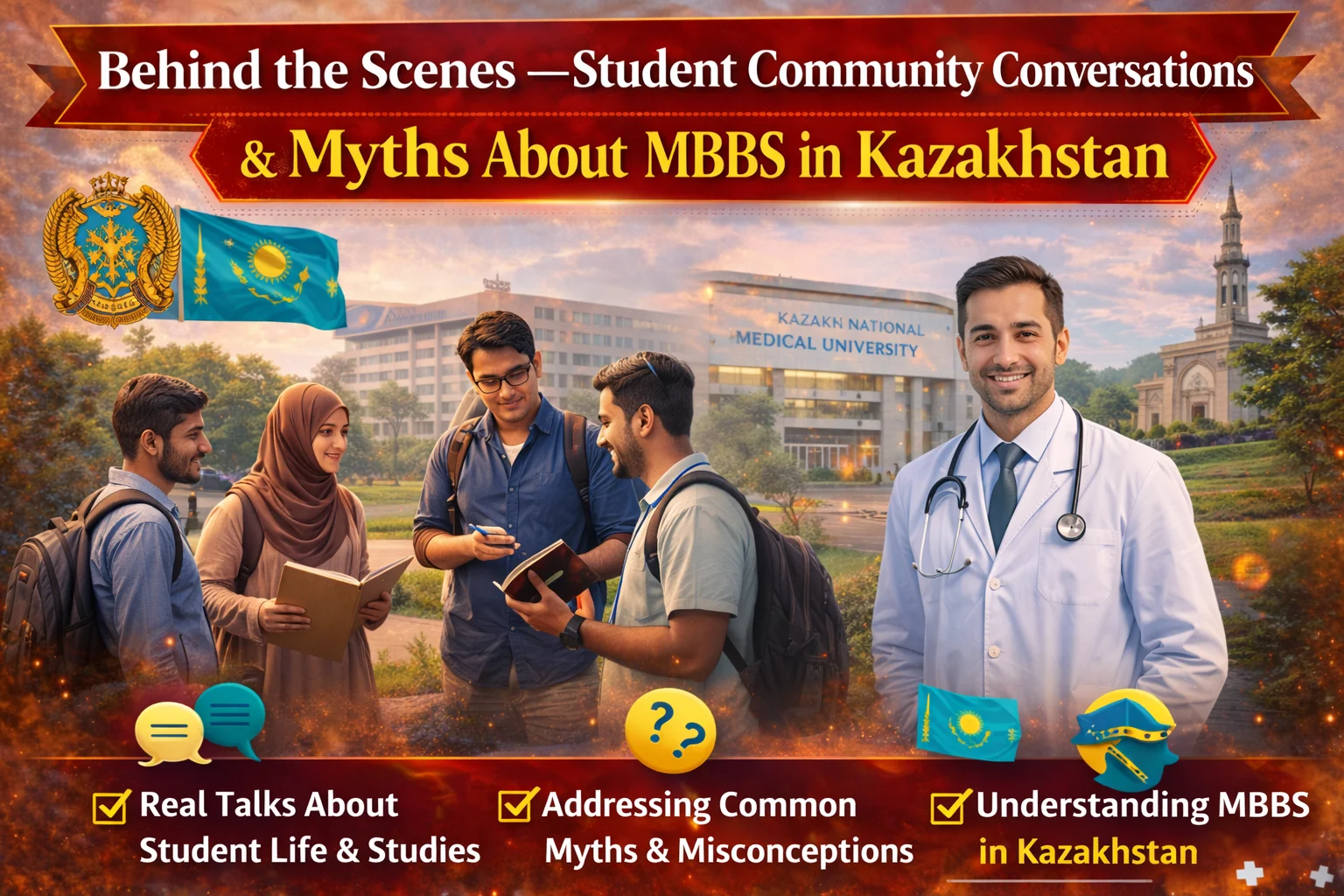
When students discuss studying medicine abroad, the real conversations are rarely around official sites. They happen in WhatsApp groups. Telegram channels. Hostel rooms. Late-night phone calls between parents. Counseling offices.
And for MBBS in Kazakhstan, the side talks are hotter than brochures.
Some students are excited. Some are confused. Some are terrified from stuff they “heard from somebody.”
So let’s take a break from promotional language and see what conversations students actually are having within student communities — and debunk the biggest myths.
What Students Really Discuss (That They’re Often Not Asking Publicly)
If you hang around in any student forums, you’ll see some common themes:
- “Is the degree really recognized in India?
- “Will I have issues related to licensing?”
- “The quality good or merely affordable?”
- “How difficult is the language barrier?
- “Do students have a hard time when they return?”
These aren’t small doubts. They shape career decisions.
And all of them from half-knowledge.
Let’s address them honestly.
Myth 1: “MBBS in Kazakhstan Is Non-Recognized in India”
And this is arguably the most popular rumor.
The reality? Recognition is not just a function of the country, but also the university and regulation compliance.
Indian students should check :
- Guidelines as per National Medical Commission (NMC)
- This is taught teaching from October 2023.
- Meets NMC rules for duration and internship
Graduates may take licensing examinations in India (FMGE/NExT as per the extant law), only if these conditions are satisfied.
In most cases, the confusion arises when students select institutions without checking off official lists.
Jul 27, 2023How community conversion works.
“Brother I heard the degree is not valid…”
But as soon as someone actually looks at WDOMS or NMC guidelines, the story is different.
The answer is verification, not assumption.
Myth 2: “Because Fees Are Affordable, Quality Is Low”
The idea is a common belief: that lower tuition comes with necessarily lower education standards.
But cost structure depends on:
- Government subsidies
- Local economic conditions
- Currency exchange rates
- Infrastructure costs
Kazakhstan’s medical universities are usually functioning within organized academic regulations due to international guidelines in health education. The country already works closely with international health bodies and conforms many policy decisions to guidance frameworks promoted by organizations such as WHO.
Rome was not built in a day — and cheap does not equal weak
What matters more:
- Clinical exposure
- Patient flow in teaching hospitals
- Faculty qualifications
- Curriculum alignment
- English medium delivery
And those students who actually go to class tend to say:
“Syllabus very tough, speed of syllabus is high, attendance is strict.”
Which is at odds with the myth of “easy degree.”
Myth 3: “Language Barrier Makes Clinical Training Impossible.
This fear is real — and pragmatic.
Medical Studies in the English stream for foreign students (English language classes) at many universities that give MBBS in Kazakhstan However, patients encountered in clinical years may converse in local languages such as Kazakh or Russian.
But here’s what conversations in the community show:
- Universities provide basic language training.
- Medical conversation vocabulary is something that students learn naturally over time.
- Senior students help juniors adapt.
- Chinese in urban areas, where many patients are located, widely understand Russian.
Language is not an obstacle, but a skill advantage.
Graduates who can speak many languages as a matter of taste possess wider competence in communicating — worldwide.
Myth 4: “Students Face Challenges Upon Returning to India”
This myth usually comes from selective stories.
Yes, students are struggling — but struggle is not location specific.
Not even Indian private medical graduates are exempted from licensing examinations and stressful postgraduate competition.
Success depends on:
- Consistent academic focus
- Early preparation for FMGE/NExT
- Clinical understanding, not rote memorization
- Internship exposure
Student communities tend to tell a story:
Starting in 3rd year – those people score much better than the ones waiting until final year to study them.
Preparation strategy matters more than where you study.
Myth 5: “There Is No Student Community Support”
This one is a shocker, but it comes up surprisingly often with parents.
But in the background, Indian student communities are very active in Kazakhstan.
They organize:
- Festival celebrations
- Peer academic sessions
- Airport pickups for newcomers
- Shared accommodation advice
- Winter survival tips
Social media groups and alumni networks smooth the way better than most imagine.
It is understandable that there is an emotional fear of “sending a child abroad.” But networks of global students today are stronger than ever.
The True Conversations: Kate Untamed vs Controlled
Let’s be honest.
Students thinking MBBS In Kazakhstan are usually in one of these circumstances:
- They did not win a government position in India.”
- The burden of private medical college fees is high.
- They want an international exposure.
- They are looking for options and planning for the long-term.
The emotional layer beneath these decisions is composed of:
- Social comparison pressure
- Family expectations
- Fear of uncertainty
- Financial risk concerns
That is why myths spread quicker than facts.
Since fear travels faster than confirmation.
Why Misinformation Spreads So Easily
There are three main reasons:
1️. Partial Information
Someone hears of one university’s problem and extrapolates it to the entire country.
2️. Consultant Competition
Different agencies promote different destinations. Comparison sometimes turns into exaggeration.
3️. Regulatory Confusion
In recent times, whenever any body like the National Medical Commission (NMC) issues rules regarding medical education, people panic without knowing their details.
This creates rumor cycles among student groups.
What Smart Students Do Differently
The process for students who make informed decisions is a straightforward one:
- They verify official listings from World Directory of Medical Schools (WDOMS)
- They study the revised NMC foreign medical graduate guidelines
- They are talking to current students — not an agent
- They verify internship structure
- They organize licensing exam preparation in advance
Since then if someone would have asked, “Log kya keh rahe hain?
They say, “What the official rules say?”
That shift changes everything.
Kazakhstan MBBS: A Balanced Take
Is it perfect? No country is.
Are there challenges? Yes — a bit like language adaptation, climate adjustment, licensing preparation.
But does it make it automatically risky or invalid? No — at least not if due diligence is performed correctly.
MBBS students studying in Kazakhstan usually say:
- Academically demanding
- Culturally enriching
- Financially manageable
- Globally exposing
The real experience relies less on geography and more on personal discipline.
The Climate Myth (And Yes, Students Are Talking About This)
“Wahan bahut thand hoti hai.”
Yes, winters are cold.
But hostels are centrally heated. Cold climates are what infrastructure is built for. Students adapt within weeks.
Interestingly, many students later say:
“Winter scary lagta tha pehle, ab kya normal ho gaya.”
Adaptation is faster than imagination.
Career Anxiety: The Silent Discussion
The largest behind-the-scenes discussion isn’t one of safety or weather.
It’s about future.
Students worry:
- Will I clear FMGE/NExT?
- Will PG be possible?
- Will society respect foreign MBBS?
The truth?
Respect comes from competence.
Patients are interested in diagnostic accuracy, empathy and clinical confidence — not just passport stamps.
Conclusion — From Rumors to Research
Keep three things separate when making MBBS in Kazakhstan evaluation.
- Emotional fear
- Market noise
- Verified information
Check recognition.
Understand regulations.
Speak to real students.
Plan your exams early.
That’s how you make smart decisions.
Every myth is based on partial information or someone’s insecurity.
Success stories are built on preparation.