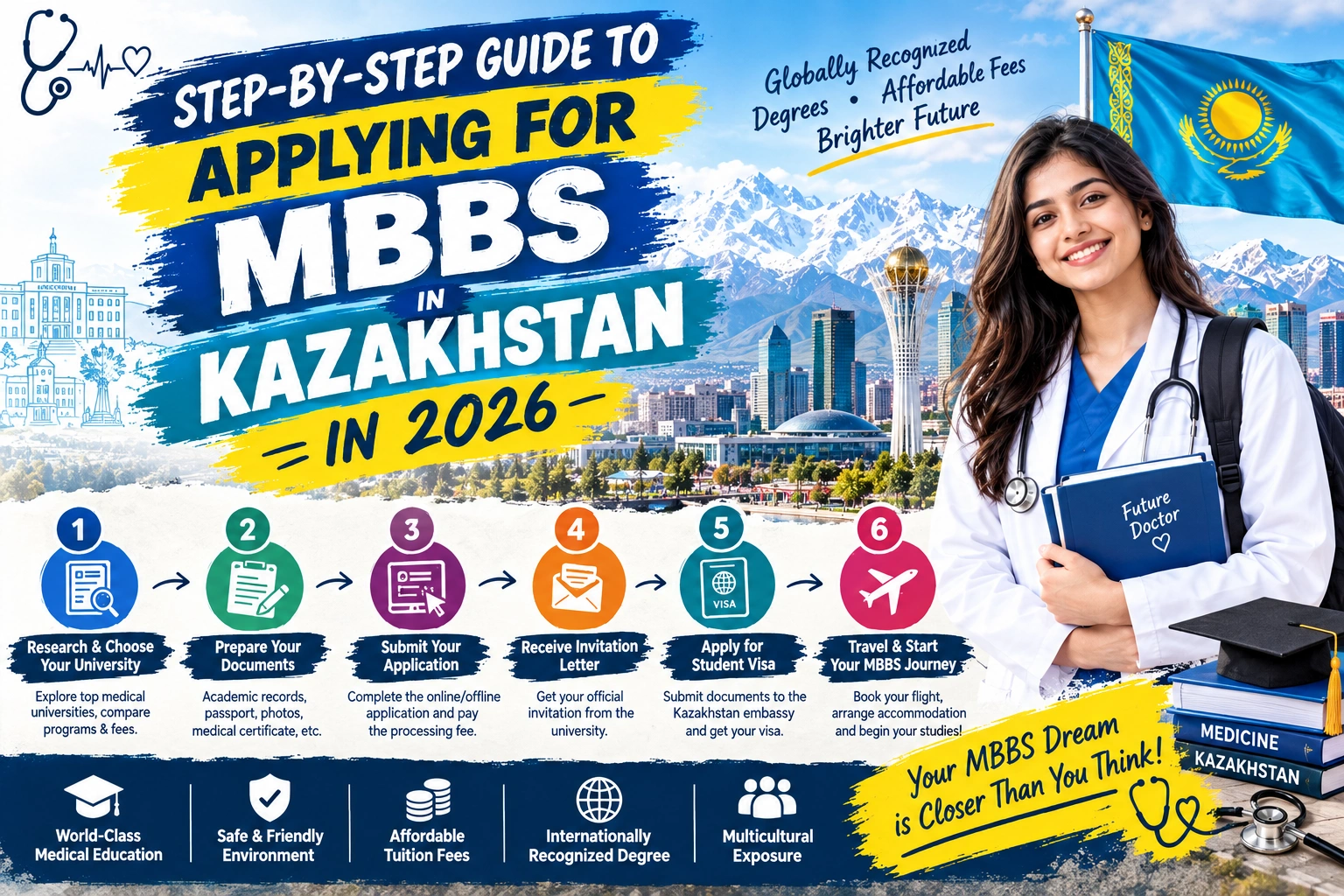
An admission agent sends a university offer on WhatsApp and asks for immediate payment. The seat is “almost gone,” apparently. Sounds familiar? This is exactly where students need to slow down. Applying for MBBS in Kazakhstan isn’t extremely complicated, but every step matters: NEET qualification, university selection, programme duration, document verification, fee payment, visa processing, and final registration after arrival. One careless decision—especially choosing a course that doesn’t meet Indian regulations—can create problems six years later. Here is the complete process, explained without sales talk.
Step 1: Check Whether You Meet the Basic Eligibility
First, the straightforward part. Indian applicants generally need to complete Class 12 with Physics, Chemistry, Biology or Biotechnology, and English from a recognised board. Under the usual eligibility framework, general-category candidates require at least 50% aggregate marks in PCB, while the minimum is commonly 40% for eligible reserved-category candidates. PwD criteria may differ. The student should ordinarily be at least 17 years old by December 31 of the admission year. Universities may also review individual marks in Physics, Chemistry, and Biology, so don’t judge eligibility only from the overall Class 12 percentage. A few institutions may conduct an interview, online assessment, or internal screening. Others issue an offer mainly on the basis of academic records. There is usually no separate national medical entrance examination in Kazakhstan for international applicants, but university-specific conditions still apply.
Step 2: Qualify NEET-UG 2026
Can an Indian student take admission without NEET? A university abroad may accept the application, but that doesn’t automatically protect the student’s future eligibility in India. Indian citizens and Overseas Citizens of India intending to obtain a primary medical qualification abroad should qualify NEET under the applicable Indian regulations. Follow the official NEET portal for the 2026 application form, bulletin, examination date, result, and qualifying criteria. Don’t depend on last year’s schedule because the NTA can change dates and procedures. NEET qualification and an Indian government-college admission cutoff are two separate things. A student doesn’t normally need 600-plus marks merely to apply abroad. The relevant requirement is the qualifying score or percentile declared for that examination cycle. Since the NEET-UG 2026 cutoff can only be confirmed after the result, avoid websites presenting a guessed number as final.
Keep these records safely:
- NEET application confirmation page
- Admit card
- Scorecard
- Result or qualification document
- Registered email address and mobile number
Retain digital and printed copies. Six years is a long time, and recovering old login details later can be irritating.
Step 3: Shortlist Universities on Compliance, Not Popularity
This step deserves patience. A lot of it. Students often compare universities using only tuition fees, city photographs, or the number of Indian students already enrolled. Those factors matter, but they shouldn’t lead the decision. For an MBBS in Kazakhstan programme, examine the entire medical course rather than just the first-year brochure. Ask about the awarding institution, programme duration, internship, teaching language, affiliated hospitals, patient exposure, local registration eligibility, and whether all training takes place in the same country. The National Medical Commission doesn’t offer a simple permanent list of “NMC-approved foreign universities.” Indian students must ensure that their qualification satisfies the regulations applicable to foreign medical graduates. Under the present framework, critical areas include the required study duration, a prescribed internship, mandatory subjects, clinical training, English-medium instruction, and eligibility to obtain a licence in the country awarding the qualification. Honestly, this is where many families hear half-truths. Get every major claim in writing.
Step 4: Verify the University Independently
A university’s name appearing in the World Directory of Medical Schools can help confirm directory information about the institution and programme. Yet a WDOMS listing isn’t the same as approval, accreditation, or guaranteed registration in India. The directory itself makes that distinction. Also check the university’s recognition and accreditation status with the relevant authorities in Kazakhstan. Visit its official website, email the international admissions office, and request the current medical curriculum. If possible, speak with students studying in the clinical years—not only freshers who arrived two months ago.
Ask direct questions:
- What is the exact duration of the medical programme?
- Is the entire course taught in English?
- Where will the internship be completed?
- Are international students eligible for local medical registration?
- Which hospitals provide clinical training?
- Does the university permit transfers to another institution?
- Will the same university award the final degree?
References to the World Health Organization should also be understood correctly. WHO works on international public health; it doesn’t personally “approve” individual medical colleges for Indian registration. “WHO-approved university” is commonly used in advertising, but it isn’t a substitute for regulatory verification.
Step 5: Compare Course Duration and Clinical Training
Here’s the tricky bit: medical programmes in Kazakhstan may be advertised using labels such as five years, five-plus-one years, or six years. Never assume those descriptions mean the same thing. Indian regulations require foreign medical graduates to complete the prescribed academic and internship structure. A shorter-looking course may appear attractive because it costs less, but if its duration, clinical subjects, or internship arrangement doesn’t meet NMC conditions, the saving becomes meaningless.
For each shortlisted university, request a semester-wise curriculum showing:
- Total academic duration
- Number of semesters
- Start of hospital-based training
- Internship duration and location
- Clinical subjects covered
- Teaching and patient-interaction language
- Eligibility for a local licence after graduation
Studying medicine in English doesn’t mean every patient will speak English. Kazakh and Russian are widely used in hospitals and daily life. Check whether the university teaches medical Kazakh or Russian before clinical postings. That small detail can strongly affect bedside learning.
Step 6: Understand the Actual Cost
Tuition fees for MBBS in Kazakhstan commonly fall around USD 3,500–6,000 per year at many institutions, though higher or lower quotations are possible. In Indian currency, that could be approximately ₹3 lakh to ₹5.5 lakh annually, depending on the exchange rate. Fees change. Currency changes too. Hostel charges may range from roughly USD 500–1,500 a year. Food, local transport, mobile service, utilities, winter clothing, and personal expenses can add another USD 150–350 per month, depending on the city and the student’s habits.
A realistic budget should include more than the advertised tuition:
|
Expense |
Approximate range |
|
Annual tuition |
USD 3,500–6,000 |
|
Hostel per year |
USD 500–1,500 |
|
Food and daily living |
USD 150–350 per month |
|
Insurance and medical checks |
Varies by policy |
|
Visa, documentation and registration |
Varies |
|
Flights from India |
Depends on city and season |
|
Winter clothing and initial setup |
USD 200–500 approximately |
These are planning ranges, not official quotations. Request the 2026 fee structure directly from the university and confirm whether tuition can increase in later years. Ask about laboratory charges, examination fees, invitation-letter costs, residence registration, hostel deposits, and agent service charges. Fees can be affordable. Quite affordable. But not if half the expenses are hidden.
Step 7: Prepare the Application Documents
Now the paperwork begins. Most universities initially accept scanned copies, followed by verified or original documents at a later stage.
Applicants commonly need:
- Valid passport
- Class 10 marksheet and certificate
- Class 12 marksheet and certificate
- NEET-UG scorecard
- Passport-size photographs
- Birth certificate, where requested
- Medical fitness certificate
- HIV or other test reports, if prescribed
- Police clearance certificate, if required
- University application form
- Signed student or parent declaration
- Bank or sponsorship documents, where requested
Names, birth dates, and spellings should match across the passport, marksheets, NEET records, and admission form. Even a minor difference—“Mohd” in one document and “Mohammad” in another—can delay verification. Some documents may require notarisation, apostille, legalisation, or certified translation. Requirements can vary by university and visa procedure, so obtain a written document checklist for your exact intake.
Step 8: Submit the University Application
Once the documents are ready, complete the official application form and upload clear, uncropped scans. Blurry phone photographs aren’t a great start. Applications for the main autumn intake often begin several months before classes, commonly between spring and late summer. Some universities may accept files into September or later, but late admission leaves less time for the invitation letter, visa, travel, and hostel allocation. Applying between May and August is often practical after NEET-related clarity, though the exact 2026 window must be verified with the chosen university.
After submission, the university may:
- Review academic eligibility.
- Conduct an interview or assessment.
- Request corrected or additional documents.
- Issue a provisional admission or offer letter.
- Ask for an initial payment.
- Begin the invitation-letter process.
A provisional offer isn’t always the final enrolment certificate. Read it carefully.
Step 9: Inspect the Admission Letter Before Paying
I always tell families to check the bank beneficiary before transferring even one rupee. The account should belong to the university or an officially authorised recipient whose role can be verified. A personal savings account with a vague explanation? Stop there.The offer letter should clearly mention the student’s name, programme, academic year, course duration, fee, payment schedule, and university contact details. Confirm the letter through an official university email address. Avoid paying the full course fee in advance unless the university formally requires it and you have independently verified the arrangement. Keep the invoice, SWIFT confirmation, receipt, email trail, and signed agreement. Cash payments without receipts create unnecessary risk.
Step 10: Obtain the Invitation and Apply for the Visa
After admission confirmation and the required initial payment, the university generally starts the official invitation process. This document supports the student-visa application. Processing time varies, so don’t book a non-refundable flight merely because someone says the invitation will arrive “tomorrow.” Visa requirements can include the passport, admission letter, invitation, application form, photographs, medical reports, insurance, fee receipt, and proof of funds or sponsorship. The exact list should be confirmed with the Embassy of Kazakhstan or its authorised visa channel before submission.
Check every visa detail after approval:
- Passport number
- Name spelling
- Visa category
- Entry validity
- Number of entries
- Expiry date
Simple check. Very necessary.
Step 11: Arrange Hostel, Insurance and Travel
The admission letter gets the attention, but arrival planning decides whether the first month feels organised or chaotic. Confirm hostel allocation in writing, including room type, annual charge, deposit, meal availability, distance from campus, and move-in date. Buy suitable health and travel insurance based on current university and immigration requirements. Pack original academic documents in cabin baggage, not checked luggage. Carry prescriptions for regular medicines, basic winter wear, some local-currency access, and digital copies of all records. Most autumn classes begin around September or October, depending on the university. Students should ideally arrive according to the reporting date rather than unnecessarily early. Ask who will receive you at the airport and whether pickup is included or separately charged.
Step 12: Complete Registration After Arrival
Landing in Kazakhstan isn’t the final admission step. Universities usually conduct original-document verification, fee confirmation, medical examination, hostel registration, immigration reporting, and academic enrolment after arrival. Attend orientation. It may sound optional, but it often covers residence rules, attendance requirements, examination patterns, emergency contacts, hospital conduct, and local laws. Missing those details creates silly problems later.
Keep copies of:
- Enrolment confirmation
- Student identity card
- Hostel contract
- Immigration or residence registration
- Insurance policy
- Medical test reports
- Annual tuition receipts
Students pursuing MBBS in Kazakhstan should also learn basic Russian or Kazakh from the first year. Lectures may be in English, yet local language skills become useful during shopping, travel, emergencies, and especially hospital interaction.
FMGE, NExT and Returning to India
Think beyond admission day. Indian students who complete a foreign medical qualification must meet the NMC regulations and follow the licensing pathway applicable at the time of their return. FMGE has historically been the screening examination for eligible foreign medical graduates, while NExT has been discussed as part of the future licensing framework. Implementation schedules and rules can change, so students shouldn’t treat an agent’s prediction as an official announcement. Follow NMC and other competent examination authorities throughout the course. Preparation should begin alongside university studies. Anatomy in the first year, pathology later, clinical medicine after that—steady revision works far better than trying to rebuild the entire syllabus after graduation.
Common Application Mistakes to Avoid
Sometimes the problem isn’t the university. It’s haste. Students frequently make mistakes such as choosing only by price, accepting verbal recognition claims, ignoring internship details, submitting mismatched documents, paying into personal accounts, or assuming that a directory listing guarantees Indian registration. Another mistake is using multiple agents for the same university. Duplicate applications can create confusion, competing offer letters, and unclear payment responsibility. Choose one transparent route, verify it, and maintain a single written record. Most importantly, don’t select a medical college because a cousin heard that “everyone passes.” Ask for facts. Actual curriculum. Actual hospitals. Actual fees.
Frequently Asked Questions
Can I apply before the NEET-UG 2026 result?
Some universities may accept a preliminary application using Class 12 records and passport details. Indian students should still satisfy the applicable NEET requirement before finalising foreign medical admission. Don’t make a non-refundable payment based only on expected marks.
What NEET score is required for Kazakhstan?
The required benchmark for Indian eligibility is generally the officially declared NEET qualifying cutoff for the relevant category, not the much higher score needed for an Indian government medical seat. The 2026 cutoff will be known only after NTA releases the result.
Is there an entrance examination for admission?
Many Kazakh universities admit international students through academic review, although some may conduct an online interview, English assessment, or basic science test. Check the specific institution’s 2026 admission policy.
How long does the application process take?
University review may take several days or weeks, while invitation and visa processing can take longer. Starting the process two to four months before the reporting date provides a safer buffer, but timelines aren’t guaranteed.
Is MBBS in Kazakhstan valid in India?
A foreign degree’s acceptability depends on whether the student, university, programme, internship, and qualification satisfy the applicable NMC regulations. The student must also complete the licensing and registration requirements in force on returning to India.
Can I pay fees after reaching Kazakhstan?
Payment rules differ. Some universities require an application or initial tuition payment before issuing an invitation, while others collect a larger amount after arrival. Use only the payment schedule stated in official university documents.
Conclusion
The process isn’t just “passport, payment, plane.” A safe application involves NEET qualification, detailed university verification, regulatory checks, a complete cost plan, correctly prepared documents, official payment, visa approval, and post-arrival registration. Take your time. Read every page. For students comparing universities, programme structures, expected expenses, and admission steps for MBBS in Kazakhstan, the information available through MBBS in Kazakhstan can help build a sensible shortlist. Still, verify the final 2026 fee, intake dates, visa conditions, and academic structure directly with the university before paying. Six years depend on that decision.