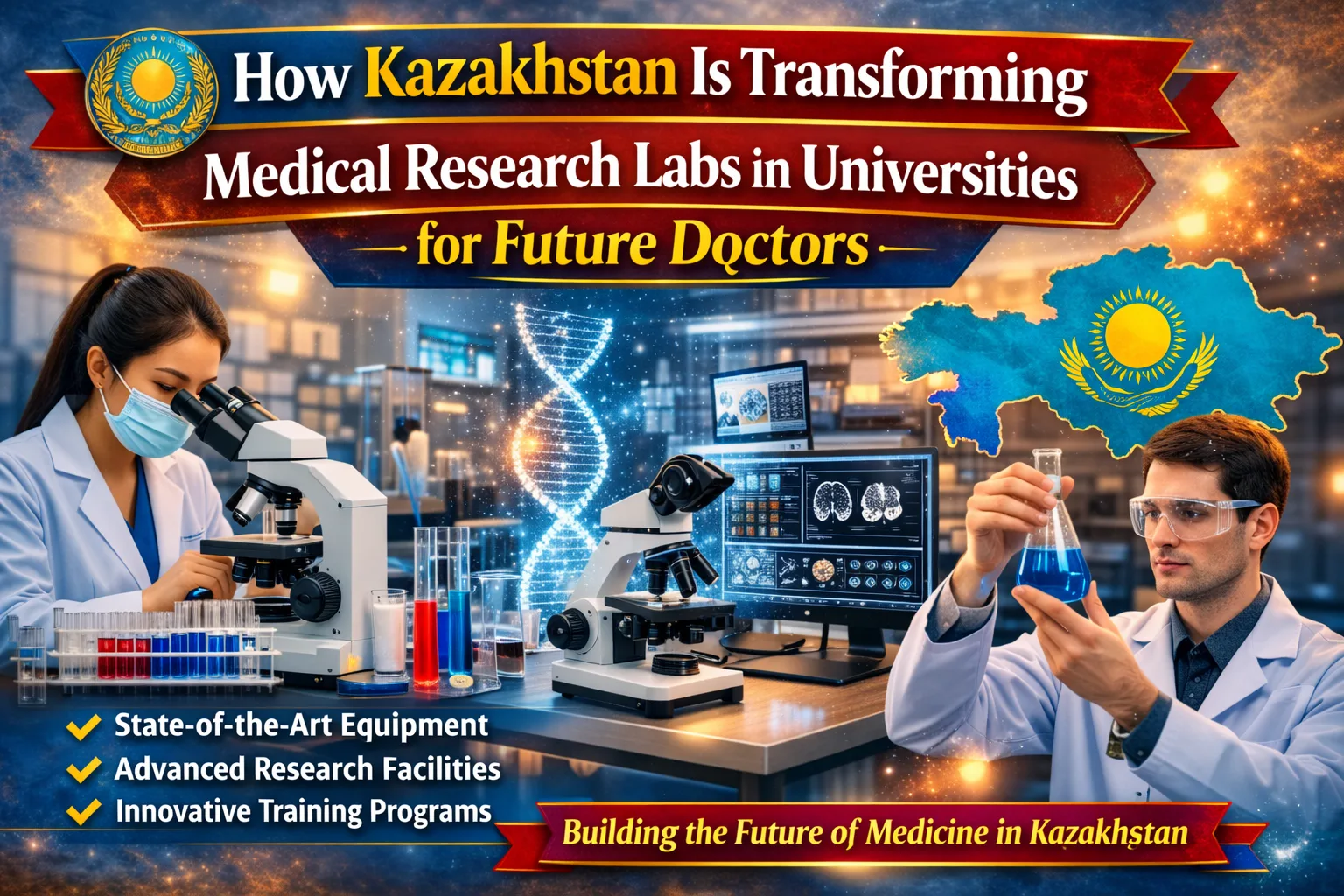
Medical education around the world is moving beyond learning in a classroom. Research, state of the art laboratory facilities and some advanced medical technologies are being heavily focused on as universities across the globe train the next generation of doctors. Investments in research infrastructure result in a more extensive pool of healthcare professionals trained to provide better datasets and solutions for global health challenges.
Kazakhstan has acknowledged this transformation and began reshaping the research environment among its medical schools. The government and academic institutions in the country have invested into state-of-the-art laboratories, research centers and scientific innovation programs over recent years. These changes are slowly enhancing the quality of medical education and opening doors for international students.
The modernization of research laboratories is a notable advantage for students that decide to necessarily MBBS in Kazakhstan. It enables medical students to develop in an environment where scientific research is expertly integrated with clinical training.
Research in Medical Education: A Growing Need
Scientific research underlies modern medicine. Research helps the healthcare system in many ways from finding new treatments to understanding complex diseases. Research training is being gradually integrated in the curriculum of medical universities around the world in order to train students to develop analytical thinking and scientific skills alongside clinical knowledge.
Kazakhstani medical universities are shifting in this direction by enhancing research infrastructure on their campuses. That's one reason universities now want students and faculty members not just to lecture or do clinical rotations, but also engage in research projects and scientific studies.
The evolution of medical research methods offers unique learning opportunities for international students pursuing MBBS in Kazakhstan, exposing them to the same standards as practiced in developed healthcare systems.
Investment in Modern Medical Laboratories
The investment of modern laboratory capacities is one of the most important changes in Kazakhstan’s medical education sector. The universities are adopting state-of-the-art equipment for research labs in areas like:
- Molecular biology
- Microbiology
- Pathology
- Medical genetics
These are where students carry out experimentation, explore the structures and mechanisms of diseases, and learn diagnostic techniques more efficiently. Informing teaching to modernise the curriculum and expose students to large-scale biomedical data.
Many of the universities are also create research centers that specialize in fields such as:
- Infectious diseases
- Biotechnology
- Pharmaceuticals
These centers allow researchers to tackle challenging medical issues while engaging students in scientific discovery.
This means that MBBS students in Kazakhstan get learning environments that are conducive to curiosity, innovation and free active research experience.
The Nuances in Application of Digital Solutions to Research
Digital technologies are playing an ever-greater role in medical research today. Rather than treat diseases individually, artificial intelligence, big data analytics and advanced diagnostic software are changing the way we study and combat disease.
Kazakhstani universities are starting to implement these technologies within their research laboratories. Modern medical training is increasingly facilitated by new digital pathology systems, simulation laboratories, and computer-based diagnostic models.
Simulation labs, for instance, enable medical students to practice clinical procedures in an academic setting prior to working with actual patients. These facilities help to build students’ confidence and develop critical clinical skills.
Medical students doing MBBS in Kazakhstan can benefit significantly from technology-driven learning tools like this.
Collaboration with International Research Institutions
Kazakhstan’s laboratory conversion also stresses international cooperation. Many of the medical universities were participating in joint research projects with many other European and Asian research institutions and universities.
Such collaborations allow Kazakhstan to use cutting-edge research approaches and link with international scientific networks. They often overlap in areas including:
- Public health
- Infectious diseases
- Cardiovascular research
- Biomedical innovation
These international collaborations provide excellent opportunities to researchers and faculty; they exchange knowledge, actively engage in conferences worldwide and publish their scientific findings in authentic global journals.
This global connection allows MBBS Kazakhstan faculty members to stay widely engaged in international research assignments and become instructors for international students pursuing their degrees.
Research Opportunities for Medical Students
This was not only faculty research — medical laboratories are also undergoing a transformation. In recent years, universities are strongly motivating their students to take part in the research during their medical education.
Students may participate in:
- Research groups
- Laboratory studies with professors
- Scientific projects
To foster research culture, many universities hold:
- Student research competitions
- Academic workshops
- Scientific conferences
Involvement in research develops the critical thinking skills of medical students, along with a more informed knowledge of medical science. It also trains them to work in specialized medical fields like biomedical research, clinical trials and medical innovation.
These students who enroll in MBBS in Kazakhstan often get these opportunities where they acquire good academic experiences with their medical education.
Internationally Recognized Medical Programs
[In Part II, we focus on Kazakhstan's medical education and how it is developing to be brought up to international standards as Kazakhstani researchers expand their studies.] The World Directory of Medical Schools (WDOMS) recognizes numerous medical universities in the country, attesting to their presence and acceptance in the global medical education arena.
It is also important for Indian students going abroad to ensure that those universities are recognised by the National Medical Commission (NMC). These directives are important guarantees that students obtain a properly structured medical education in accordance with global standards.
Research and science-based collaboration are also an emphasis of global health organizations like WHO to create better healthcare systems around the world.
Investing in research laboratories and academic innovation, Kazakhstan’s universities are boosting their global credibility and luring more foreign students.
Research: A Sine Qua Non of Quality Healthcare
Modern research laboratories are not only a service to students, but they also help improve national healthcare.
Research in university laboratories leads to:
- New approaches for treating diseases
- Better disease prevention strategies
- Development of new medical technologies
These findings can affect policies and practices in healthcare.
Kazakhstan’s research efforts are especially significant for investigating regional health issues including infectious diseases, environmental health problems and chronic conditions. The research that scientists perform right here in the Baltimore-D.C. area lead to solutions that are more tailored to the healthcare needs of our population.
Moreover, medical students doing MBBS in Kazakhstan had several insights into ongoing research projects which allow them to better comprehend the translation of scientific discoveries into practical applications within the healthcare sector.
Developing a Research Culture in Medical Universities
Transforming labs is just one aspect of Kazakhstan’s plan. Universities are also trying to develop a culture of research among students and faculty.
Rather academic institutions are promoting interdisciplinary research that integrates medicine with other disciplines like:
- Biotechnology
- Engineering
- Data science
This also enables scientists to fall back on new solutions for old medical problems.
Regular workshops, research training programs, and scientific conferences have also been conducted to exchange knowledge and collaborate with each other.
This provides an opportunity for international students studying MBBS in Kazakhstan to get involved in scientific research early on in their career.
Promising Medical Education and Future Opportunities in Kazakhstan
Kazakhstan’s investment in its medical research infrastructure is indicative of a long-term national strategy for becoming a regional center for healthcare education and scientific innovation. The country is reshaping its medical universities through the improvement of laboratories, enhanced research collaborations and advanced technology integration into medicine education.
Such recent events are leading Kazakhstan to become a more and more appealing place for students who want an affordable and globally relevant medical education.
With expansion and improvement of research laboratories, students will have more opportunities to be involved in leading edge scientific investigations and premiere clinical training.
Conclusion
Kazakhstan is making significant progress in modernization of the medical research laboratories and strengthening the scientific base of its medical universities. Nation is developing an ecosystem conducive to medical innovation, and this ecosystem entering the global stage is made possible through investment in advanced equipment, digital technologies and international research collaboration.
These are exciting times that pave the way for international students, including those looking into MBBS in Kazakhstan to experience cutting-edge learning environments where research accompanies and enhances medical training.
Kazakhstan's medical universities are gradually cementing their place in worldwide medicine via acknowledgment from global authorities like the World Directory of Medical Schools (WDOMS) harmonious with principles set by the National Medical Commission (NMC), reflecting standards embraced globally including those outlined by WHO, and even involvement through international healthcare programs backed through WHO.
With the introduction of more innovative technologies into Kazakhstan’s research labs, these future nation builders will have the opportunity to heal and innovate for modern medicine right from their home country.