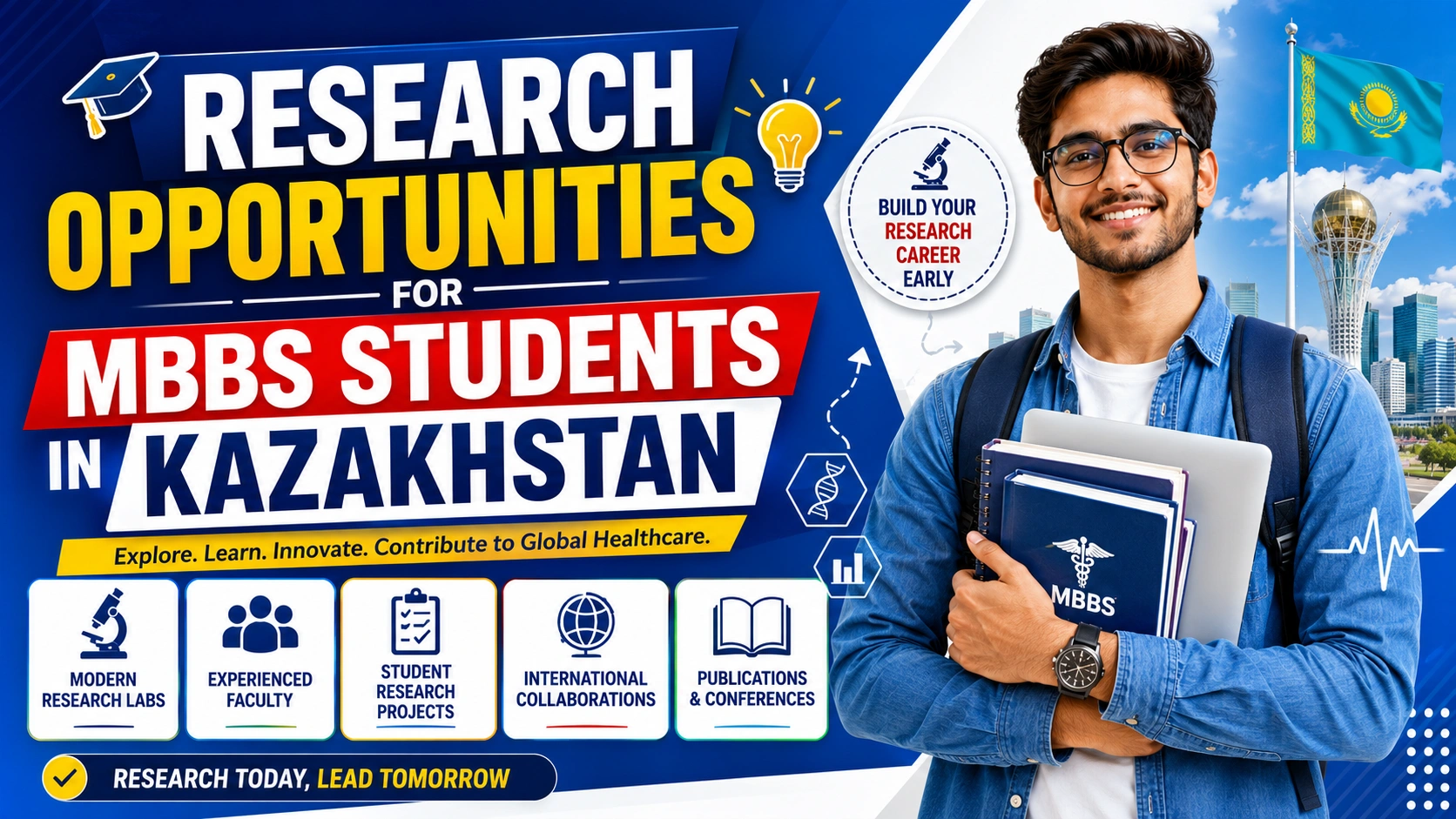
When considering MBBS in Kazakhstan, students typically look at several factors: tuition, hostels, and FMGE and NExT pass percentages. These are all factors that students should look at. However, one area that is overlooked, and should not be, is research. Medical school is not just about passing all of your classes and starting to practice. The students that are selected for residencies and have the best opportunities for post-graduate programs are the students that have research experience in medical school. Most of the time, these students do research during medical school, not after.
In this blog, we examine some of the research opportunities that are available to MBBS/MD students in Kazakhstan, and how to access them, and talk about how valuable these opportunities are to people's careers in medicine as compared to what most students think.
Why Research Experience is Important for an MBBS Student
Research experience is important for a number of reasons. Here are three upon which most students can agree:
- Strengthens applications for residency and post-graduate studies — Whether you are applying for post-graduate studies in India after NExT or for residency in another country, one of the best ways to differentiate yourself is research that you have published or conferences that you have presented at.
- Facilitates the development of critical thinking and clinical reasoning — The process of asking a research question and analyzing the answer is the same as the process of thinking through a clinical case.
- Allows the Pursuit of Different Postgraduate Career Options — Research allows students to build a foundation for many different options after completing their studies, such as public health and academic medicine, as well as different medical career paths, such as medical writing and research. All of these fields are well-paying and represent significant opportunities.
- Recognizing the benefits of early-stage research opportunities, more Kazakh universities offering MBBS in Kazakhstan for Indian students have begun incorporating research for students into the university program, rather than leaving it to the motivated minority.
Student Scientific Societies and Research Circles
Most of the larger Kazakh medical universities have student scientific societies (sometimes called research clubs or scientific circles) organized by departments — cardiology, public health, microbiology, surgery, etc. These include:
- Opportunities to attend regular meetings at which students present a case study or literature review.
- Small research studies which students undertake in partnership with faculty and offer guidance.
- Intra-college competitions around research and presentations.
- Strong student work is communicated to conferences or publications through these societies.
- Joining one of these societies by your 2nd or 3rd year (after the basics have been taught) should be the goal. Trying to develop a research profile in your 5th year will be difficult, as clinical rotations take up most of your time.
International Conferences and Exchange Programs
Kazakh universities have a strong tradition of being hosts for international medical conferences and student exchange programs. This is even more true among larger universities which have developed their own international partnerships and offers students opportunities to present research and meet faculty and peers from other countries as well as the opportunity to spend a semester abroad at the university's international partner through credit mobility.
This type of exposure is invaluable for students who Study MBBS in Kazakhstan. This experience combines international exposure at a far lower cost than the traditional international exchange programs.
University- Backed Research Infrastructure
This is a lot more than just student organizations. Kazakhstan's medical schools have been working to build their own research structures and have developed the following resources:
- Modern university campus research labs that house and encourage student participation and engagement in the research process.
- Public Health Institutes located at numerous universities offer research and programs that deal with many issues, such as workplace health and the study of epidemiology and infectious diseases — areas that often welcome active student participation.
- Specifically, universities that have received national recognition in the field of excellence in simulation education have research opportunities in both simulation and technology-based research.
- Kazakhstan's medical schools provide faculty support to medical students who want to publish and participate in research, creating a culture of collaborative writing at many of the participating medical schools.
- Kazakhstan's medical schools have a rich and expanding culture of research to include a variety of topics in psychology and public health. This culture of research extends beyond clinical medicine to health systems research and may provide a definitive focus for students interested in global health.
Faculty Mentorship: An Important Factor
Direct access to faculty mentors may very well be an underappreciated resource. Because of the structure of many Kazakh medical universities, class and faculty-staff ratios often provide one-on-one mentorship at levels that many larger, more crowded systems cannot achieve. Faculty members who supervise research are often open to having motivated undergraduates involved. However, this is often dependent on the students taking initiative. Most faculty members will not extend an invitation.
Practical Tip: to build your research profile, make sure that you introduce yourself to faculty, ask them about their research, and express interest to help them in areas that are active. To help you get involved in a study, consider the research team, the faculty member, and the unit.
Post Graduate Pathways that Focus on Research
Research is not restricted to the MBBS/MD level of training. In addition, the structured system of postgraduate training in Kazakhstan is made up of Masters programs, residency training, and PhD training of a variety of specialties. Many of these have a substantial amount of research integrated within the training. For those students who have discovered that research is their passion during their MBBS years, this is an easily accessible option that is not within a different country or healthcare system.
While you are planning your career, keep in mind that the Kazakhstan postgraduate system has more options than many of the other countries you have considered if you are interested in areas of academic medicine and research.
Extensive Career Opportunities With an MBBS/MD From Kazakhstan
There are many options available after earning an MBBS/MD from Kazakhstan that are not limited to the traditional scope of medical practice. Graduates with a strong emphasis on research during their studies are able to pursue many opportunities. These include:
- Biomedical and clinical research in Kazakhstan and abroad
- Public health positions with the WHO or UNICEF. This option is especially relevant to those who have engaged in public health research during their studies.
- Research and publishing in the medical and academic sectors
- Administration and policy in the health sector. This option is more likely with the additional attainment of a Master of Public Health (MPH) or Master of Business Administration (MBA) with a concentration in health care services.
- Medical education or academic practice when further postgraduate studies and specialization are completed
None of these options will require you to give up your clinical practice. It is common for physicians to pursue research and public health practice while engaged in clinical practice. However, the foundation for that flexibility is built during your MBBS years, not after.
Getting Involved in Research
If you would like to develop a meaningful research profile in your first or second year, follow these steps:
- Year 1 – 2: Become a member of the student scientific society at your university. Attend meetings to become acquainted with research society activities, even if you do not have a specific research interest yet.
- Year 2 – 3: Identify a faculty member whose research interests you, and ask to join them in that research. Assisting with a literature review or data collection are common ways to get started in research.
- Year 3 – 4: Present your first research at a conference. You may even present your research as a poster at a local or university-affiliated conference. This experience will help you to get started and to build your personal research profile.
- Years 4–5: Aim for a co-authored publication or other independent research endeavors that are more substantial. Ideally, these will relate to an area that will help you speak more comfortably in your postgraduate or residency interviews.
- Years 5–6: During your clinical rotation years, relate research interests to case studies or clinical research. This pairs well with the contact you will have with hospitals.
This plan should be flexible, yet early activity is the most important factor separating students with a research portfolio with multiple entries from students with a single, hurried poster from the final year.
Research Shouldn't Compete With Study Fundamentals
One important note: research should have a place alongside core educational activities. Preparation for the FMGE/NExT, clinical competencies, and core medical studies are activities that you cannot compromise on. The most successful students are the ones who treat research in a structured, time-boxed manner. This is done through a few hours a week, and research is added to studies, rather than a time-consuming, all-consuming endeavor.
Confirm the University Before Committing to Research
Research activities are a benefit. Still, it is a small consolation if the university itself is of low standing. Before considering any university based on research activity, make sure that:
- It is listed in the World Directory of Medical Schools (WDOMS), the worldwide reference list of legitimate medical schools.
- It meets the World Health Organization (WHO) standards for research and education.
- It is currently compliant with India's National Medical Commission (NMC), as this will determine your eligibility for FMGE/NExT and returning to India.
- Your admission to any MBBS route relies on a valid NEET qualification, as stipulated for MBBS admissions by the National Testing Agency.
A university that has invested heavily in research but is poorly ranked in the regulatory apparatus is still a bad choice — always verify both.
Conclusion
Research opportunities for MBBS students in Kazakhstan are better than most candidates expect, with a student research society, faculty supervision, international conferences, dedicated research labs, and postgraduate pathways with real research. For students who are willing and dedicated, this is an important factor when differentiating their residency and postgraduate degree applications and also for a flexible and varied career.
If you are assessing MBBS universities in Kazakhstan, and want to find out which universities have the best research ecosystems alongside NMC and WDOMS and their recognition, it is a good idea to speak with a consultant who can give you the most up to date and trustworthy routes that are focused on your specific preferences.