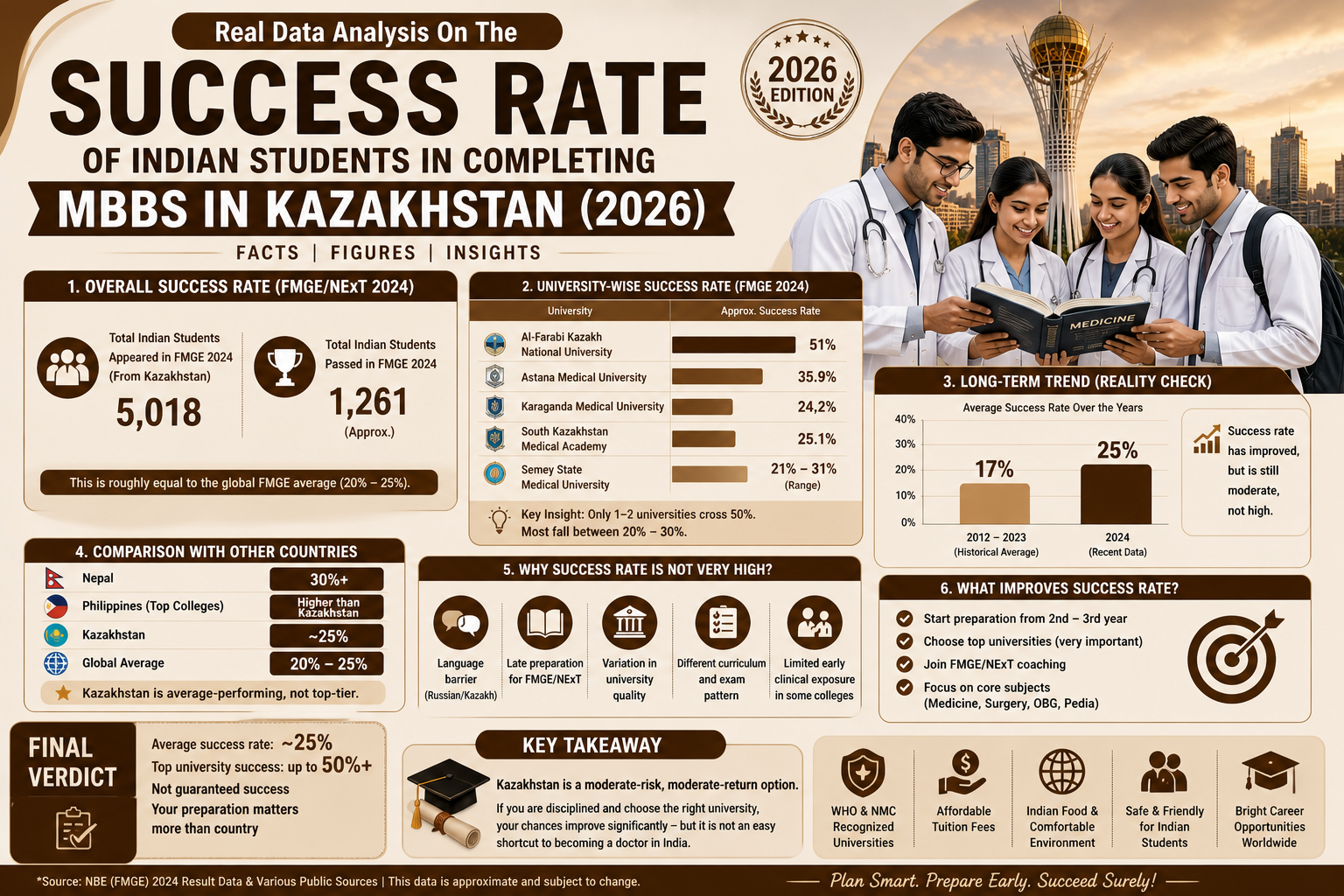
Overall, on assessing the MBBS in Kazakhstan, the “success rate” for Indian students is more or less gauged based upon their performance in screening/licensing exams required to serve as a practitioner box. The FMGE is the most relevant of these benchmarks, and the most closely regulated by NMC, which is gradually moving over to be subsumed into the NExT system in MBBS in Kazakhstan.
Overall FMGE Success Rate
According to the latest data, Indian students passing FMGE from Kazakh universities have between a 20% and a 25% average pass rate. The pass percentage recently in some of the sessions has been 25% —higher than the global FMGE overall average of 20–23%.
It means that about one in four students passes the screening exam the first time around.
Long-Term Performance Trend
The performance trend has been steadily improving over the last ten years:
- Historical pass rates: 10%–ish: ~18%
- Latest range: 20%-25%
This change indicates a greater awareness and access to coaching resources, along with changes in academic structures at some colleges.
University-Wise Variation
However, the success rate is not consistent across all institutions. Depending on the chosen university, it greatly varies:
- Kazakh National Medical University and other renowned institutions frequently exhibit slightly superior performances,
- Astana Medical University reasonably good
- The normal range for Karaganda Nation/university Medical University and Near-Caspian State Medical Academy
Top institutions may be in the region of 35% or more and average universities are in the 20–30%.
Key Factors Affecting Success Rate
The outcomes are affected by a few academic and practical aspects:
Curriculum Differences
Indian exam pattern : Significant differences in the Kazakhstan MBBS curriculum from Indian exam pattern; Significance of clinical integration during all aspects of training; MCQ based assessment
Clinical Exposure
Universities may vary in how well they provide hospital training so practical knowledge may be different.
Language Barrier
Clinical interactions are mostly limited to Russian/Kazakh and early patient interaction may be restricted.
Preparation Strategy
Most of the students start preparing late and it reflects in their performance during exams.
Comparison with Other Destinations
- Kazakhstan: approximately 20–25%
- Global average: approximately 20–23%
- Nepal: typically over 30%
Success rate: Kazakhstan is a relatively moderate destination when it comes to success.
Interpreting the Success Rate
This does not necessarily signify poor quality of education especially when the pass rate is between 20–25%. Rather, it indicates how tough screening tests such as FMGE are — which have to be relatively hard because the test aims at retaining very high standards for those practicing medicine in India.
Ultimately, success depends not so much on where a student studies as how prepared that student is.
How to Improve Success Chances
The most successful students tend to do this:
- Start FMGE/NExT Preparation in 2nd/3rd year
- The high-weighted subjects are important to focus including Medicine, Surgery, Pharmacology and Obstetrics
- Practice MCQs consistently
- Use arranged based teaching or test series
- Pick a university with an established academic history
Final Assessment
MBBS in Kazakhstan Day MBBS Success Rate for Indian Student — Moderate increasing. The average result might not be particularly high, but in comparison with most other study-abroad destinations, it holds the ground.
It depends on which university, what clinical exposure, and when you start preparing for the exams. Those who study wisely can greatly enhance their odds of passing licensure exams and constructing a successful clinical career.