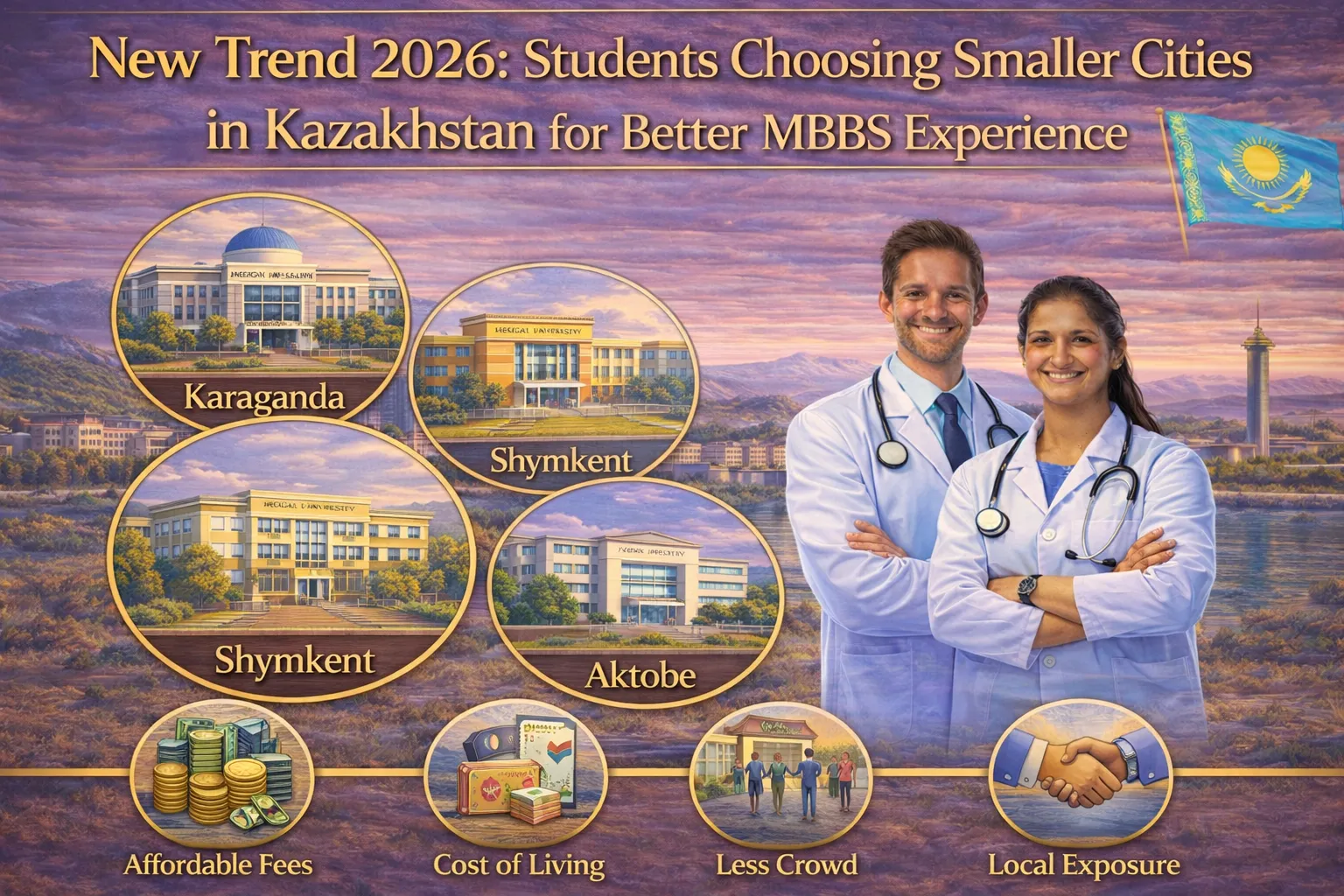
Until 2026, a very interesting thing is happening in MBBS in Kazakhstan:
👉 Students are also not necessarily concentrating on large cities such as Almaty or Astana
👉 They now want to venture out to smaller cities
This is not random — this is a strategic decision based on real experience, cost and learning outcomes.
So what’s driving this trend?
And is picking a smaller city really better?
Let’s dissect it with some practical insights.
What Do We Mean by “Smaller Cities” in Kazakhstan?
As far as MBBS in Kazakhstan is concerned, cities with low population are:
- Semey
- Shymkent
- Kostanay
- Pavlodar
These are not disadvantaged areas—they have:
- Recognized medical universities
- Hospital infrastructure
- Lower population density
👉 They are less crowded than major cities, however.
Why Students Used to Favor Major Urban Areas
Earlier, most students chose:
- Almaty
- Astana
Because of:
- Better lifestyle
- Bigger Indian community
- More exposure and facilities
However, the priorities are shifting in 2026.
Reason #1 — Lower Cost of Living (Main Reason)
Cost is one of the largest reasons driving this change.
In smaller cities:
- Hostel and rent are cheaper
- Food expenses are lower
- Daily life is more affordable
The cost of living is lower in smaller cities, making the already low MBBS in Kazakhstan even more affordable.
👉 This is important for middle-class families.
Reason #2: Less Distraction == Better Focus
Big cities come with:
- More distractions
- Social lifestyle
- Higher spending habits
In smaller cities:
- Life is simple
- Fewer distractions
- More study-focused environment
👉 This is being preferred by many students now because they seriously want to clear FMGE/NExT under NMC.
Reason 3: Better Student-Teacher Interaction
In smaller universities or cities:
- Class sizes are often smaller
- Faculty attention is higher
- Personalized guidance is better
This leads to:
👉 Stronger academic understanding
👉 Better exam preparation
Reason #4: More Real World Exposure (In Certain Cases)
This might sound surprising — but in some smaller cities:
- Hospitals have fewer students
- Less crowd during clinical rotations
So students get:
When you get the chance to meet with patients more
Better hands-on experience
But this varies by the university quality.
The Fifth Reason: Decreased Competition Between Students
In big cities:
- More international students
- High competition
In smaller cities:
- Less competition
- More learning opportunities
👉 Students have the opportunity to be involved rather than simply spectators.
Reason 6: You Can Get Seats in 2026
Due to rising demand:
Very few big city universities fill.
University places still availableOutside of the bigger city universities, there is availability
👉 Students are now beginning to look at cities of fewer than 250,000 people as an astute first decision, not a last resort.
One of the reasons is that they are yet focused on their ROI (Return On Investment)
Parents in 2026 are less idealistic.
They now think:
👉 “Same degree, same recognition… so why pay more?”
Since universities are:
- NMC-(Environment Approved)>
- By WHO (World Health Organization)
- Registered on WDOMS (World Directory of Medical Schools)
(👉 Oops, the degree value is still unchanged.
So students prefer:
- Lower cost
- Better focus
- Same outcome
Reality Check: Are Smaller Cities Always Better?
Indeed, let’s be honest — this trend is real, but it has its upsides and downsides.
Advantages of Smaller Cities
- Lower living cost
- Peaceful environment
- Better focus on studies
- Less competition
- Potentially better patient interaction
Challenges Students May Face
Limited Indian Community
In smaller cities:
- Fewer Indian students
- Less cultural familiarity
Some students may feel isolated.
Language Barrier is Stronger
In big cities:
- English usage is more common
In smaller cities:
- More reliance on Russian/Kazakh
👉 Students must adapt quickly.
Lifestyle is Simple
If a student expects:
- Nightlife
- Luxury lifestyle
👉 They may not adapt to small towns.
Limited Exposure Outside Campus
Big cities offer:
- More hospitals
- More networking
Larger cities are likely to have more.{"Smallular":1}
Key Factor: University Dominates Over City
That is the key, crucial insight.
👉 Don’t pick a city, pick a good university
Because:
- Hospital tie ups matter for clinical exposure
- Quality of teaching determines FMGE/NExT results
- Career depends on preparation—not location
NEET, NMC, WHO & WDOMS — Their Part
This new trend notwithstanding, core requirements are unchanged:
- NEET
Mandatory for Indian students
- NMC
Ensures degree validity in India
- WHO & WDOMS
Provide global recognition
👉 These must be verified: big city, small city—regardless of size.
Who Should Choose Smaller Cities?
What kind of student is good for smaller cities?
✔ Want low-cost education
✔ Are serious and disciplined
✔ Like to study in a less distracting environment
✔ Used to adjust the simple lifestyle
Who Should Avoid Smaller Cities?
Avoid if you:
❌ Need strong Indian community
❌ Prefer metro lifestyle
❌ Struggle with isolation
❌ Want exposure beyond academics
The Bottom Line: Is This Trend Worth the Hype?
👉 Yes, it is a clear trend in 2026 and a smart and pragmatic one
Students have become more informed and strategic.
Rather than pursuing big cities, they are opting for:
- Better ROI
- Better focus
- Better academic environment
Conclusion
Small cities development in MBBS in Kazakhstan is the tip of an iceberg showing transition in students perception.
👉 From “location-based decision”
👉 To “career-focused decision”
Here’s an overview of the recognition for Indian medical degrees abroad (under MCI regulation) with NMC, WHO and WDOMS recognition & admission via NEET – final verdict however lies on:
- Your discipline
- Your university
- Your preparation
Not just the city you choose.
So if it’s a big city or a little widdle—
👉 Effort and strategy will always make the difference.