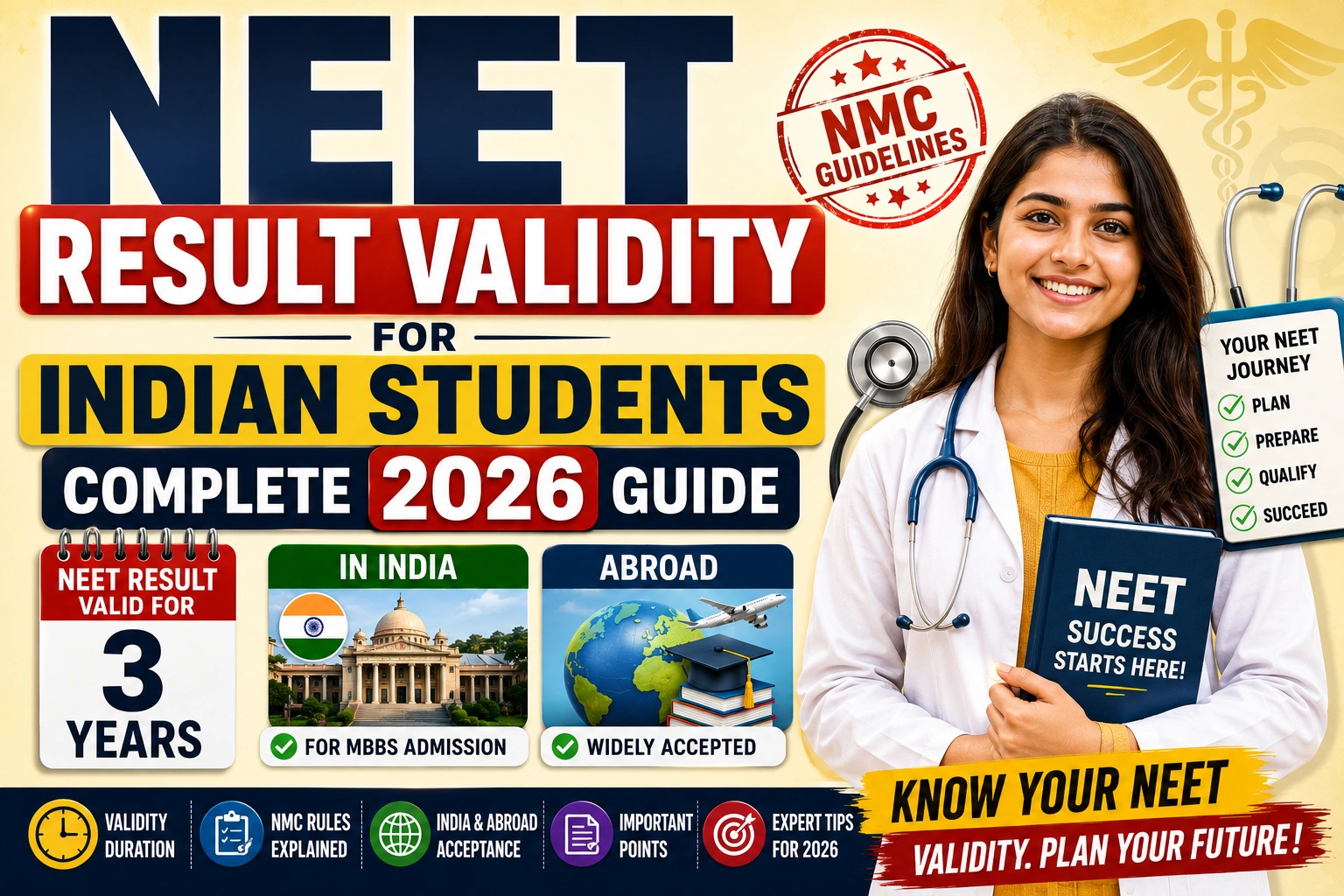
Every year, millions of students appear for the National Eligibility cum Entrance Test (NEET) with the goal of pursuing a career in medicine. Once the results are announced, many students and parents begin searching for answers to an important question: How long is a NEET result valid? Understanding the validity of a NEET score is essential because it directly affects admission opportunities in India and abroad.
Whether you are planning to join a government medical college, a private university, or pursue medical education overseas, knowing the validity period of your NEET qualification can help you make informed decisions and avoid unnecessary confusion during the admission process.
This comprehensive 2026 guide explains everything Indian students need to know about NEET result validity, eligibility requirements, and how NEET impacts MBBS admissions in India and foreign countries.
Understanding the Core Purpose of NEET
First, we formalize NEET’s core definition: it is India’s national unified medical entrance eligibility exam, a mandatory prerequisite for all medical program admission applications. Whether applying to domestic or overseas medical schools, all candidates must pass this exam first.
NEET Validity Rules for Different Admission Scenarios
We then break down the differentiated validity rules for 2026 NEET scores across two completely distinct application scenarios.
NEET Validity for Indian Medical Colleges
The first scenario is applications to domestic Indian institutions.
The 2026 NEET score is only valid for the corresponding 2026-27 academic year admission cycle, and its scope of application includes:
- Public medical schools
- Private medical colleges
- Medical institutions granted university status
- Dental colleges
- All AYUSH medical colleges
All candidates must participate in the official counseling and admission process in that same year.
If a candidate fails to secure an admission offer within that cycle, they must retake the NEET exam for any future applications and cannot reuse their 2026 NEET score.
NEET Eligibility for MBBS Abroad
The second scenario is applications to study medicine abroad.
A passing NEET score is only a basic prerequisite for such applications. Currently, the most popular study-abroad destinations for Indian candidates include Russia, Georgia, Uzbekistan, Kyrgyzstan, and Kazakhstan.
Because the application timelines of overseas institutions differ significantly from India’s domestic admission schedule, candidates planning to apply to overseas schools must verify the latest NEET eligibility requirements with their target institutions in advance, to avoid delaying their admission applications due to rule misunderstandings or timeline mismatches.
Growing Demand for Medical Education Abroad
For Indian students planning to pursue a medical degree overseas, the long-standing supply shortage of domestic medical degrees has given rise to a continuously growing boom in studying medicine abroad.
The five core advantages commonly offered by overseas medical schools have further boosted the appeal of this choice, keeping its popularity persistently high.
The mbbs in kazakhstan program, which has seen unwavering high demand, is a typical testament to this strong demand for overseas medical education.
NEET Passing Eligibility vs NEET Score
To address the core questions that matter most to the student group, we first clarify the fundamental difference between the passing eligibility for the NEET exam and NEET scores, correcting the widespread misconception among many students that overseas medical schools require high NEET scores.
In contrast to the strict score thresholds of Indian domestic institutions, overseas universities only use NEET passing eligibility as their core evaluation standard.
This eligibility is not only a basic prerequisite for submitting an application, but also a universal mandatory requirement for all students who study medicine abroad to practice in India after returning.
All applicants must review the latest official regulatory provisions before submitting their applications.
Essential Documents to Preserve After NEET Results
After NEET scores are released, you need to prepare and retain 8 types of mandatory application documents in advance.
These documents should be carefully preserved throughout the admission process to avoid delays in application processing.
University Accreditation Verification Requirements
Meanwhile, you must prioritize verifying the legal accreditation of your target overseas medical school, which can be cross-checked through four authoritative channels:
This verification helps ensure that the selected institution complies with recognized international medical education standards.
Career Planning Opportunities After NEET
After passing the NEET exam, you will have six clear career planning paths to choose from.
During the school selection stage, in addition to tuition costs, you also need to assess two additional core dimensions to ensure that your school selection plan fully aligns with your long-term development needs.
MBBS in Kazakhstan Admission Planning for 2026
For Indian medical students planning to apply for the 2026 MBBS program in Kazakhstan, we have compiled the core key points for the full application process, splitting information modules into sub-themed subheadings to reduce applicants’ information access costs.
Students considering mbbs in kazakhstan for indian students should carefully evaluate every aspect of university selection before submitting applications.
School Selection Evaluation Criteria
First, the basic dimensions for school selection evaluation, which cover:
- The core value of institutions’ physical infrastructure
- The full scope of exclusive support services for international students
- The matching requirements of the degree for both local and cross-border career pathways
Four Common Application Mistakes to Avoid
Second, four common application pitfalls to avoid:
- Missing official updates for the NEET exam and application timelines
- Starting application planning too late
- Disregarding institutions’ valid official accreditation
- Relying on rankings as the sole standard for school selection
Why Kazakhstan Remains a Preferred Destination
Third, seven core driving factors that have made Kazakhstan a popular study-abroad destination for Indian medical students:
- Affordable medical programs
- Internationally accredited institutions
- High-quality educational infrastructure
- Safe study environment
- Modern teaching methods aligned with international standards
- A fast-growing community of Indian international students
- Additional student-focused academic opportunities
Students planning for mbbs in kazakhstan 2026 often consider these factors when comparing international medical universities.
Application Compliance and Success Factors
Finally, we sort out application compliance requirements and success factors.
Applicants must remember the validity period of their NEET scores, confirm that their own application eligibility is fully compliant, and improve their application success rate through three core actions:
Develop a Detailed Timeline
Create a structured schedule covering examination results, university applications, documentation, and enrollment milestones.
Prepare Complete Application Documents
Ensure all academic, personal, and regulatory documents are complete, accurate, and submitted within the required timelines.
Conduct Thorough University Research
Evaluate recognition status, facilities, academic quality, internship opportunities, and future licensing eligibility before finalizing your decision.
Students who plan to study mbbs in kazakhstan should combine proper NEET planning with comprehensive university research to maximize their chances of successful admission and future medical career development.