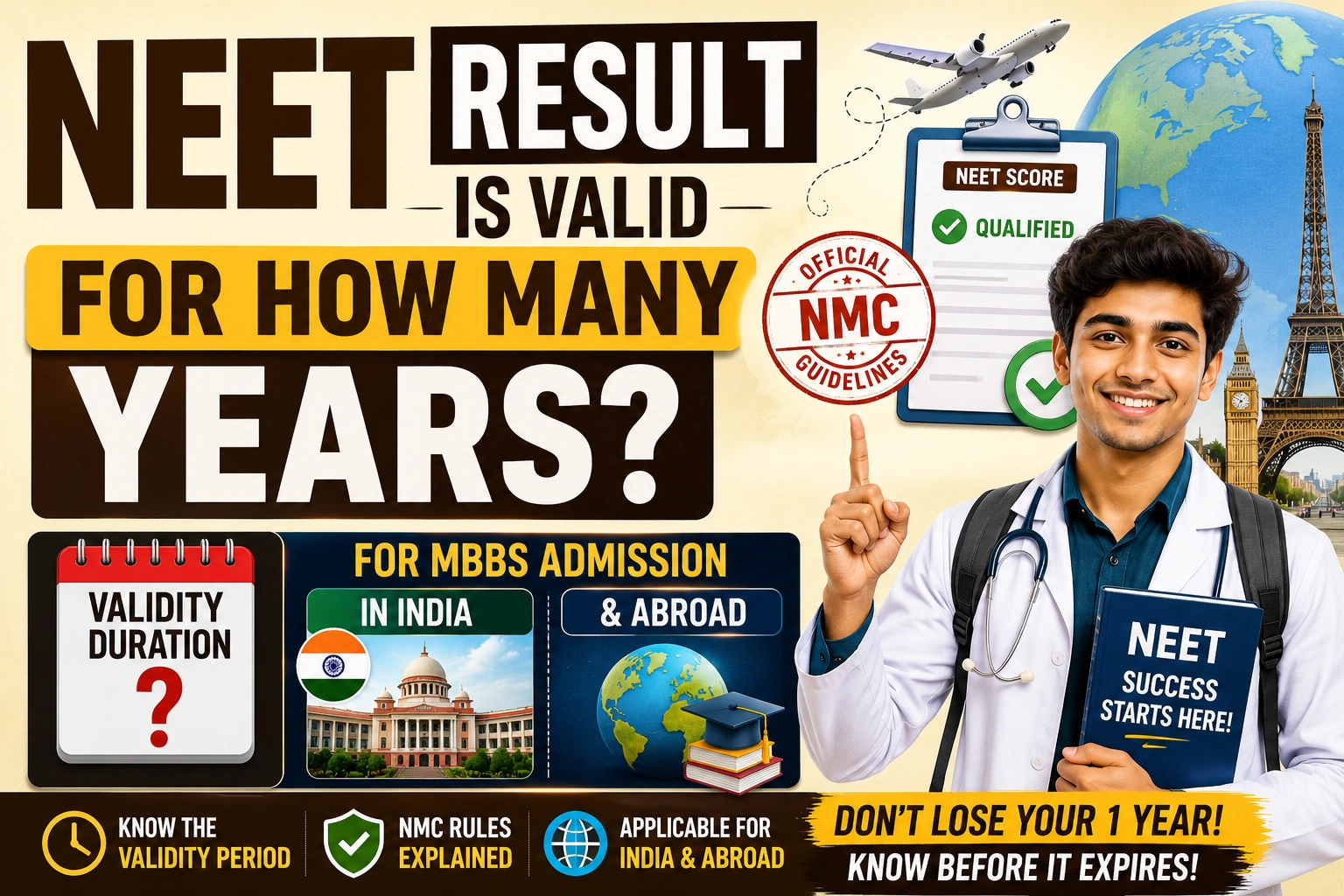
Every year, hundreds of thousands of Indian test-takers sit for the National Eligibility cum Entrance Test (NEET), the unified qualifying exam for admission to undergraduate medical (MBBS) programs at institutions both within and outside India. Right after exam results are released, the most common high-priority question on every candidate’s mind is: What exactly is the validity period of a NEET score? Can it be used across years, or do test-takers have to retake the exam?
This question is especially critical for students who plan to take a gap year before enrollment, or who intend to study medicine overseas. The validity of a NEET score differs clearly depending on whether a candidate applies to domestic or foreign institutions, and clarifying these rules in advance can help applicants avoid application chaos and plan their medical study path rationally.
Understanding the Importance of NEET Score Validity
A NEET score is an official certificate proving a candidate meets the minimum entry qualifications for medical education. Enrollment in the medical field is strictly regulated, so failing to understand the score validity rules can easily lead to missed admission opportunities.
Many applicants delay their enrollment for reasons including:
- Financial preparation
- Institution selection
- Visa processing
- Personal circumstances
Clarifying score validity is the core prerequisite for making all informed decisions related to enrollment.
NEET Validity for MBBS Admission in India
For candidates applying to MBBS programs at Indian domestic institutions, NEET scores are only valid for the academic year of the year in which the exam is held.
For example, scores from the 2026 NEET can only be used to apply for admission to the 2026-27 academic year. Once that year’s admission cycle ends, scores cannot be carried over to the centralized counseling rounds of subsequent years.
Students who fail to secure an admission offer in the same year must retake the exam to apply in the future.
Institutions Covered Under This Rule
This rule applies to all medical-related admission scenarios across India:
- Government medical colleges
- Private medical colleges
- Deemed universities
- Dental colleges
- Institutions offering AYUSH traditional medicine courses
All applicants to domestic institutions must complete their counseling in the same year they take the exam.
NEET Validity for MBBS Abroad
For candidates applying to overseas MBBS programs, the rules are completely different from those for domestic programs.
NEET qualifying status has a longer validity period, which is enough to allow candidates to complete school selection, document preparation, and financial planning at a manageable pace, without rushing to meet tight deadlines.
Many candidates use this qualification to explore opportunities to study medicine abroad, and this policy is particularly friendly for students applying to regions that use year-round rolling admissions instead of a single centralized counseling system.
Why More Students Are Choosing MBBS Abroad
Every year, a large number of NEET-qualified candidates choose to pursue an MBBS degree overseas, due to the limited number of seats and intense competition at India’s government medical colleges.
Every year, thousands of Indian students intending to pursue a bachelor’s degree in medicine overseas start sorting out the application rules for international medical education at an early stage and prepare to avoid common application pitfalls.
Popular Countries for Indian Students
Currently, Kazakhstan, Uzbekistan, Kyrgyzstan, Georgia, and Russia are all popular destinations for Indian student applicants.
Among these, mbbs in kazakhstan programs are especially favored, as they not only have a simple application process, but also fully meet the unified standards of international medical education.
Is NEET Mandatory for MBBS Abroad?
A core question that most students raise first is: is it mandatory to take the National Eligibility cum Entrance Test (NEET) to study MBBS abroad?
We state this clearly: if you plan to return to India to practice medicine after completing your medical degree, you must pass the NEET exam; otherwise, you will face mandatory, insurmountable barriers to your subsequent professional practice registration.
A Common Misconception About NEET Scores
We also need to clarify a widespread misconception: many students mistakenly believe that a high NEET score is required to apply to overseas universities.
In fact, high NEET scores are only used to compete for spots at top public medical colleges within India. All partner overseas universities only require applicants to meet NEET’s minimum passing score.
Four Major Advantages of Studying Medicine Abroad
Studying medicine abroad also has four core advantages:
Flexible Admissions
Application timelines are flexible, with multiple rounds of admission opportunities, unlike India’s college application system that only operates on a fixed annual application cycle.
Multiple Country Options
Students can select schools across multiple countries, giving them a wide range of options.
Lower Competition
Admission competition is far less intense than that in India.
Campus Visits Before Admission
Students can visit the facilities of their target schools in person to understand their actual operating conditions.
Documents Required After Qualifying NEET
After you meet NEET’s passing threshold, you must also prepare all required application documents in advance, including:
- Your NEET score report
- NEET admit card
- 10th-grade graduation certificate
- 12th-grade transcript
- Passport
- Passport-sized photos
- National identity card
Importance of University Accreditation Verification
Finally, a critical reminder: before submitting your application, you must verify the official accreditation of your target overseas university to avoid falling into the trap of enrolling in an unaccredited education provider.
MBBS in Kazakhstan Admission Guide for 2026
For Indian medical students planning to pursue an MBBS degree in Kazakhstan in 2026, the first required step is to complete qualification verification of their target institution, which is the core prerequisite for their application.
Students considering mbbs in kazakhstan for indian students should complete this verification process before proceeding with admissions.
Authoritative Verification Sources
This verification can be carried out through the four authoritative bodies outlined in this paper:
This helps ensure the target institution meets international medical education standards.
Seven Factors to Evaluate Before Selecting a University
When selecting a school, students must conduct a comprehensive assessment based on seven core dimensions:
- The institution’s accreditation status
- Clinical practice resources
- Teaching quality
- Internship opportunities
- Research facilities
- Eligibility for medical practice credentials
- Alignment with one’s long-term personal career goals
Four Common Mistakes Indian Students Must Avoid
Students must also avoid four common application mistakes made by many Indian students:
- Mistakenly believing NEET scores are permanently valid
- Trusting misinformation spread on unofficial social media platforms
- Using tuition fees as the only criterion for choosing a school
- Delaying application planning
Why Kazakhstan Remains a Preferred Destination
Kazakhstan has become a popular study-abroad destination for Indian medical students, and its core appeal comes from six key advantages:
- Affordable tuition fees
- Modern facilities at its medical schools
- Internationally recognized degrees
- A safe environment for students
- High-quality clinical training
- A well-established community of Indian international students
Students planning for mbbs in kazakhstan 2026 continue to benefit from these advantages while exploring internationally recognized medical education opportunities.
Final Advice for NEET-Qualified Students
Finally, students must clarify the rules governing the use of NEET scores, make long-term plans that fit the timeline requirements for 2026 applications, and build a complete career path to practice medicine both in India and overseas, based on their NEET results.
Students who intend to study mbbs in kazakhstan should begin planning early, verify university recognition status, and ensure compliance with all admission and licensing requirements before making a final enrollment decision.