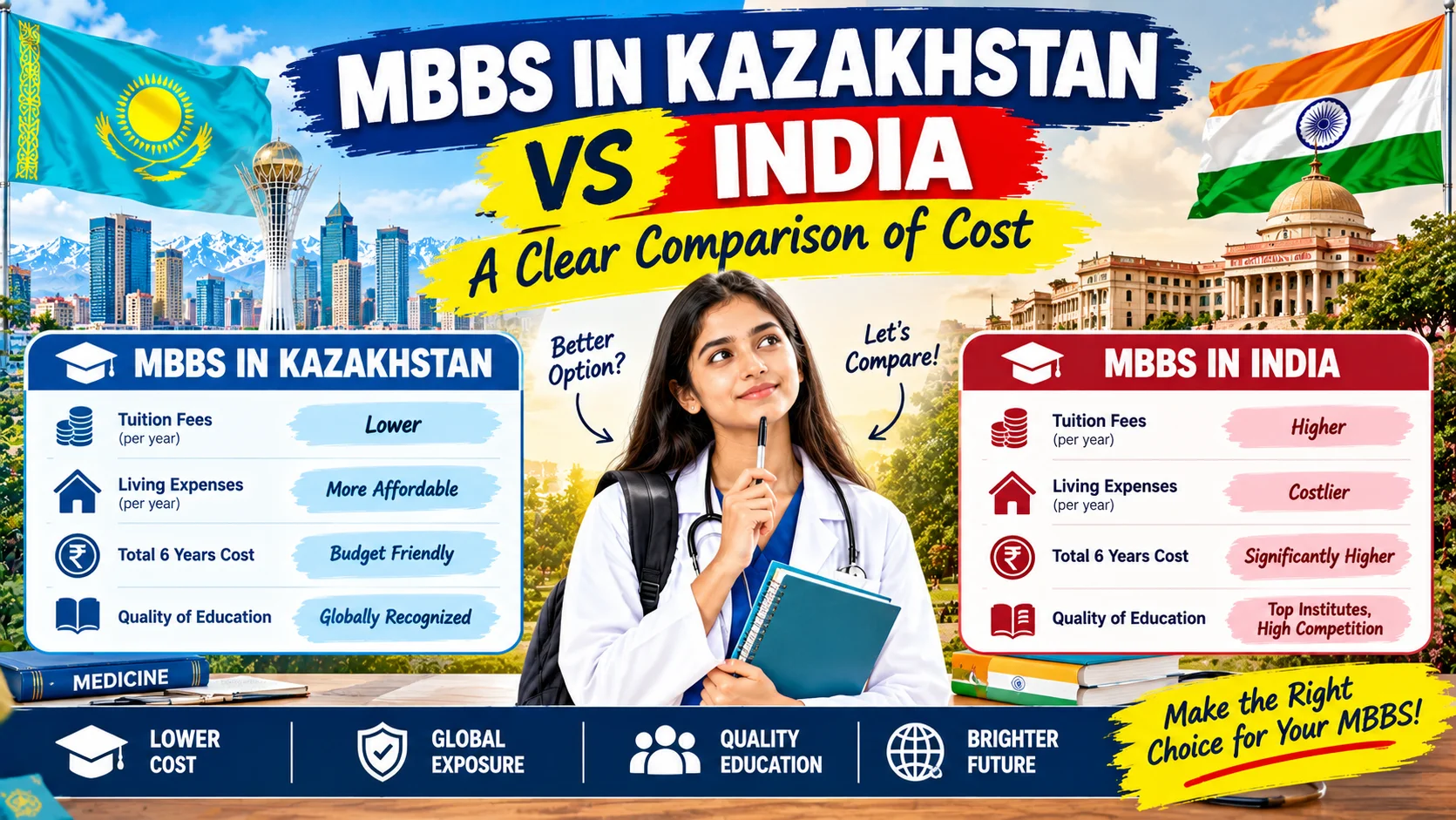
Two students can study the same medical subjects and graduate with completely different financial stories. One secures a government MBBS seat in India and pays a relatively modest annual fee. Another enters a private or deemed university and faces a bill that may cross ₹1 crore. A third chooses MBBS in Kazakhstan and spends somewhere between those two extremes. That’s why asking, “Is Kazakhstan cheaper than India?” doesn’t produce one clean answer. Cheaper than an Indian government college? Usually not. Cheaper than many private and deemed universities? Often, yes. Quite a lot, sometimes. The sensible comparison must include tuition, hostel, food, travel, currency changes, coaching, licensing requirements, and the value of clinical exposure. The brochure fee is only the beginning.
Quick Cost Comparison: Kazakhstan and India
Let’s begin with the numbers. The figures below are broad planning ranges, not fixed quotations. Medical-college fees in India differ by state, institution type, quota, and annual policy. Kazakhstan fees vary by university, city, currency, and accommodation.
|
Cost Factor |
Kazakhstan |
Indian Government College |
Indian Private/Deemed College |
|
Annual tuition |
₹3–6 lakh approximately |
₹10,000–₹2.5 lakh approximately |
₹8–30 lakh or more |
|
Hostel per year |
₹50,000–₹1.3 lakh |
₹10,000–₹1 lakh |
₹75,000–₹3 lakh |
|
Monthly living cost |
₹13,000–₹27,000 |
₹8,000–₹20,000 |
₹10,000–₹25,000 |
|
Typical course duration |
Around 6 years, depending on programme structure |
5.5 years, including internship |
5.5 years, including internship |
|
Broad total expense |
₹25–40 lakh or higher |
₹3–15 lakh, though some colleges cost more |
₹60 lakh–₹1.5 crore or higher |
|
International travel |
Required |
Not required |
Not required |
|
Indian licensing route |
Applicable foreign-graduate requirements |
Indian registration pathway after MBBS |
Indian registration pathway after MBBS |
Government seats remain the strongest financial option for most Indian families. No argument there. The real cost comparison becomes relevant when a student does not obtain a government seat and starts considering private colleges, deemed universities, or study abroad.
Tuition Fees in Kazakhstan
Annual tuition for MBBS in Kazakhstan commonly falls in the range of roughly USD 3,500–6,500 at many universities, though particular programmes may charge more. Converted into Indian currency, that may be approximately ₹3–6 lakh per year, depending on the exchange rate. Over six years, tuition alone may come to around ₹18–35 lakh. Some advertisements show totals below this range, but parents should check whether hostel fees, insurance, registration, documentation, and internship-related costs have been excluded.
A lower quotation can look attractive. Very attractive. Yet the written fee structure should answer several questions:
- Is the tuition fixed for all six years?
- Is it charged in US dollars or Kazakh tenge?
- Does the first-year amount include admission charges?
- Is hostel accommodation compulsory?
- Are clinical or laboratory fees separate?
- Does the quoted duration include internship?
- Can the university revise fees during the programme?
Get the answer directly from the university. A screenshot sent by an intermediary isn’t enough.
Government MBBS Fees in India
Here is the difficult part: winning the seat. Government medical colleges in India generally charge much less than foreign universities and private institutions, but admission depends on NEET rank, category, domicile rules, counselling, and seat availability. Annual tuition may range from a few thousand rupees at heavily subsidised institutions to around ₹1–2.5 lakh at some government or government-linked colleges. Hostel and mess charges are usually additional but remain comparatively manageable. A student completing MBBS at a low-fee government college might spend approximately ₹3–10 lakh across the course, excluding personal expenses and coaching. In some states or particular institutions, the amount can be higher. Service bonds, rural postings, penalties for leaving a seat, and other conditions may also apply. Financially, government MBBS wins. The problem is access. More than two million candidates may compete in a NEET cycle, while government seats represent only a fraction of the demand. A qualifying score doesn’t guarantee a government college; counselling rank does the real work.
Private and Deemed-University Costs in India
Private MBBS fees are where the comparison changes sharply. Depending on the state and quota, tuition can range from approximately ₹8 lakh to ₹25 lakh per year. Deemed universities and certain private institutions may charge ₹15–30 lakh annually, sometimes more after adding university, hostel, and miscellaneous charges.
The total course cost may reach:
- ₹60–80 lakh at the lower end of many private options
- ₹80 lakh–₹1.2 crore at numerous high-fee institutions
- ₹1.2–₹1.5 crore or more in expensive deemed-university programmes
Management or institutional quota fees can differ significantly from regulated state-quota fees within the same college. Hostel charges may be compulsory. Security deposits, examination fees, laboratory charges, and mess costs also add up. This is the financial space where MBBS in Kazakhstan attracts attention. A complete foreign programme may cost less than two years of tuition at an expensive Indian private college.
Hostel and Living Expenses
A tuition comparison without living costs is incomplete. In Kazakhstan, hostel fees may be around USD 600–1,500 per year, depending on the institution, room type, and city. Shared rooms cost less. Private accommodation costs more and may require an additional deposit. Monthly food and personal expenses can range from about USD 150 to USD 300. Students who cook and use university transport may stay near the lower end. Frequent restaurant meals, taxis, imported food, and weekend travel change the calculation quickly. In India, a student living with family may save a substantial amount. Someone studying in another state could spend ₹8,000–₹25,000 monthly on hostel, food, transport, and personal needs, depending on the city. Almaty and Astana generally demand a larger living budget than smaller Kazakhstan cities. The same pattern exists in India: studying in Mumbai or Bengaluru can cost more than studying in a smaller district city.
Travel, Visa, and Other Abroad-Only Expenses
A foreign degree has expenses that an Indian college does not. Flights are the obvious ones. A return journey between India and Kazakhstan may cost around ₹35,000–₹80,000 or more, depending on the city, airline, route, baggage, and booking season. One annual trip home over six years can add several lakh rupees to the family’s budget.
Other expenses may include:
- Visa or residence-permit processing
- Annual medical insurance
- Document translation and notarisation
- University registration
- Health screening
- Airport transfer
- Local SIM and initial household setup
- Winter clothing
- Degree authentication and apostille
- Emergency travel
Winter preparation alone may cost ₹25,000–₹60,000 in the first year. Proper boots, thermals, gloves, and an insulated jacket aren’t luxury purchases in sub-zero weather. Honestly, these are the costs that disappear from many “complete package” advertisements.
NEET Requirement and Admission Cost
Indian admission is based on NEET-UG and the relevant counselling process. A good rank can secure a government seat, while a lower rank may restrict the student to costly private choices or leave no suitable option at all. Indian students planning MBBS in Kazakhstan must also qualify NEET under the applicable regulations if they intend to pursue medical registration in India. The qualifying score changes each year because it is linked to percentile. Students should check the latest result and information bulletin on the official NEET portal. Admission abroad may not involve the same high closing rank as an Indian government medical college, but that doesn’t mean students should accept any university offering an easy seat. The course must still meet academic and regulatory requirements. Students should budget for application, translation, visa, and documentation costs. These can collectively range from several thousand rupees to well above ₹1 lakh, depending on what is included and whether professional support is used.
Recognition: A Financial Risk People Underestimate
The most expensive medical degree is one that creates registration problems later. A family may save ₹30 lakh on tuition and still suffer a serious loss if the programme doesn’t meet the applicable Indian requirements. Before admission, review current regulations through the National Medical Commission. Foreign medical graduates may need to satisfy requirements connected with study duration, subjects, teaching medium, clinical training, internship, and eligibility for medical registration in the country awarding the qualification. Students should also search the exact institution and campus in the World Directory of Medical Schools. A WDOMS entry is a useful check, but it does not independently guarantee registration in India. Claims such as “WHO approved” should also be handled carefully. The World Health Organization does not personally certify a foreign medical course as eligible for Indian registration. The programme’s structure and the regulations applicable to the student remain decisive.
FMGE or NExT Preparation Costs
An Indian MBBS student studies within the domestic curriculum and healthcare system. A Kazakhstan graduate may need extra preparation for Indian public-health programmes, national guidelines, legal medicine, commonly tested patterns, and the licensing examination applicable upon return. FMGE has traditionally been the screening examination for eligible foreign medical graduates. NExT has been proposed for wider licensing and postgraduate-admission purposes, but students must follow current NMC notifications for its implementation and applicability.
Preparation expenses can vary:
|
Preparation Type |
Approximate Cost |
|
Self-study books and test series |
₹10,000–₹30,000 |
|
Online course and question bank |
₹20,000–₹70,000 |
|
Full coaching package |
₹50,000–₹1.5 lakh or more |
|
Accommodation during preparation |
Depends on city and duration |
|
Repeated examination attempts |
Additional application, travel, and living costs |
Students shouldn’t wait until graduation. If licensing preparation begins gradually from the first or second year, the final financial and academic pressure becomes easier to manage.
Does a Lower Kazakhstan Fee Mean Lower Quality?
Not automatically. Cost and quality don’t move in a straight line. A relatively affordable university may have experienced teachers, busy teaching hospitals, and a disciplined academic calendar. A more expensive institution may provide better infrastructure but limited patient interaction for international students. Or the reverse. That’s why price cannot be the only filter.
Students comparing universities should examine:
- English-medium teaching in actual classes
- Availability of Russian or Kazakh language training
- Number and quality of affiliated hospitals
- Patient volume
- Clinical group size
- Laboratory facilities
- Attendance policy
- Internship structure
- Student feedback from senior batches
- Licensing-exam preparation support
Speak with current fourth-, fifth-, or sixth-year students independently. First-year students can describe hostel life, but senior students know whether clinical exposure is genuinely available.
Return on Investment: Which Option Makes Financial Sense?
The answer depends on the seat available to the student.
If You Secure an Indian Government Seat
Take it seriously. In most cases, it offers the best combination of low cost, Indian clinical exposure, familiar regulations, and a direct domestic training environment.
If Your Choice Is an Expensive Private Seat
Then MBBS in Kazakhstan may offer meaningful savings. A ₹30–40 lakh foreign-education budget can be considerably lower than a ₹1 crore private MBBS bill. But those savings are worthwhile only if the selected programme satisfies regulatory requirements and provides adequate clinical education.
If Your Family Must Borrow Heavily
Compare the monthly loan burden after graduation. Medical careers take time to build, especially if the graduate needs additional exam preparation or postgraduate training. A large education loan doesn’t wait patiently while the student prepares. Calculate interest, not just tuition. A ₹70 lakh loan can cost far more than ₹70 lakh by the time it is repaid.
Hidden Costs in Both Countries
Kazakhstan has flights, visa renewals, currency changes, and winter expenses. India has security deposits, compulsory hostels, university charges, bonds, and high private-college tuition.
Commonly overlooked expenses include:
- Annual fee increases
- Examination and laboratory charges
- Laptop and medical equipment
- Books and digital subscriptions
- Coaching for licensing or postgraduate exams
- Health emergencies
- Repeat examinations
- Internship relocation
- Daily transport
- Food outside the hostel
- Document verification after graduation
Keep a contingency fund equal to at least 10–15% of the estimated total. Six years is a long financial commitment. Something will change.
Pros and Cons of Kazakhstan from a Cost Perspective
Possible Financial Advantages
- Lower tuition than many Indian private colleges
- No donation structure at legitimate direct-admission institutions
- Manageable hostel charges at several universities
- Six-year total often below high-fee deemed universities
- Daily expenses can remain controlled with shared living
Possible Financial Drawbacks
- Currency fluctuations can raise fees
- Annual flights add to the total
- Visa, insurance, and documentation are recurring costs
- Extra licensing-exam preparation may be required
- Emergency travel can be expensive
- Poor university selection can create academic and financial loss
FAQs
Is MBBS in Kazakhstan cheaper than India?
It is generally costlier than an Indian government MBBS seat but often cheaper than private and deemed-university options. The final comparison depends on the institution, quota, city, and lifestyle.
What is the total cost of studying in Kazakhstan?
A broad six-year estimate is around ₹25–40 lakh or higher, including tuition, hostel, food, insurance, travel, and administrative costs. Verify current university fees before planning.
Can I study medicine in Kazakhstan without NEET?
A foreign university may have its own admission criteria, but Indian students covered by applicable rules must qualify NEET if they plan to seek medical registration in India.
Is an Indian private college better despite the higher fee?
It offers education within the Indian system and avoids foreign-graduate licensing complications. Still, a fee above ₹1 crore may not be financially realistic for every family. Academic quality should be compared institution by institution.
Are Kazakhstan university fees fixed for six years?
Not always. Some universities may revise tuition, hostel charges, or administrative costs. Currency conversion can also change the rupee amount even if the foreign-currency fee remains stable.
Does WDOMS listing guarantee Indian registration?
No. WDOMS is a directory. Students must separately confirm that the course satisfies the NMC requirements applicable to their admission and graduation.
Conclusion
An Indian government medical college is usually the most affordable option. A private or deemed university in India can be the most expensive. Kazakhstan often sits in the middle more costly than a subsidised government seat, yet far less expensive than many private alternatives. Still, price shouldn’t make the decision alone. Before choosing MBBS in Kazakhstan, compare the complete six-year expense, programme structure, hospital exposure, internship, local licensing eligibility, and Indian registration pathway. Saving money is useful. Saving money on the wrong course isn’t.