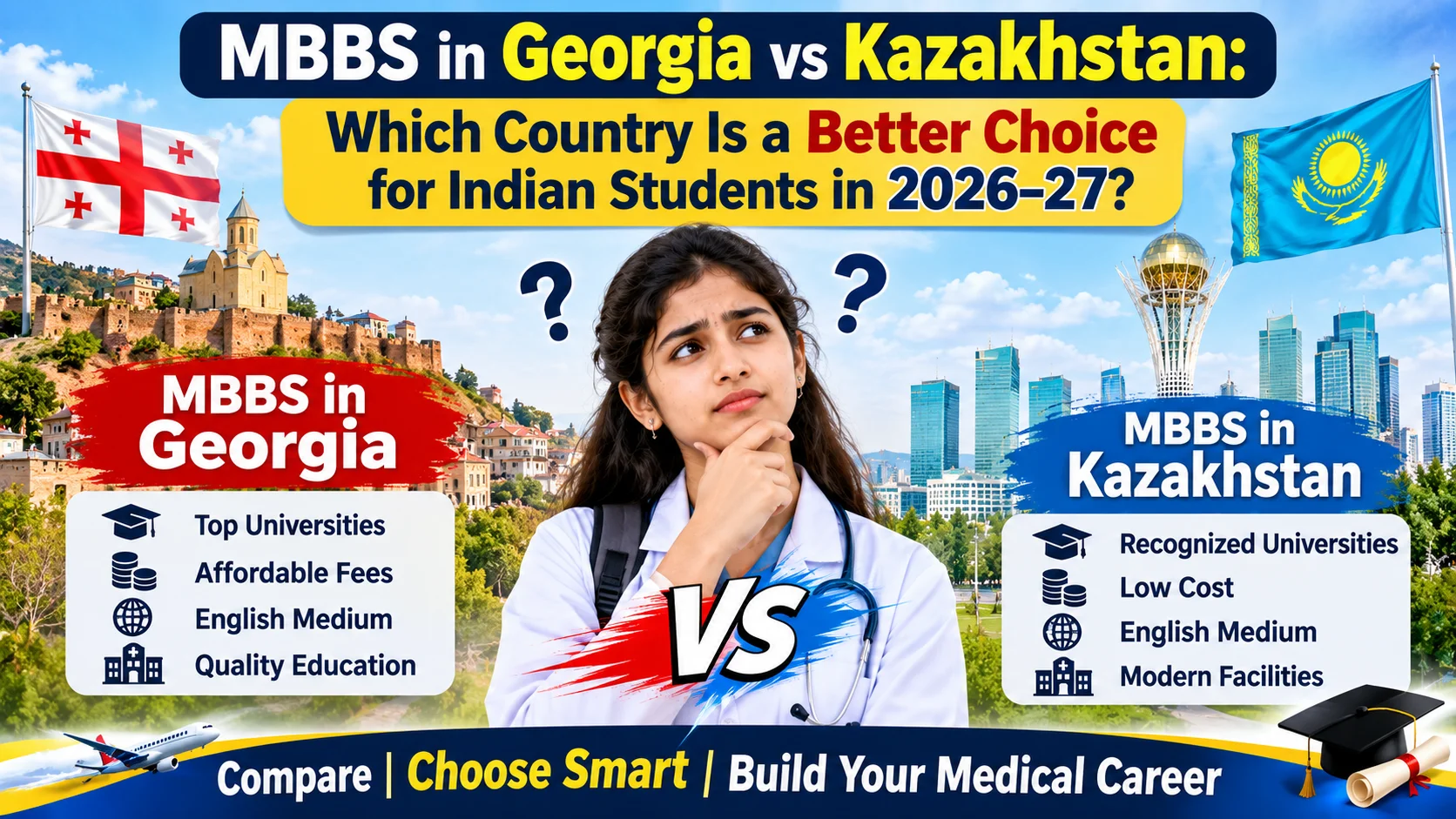
When considering studying MBBS abroad, one of the most important choices Indian students will make is which country to choose. Due to the highly competitive nature of government-funded medical seats and the high cost of many private medical colleges in India, many students are now looking to study abroad. Georgia and Kazakhstan are popular choices for Indian medical students due to the availability of courses for international students and experience teaching international students.
However, it is important to consider the course content, entry requirements, language, clinical experience, accommodation, cost, and what happens upon returning home.
Considering all factors, it is important to carefully consider both options within the 2026–27 academic session. Based on your academic priorities, family budget, learning environment, and future goals, this guide will help determine if Georgia or Kazakhstan would be the best choice for you as an Indian medical student.
1. About Medical Courses in Georgia and Kazakhstan
MBBS in Georgia
Georgia offers an integrated six-year Medical Doctor (MD) course.
Courses require students to complete a minimum of 360 ECTS credits across six academic years. The course contains a combination of basic medical science, clinical and practical elements. Clinical rotations generally begin in later years, meaning that there is significant clinical learning within years five and six. There are a number of universities offering MBBS courses in English. For example, Tbilisi State University offers a six-year Medicine course in English. Tbilisi Medical Academy also offers a six-year MD course in English.
MBBS in Kazakhstan
Kazakhstan has a long tradition of welcoming international students, including students from India. There are a number of universities offering medical courses in English. Information can be found on universities such as Astana Medical University.
However, if you are planning to start in 2026–27, it is important to note that recently the Embassy of India in Astana issued an advisory stating that medical courses in Kazakhstan tend to be seven years long. International students may be able to complete their course in six years; however, the Embassy has not received any clear confirmation as to whether international students who complete the accelerated course would be eligible for a practice licence. Therefore, it is important to check that you are eligible for all requirements for a six-year course.
2. Length of Course – Georgia vs Kazakhstan
Leng Georgia
Indian students will usually need th of course is one of the most important factors to consider, as it can impact tuition, accommodation, cost and how long it will take to qualify.
Course Duration Comparison
|
Factor |
Georgia |
Kazakhstan |
|
Qualification |
Medical Doctor (MD) |
Medicine/Physician |
|
Published course length |
6 years |
7 years (new standard policy) |
|
Accelerated course |
6-year course |
6-year accelerated course may be available for eligible international students |
|
Language |
English |
English (selected universities) |
|
Clinical experience |
Yes |
Yes (check course structure) |
|
Important to check |
Professional licence |
Accelerated course length and licence |
Overall, the six-year course in Georgia is easy to understand based on the information given. However, with the changes to Kazakhstan in 2026–27, it is important to check official confirmation that the course is the correct length.
When paying a deposit, we recommend asking for the full academic calendar, total length of course, internship information and legal confirmation of the course.
We do not recommend relying on information provided in a brochure or verbally by an agent. Ask the university to confirm the information in writing and double-check with the relevant authorities.
3. Entry Requirements for Indian Students
Both countries will accept international students; however, requirements will vary based on the university and course.
Entry Requirements –to provide:
- Valid Passport.
- Class 10 and 12 Academic Certificates.
- Class 12 Mark Sheets – Biology, Chemistry and Physics if required.
- NEET Qualification.
- Evidence of English if required.
- Application Form and Other Documents.
- Medical and Other Documents.
Some universities may also require an online interview or checking your academic background. Please check the official entry requirements page for your chosen university to see what requirements they have.
Tbilisi State University has published information on its English Medicine course. This requires a Secondary School Certificate, Evidence of Relevant Subjects, NEET Certificate (for Indian Citizens) and Evidence of English.
Entry Requirements – Kazakhstan
Indian students may be required to provide:
- Valid Passport.
- Class 10 and 12 Certificates.
- Academic Transcripts.
- NEET Qualification.
- Evidence of English if required.
- Application Form.
- Medical Documents and Other Certificates.
- Translated/Notarised Documents (depending on the university).
Some universities may require entrance exams or interviews. For example, Karaganda Medical University has published information on its entry requirements for foreign students. The university requires entrance exams and an online interview.
Important: The NEET qualification is not related to entry requirements. You will need to meet the Indian requirements to study medicine abroad and also meet the entry requirements for your chosen university.
Indian students can check the latest examination-related information through the official NEET website.
4. Cost of Study – Georgia Versus Kazakhstan
Often the cost of study is a big factor when deciding between Georgia and Kazakhstan. However, tuition fees will vary depending on the university, course, city, language and academic year.
Cost of Study – Georgia
There are a variety of universities with differing tuition fees. We recommend asking for the latest official information from the university. Tbilisi State University charges USD 8,000 per year for its English Medicine course.
In addition to tuition fees, you should also budget for:
- Accommodation (Hostel/Rented).
- Food and Groceries.
- Local Transport.
- Health Insurance and Medical Costs.
- Residence Permit and Documentation.
- Books and Study Materials.
- Flights to and from India.
Cost of Study – Kazakhstan
Kazakhstan is often considered by Indian families as there are a variety of universities with varying tuition fees. Costs vary, so we recommend looking at official tuition fees.
As the course may be seven years long from 2026–27, this will impact your overall budget. Although the tuition may be affordable per year, the extra year will increase your accommodation, food, transport and other costs.
What to Compare Before Admission
Rather than just looking at the costs per year, look at the overall cost of completing the course.
|
Cost Check |
What to Consider |
|
Tuition |
Cost per year and total cost |
|
Accommodation |
University hostel, private hostel or apartment |
|
Food |
Monthly grocery budget |
|
Transport |
Annual flights and local transport |
|
Insurance |
Mandatory and renewal cost |
|
Documentation |
Visa, residence permit, translations and medical checks |
|
Extra Study Costs |
Books, equipment, exams and other university costs |
A fee schedule should help clarify if the tuition is fixed or varies per year. Ask the family about the refund policy, payment deadlines and if there are any extra costs.
5. Recognition, Accreditation and NMC Rules for Indian Students
Recognition and eligibility should be one of the first things Indian students check.
The National Medical Commission (NMC) regulates the requirements Indian students need to meet to gain their primary medical qualification abroad and then register in India. The Foreign Medical Graduate Licentiate (FMGL) Regulations, 2021 contain important information regarding the length of course, language, subjects, clinical experience and practice licence. The NMC has published an FAQ page which outlines that courses must be a minimum of 54 months and taught in English.
Although a university may be listed on the World Directory of Medical Schools (WDOMS), this does not guarantee that you will be eligible to register as a medical student in India. General statements such as internationally recognised or approved for Indian students should not be relied upon.
Specific to Georgia
The quality assurance body in Georgia states that they offer six-year MD courses, clinical experience and English language. They also explain how graduates will be recognised as junior doctors.
However, just because a statement is made that the MD course is internationally recognised does not mean that you will automatically meet all the NMC requirements.
Recently, there was a report (27th October 2026) regarding clarification from the NMC regarding whether Georgia’s junior doctor status would meet the ‘practice licence in foreign country’ requirement. It is important to know if the legal status of being a junior doctor meets the level of practice required.
Before enrolling at a university in Georgia, we recommend asking for official clarification on:
- The legal status of the graduate once they have completed the exact MD course.
- Are they legally allowed to practise at the level required by the relevant Indian regulations?
- Will they need to sit any extra exams/residency to gain the relevant licence?
- Does the university and course meet all the requirements of the FMGL for the year of admission?
Specific to Kazakhstan
The Embassy of India in Astana issued an advisory (1st October 2026) regarding the standard medical course length. The standard medical course tends to be seven years; however, some international students may be eligible for an accelerated six-year course. However, the Embassy is waiting for clarification on whether international students who complete the accelerated course will be issued with a practice licence.
Therefore, we recommend asking for official confirmation on the legal status of the course, internship and if graduates will be eligible for a licence. Do not rely on marketing material from the university or promises from your education consultant.
6. Language
The language of the course will impact how you learn, exams and communicating with patients.
Study in Georgia
Many universities in Georgia offer courses in English. This can help Indian students as everything will be in English, including lectures, textbooks and academic discussions.
However, you should also remember that in local hospitals patients and medical professionals may speak in Georgian. Knowing some basic Georgian will help you understand patients, communicate with hospital staff and get involved in clinical practice.
The quality assurance body states that they offer English courses with Georgian language.
Study in Kazakhstan
There are universities in Kazakhstan offering medical courses in English. However, this will vary depending on the university and course. Some universities will teach in Kazakh/Russian.
Although the course may be taught in English, when visiting hospitals you may come across Russian/Kazakh. Knowing some basic local language will help you communicate better and get the most out of your clinical experience.
Before admission, we recommend checking the course is fully taught in the language stated within the official documents.
7. Clinical Experience
Medical courses will involve more than just textbooks and exams. You will develop your skills to examine patients, understand symptoms, interpret investigations and work under the supervision of experienced medical professionals.
Clinical Experience – Georgia
Medical courses in Georgia will involve pre-clinical, clinical skills and hospital-based learning. Clinical rotations begin in year four and years five and six involve clinical learning in the correct healthcare setting.
We recommend asking each university what hospitals they use for training, how clinical placements are organised and how much supervised patient interaction you will have. Also ask if international students are allowed to get involved in the practical aspects of the course.
Clinical Experience – Kazakhstan
Medical courses in Kazakhstan will also involve practical and clinical elements. However, this may vary depending on the university, affiliated hospitals, language and local factors.
Ask the university:
- What hospitals do they use for clinical rotations?
- What year do they begin patient-facing training?
- How many clinical placements are there and how long are they?
- Are qualified doctors providing supervision?
- Are there opportunities to practise examining and clinical skills?
- What language is used during hospital-based learning?
- What are the internship arrangements and who provides them?
Do not be fooled by a good reputation or picture of a hospital. Ask for the course content, clinical rotation schedule and teaching hospitals. Do not pay until you have this information.
8. Accommodation
Overall, your experience will depend on the accommodation, food, transport, weather and general amenities.
Living in Georgia
Indian students will be able to find accommodation at the university or privately. Larger cities may have greater amenities such as supermarkets, restaurants, public transport and student facilities. The availability and cost will depend on the city and how far away the university is.
Check that the hostel provides heating, internet, kitchen, security and suitable study spaces. If you are looking for private accommodation, calculate how much rent, utilities, deposits and transport will cost.
Living in Kazakhstan
There are a variety of accommodation options available. Universities will offer hostels and there are private apartments. Cities such as Almaty, Astana and Karaganda will vary.
The weather is an important factor to consider. Many areas in Kazakhstan have very cold winters. If you are coming from a warmer area of India, you may need time to adjust. You should budget for winter clothes, heating and transport.
Ask if there will be access to food you are used to, an Indian student community, public transport and support from the university.
9. Food, Weather and Culture
Whilst this may seem like a small factor, it is important to consider what food is available and the weather.
Food and Lifestyle in Georgia
Georgia will have local food, international restaurants and shops. Depending on where you are, there may not be much Indian food available. If you like eating home-cooked meals, ask if there is a kitchen available and if there are Indian ingredients nearby.
Food and Lifestyle in Kazakhstan
Kazakhstan will have local and international food. Some areas may have Indian restaurants and shops; however, we recommend checking what is available near your chosen university.
Weather and Cultural Adjustment
The weather will differ. Georgia will have varying weather depending on the region. Many cities in Kazakhstan will have long, cold winters. Research what the weather is like in the actual city of the university and ensure you have suitable clothing and footwear.
It will take time to adjust to the culture. Being respectful, knowing some basic language and understanding public transport can help students settle into their new environment.
Conclusion
Choosing between Georgia and Kazakhstan for MBBS in 2026–27 requires careful consideration of the university, course duration, tuition fees, language, clinical experience and professional licensing requirements.
Students should compare the complete academic programme and total cost rather than relying only on advertised tuition fees. It is also important to check the latest NMC regulations and obtain written confirmation about the course structure and practice licence requirements before taking admission.
Both destinations offer medical education opportunities for international students, but the right choice will depend on individual academic priorities, family budget, preferred learning environment and future career plans.
For Indian students, proper research and verification before admission can help avoid unnecessary academic and financial difficulties while working towards a future medical career.
For additional information about international medical education and global health, students can also refer to the World Health Organization (WHO).
Students exploring medical education opportunities in Kazakhstan can also visit MBBS in Kazakhstan for related information.