Kazakhstan emerges as a prime destination for Indian medical candidates by providing quality and affordable medical degrees that are recognized globally. The first and possibly most important query students and parents ask potential universities is 'How long is the MBBS course in Kazakhstan?'
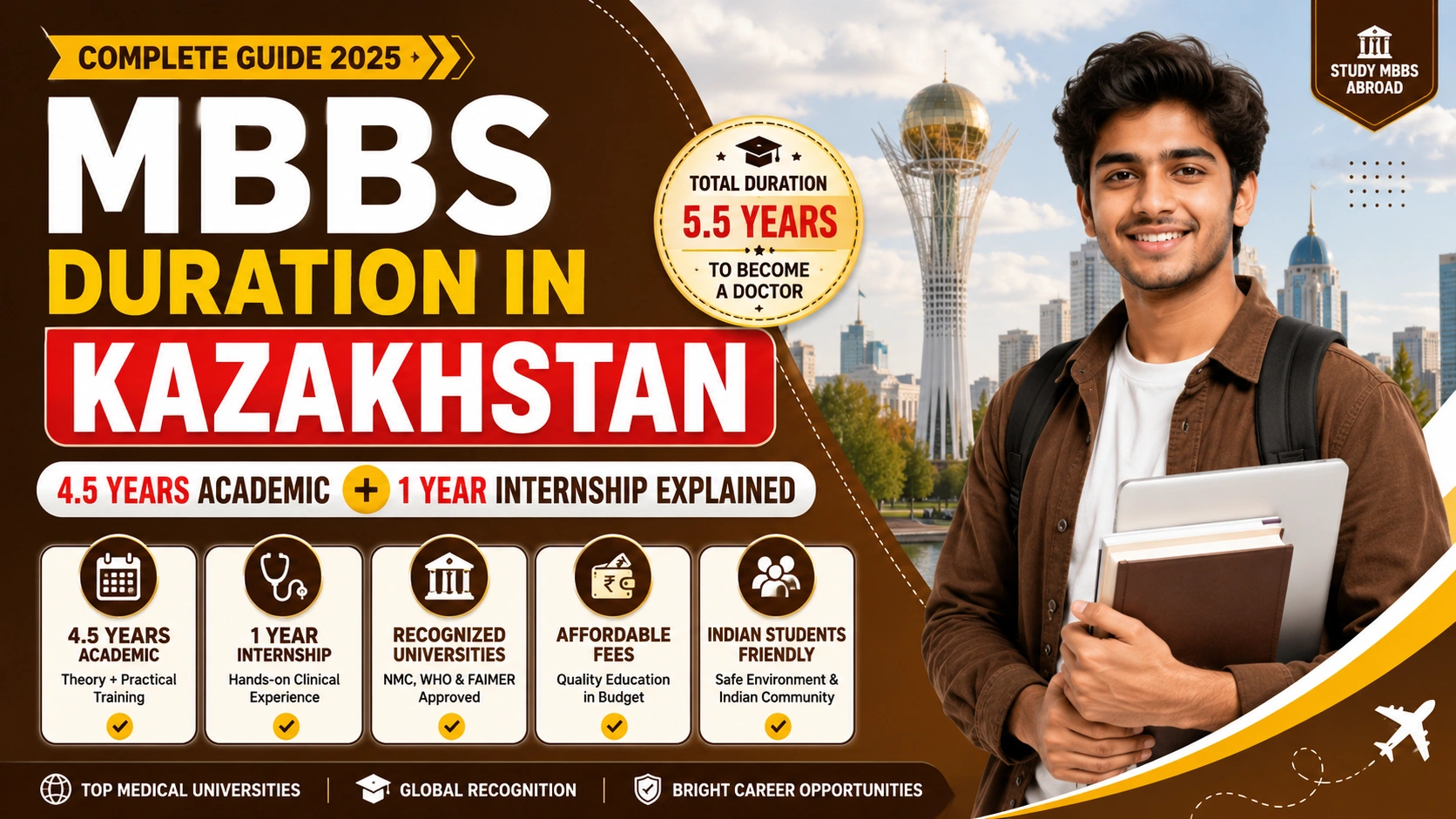
Let's start with a short answer. The MBBS in Kazakhstan program is typically 6 years long, consisting of either 4.5 years or 5 years of classroom instruction, followed by a mandatory 1-year internship. This article elaborates on the duration of the MBBS program and examines the structure of the program in relation to the National Medical Commission (NMC) of India and the World Health Organization (WHO).
Total Duration of MBBS in Kazakhstan
The MBBS in Kazakhstan follows global standards for medical education and Indian compliance. The program for Indian students looks like this:
- 54 months (4.5 years) of academic education
- 12 months (1 year) of compulsory clinical internship
This leads to the total duration of the MBBS in Kazakhstan to be around 5.5 to 6 years. The academic calendar of the university in Kazakhstan determines the exact duration. While some universities take a full 5 years for the academic education and then a 1 year internship, leading to a total of 6 years, some other universities take the 54 months (4.5 years) academic education spelled out by the NMC, followed by a 1 year internship.
The variation in duration stated by different universities often creates confusion among students. However, the objective remains the same. Before a student is conferred with a medical graduate degree, it is mandatory that a student has undergone a minimum of 54 months of academic education, and has completed 1 year of clinical internship.
Why the 4.5 Years + 1 Year Structure Exists
The 54-month educational standard is based on the NMC's Foreign Medical Graduate Licensure (FMGL) Regulations, 2021. It specifies the minimum length of schooling for foreign medical degrees to be validated for practice in India. According to these regulations, any medical degree obtained outside India must contain a minimum of 54 months of academic courses and 12 months of internship. Moreover, this internship must be done in the same institution or the affiliated teaching hospital of the medical school where the courses were conducted.
Since the best medical universities of Kazakhstan are recognized by the National Medical Commission (NMC) of India, the MBBS programs are designed within the frame of 54 months + 12 months. This helps make sure that the Indian students who go to Kazakhstan for their MBBS do so without impacting their eligibility to sit for the licensing exams in India, as there are no restrictions pertaining to duration.
Year-Wise Breakdown of MBBS in Kazakhstan
To appreciate the utilization of the 4.5 years allocated, this section provides a general year wise description of the programs offered in most medical universities of Kazakhstan:
Years 1–2: Foundation Phase
The main focus of the first 2 years of medical education is on the basic medical sciences: Anatomy, Physiology, Biochemistry, Histology and Medical Biophysics. These courses are taught largely on-campus. This phase of medical education provides theoretical foundations of the clinical medical sciences. Students are also taught introductory Kazakh or Russian language modules to assist them in communicating with local patients during clinical rotations that are conducted later in the course of their medical education.
Year 3: Transition to Clinical Learning
As the course progresses into the third year, the focus shifts to the para-clinical subjects, such as Pathology, Microbiology, Pharmacology, and Forensic Medicine. Students also make short visits to hospitals and start observing clinical procedures. This is the first step towards bridging the gap between classroom instruction and their first interactions with patients.
Year 4 and Year 5: Core Clinical Training
The focus of these years is on the core clinical subjects - Internal Medicine, Surgery, Obstetrics and Gynaecology, Paediatrics, Psychiatry, and Dermatology, Orthopaedics, ENT, and Ophthalmology. During these years, students spend most of their time in the hospitals associated with the university and teach and guide other faculty members and interact with patients. The core clinical training is emphasized the most during these years.
Year 6 (Internship): The Practical Bridge
The last year of the course is completely dedicated to supervised, practical training. The interns are rotated through the departments of General Medicine, Surgery, Emergency Medicine, Gynaecology, Paediatrics, and Orthopaedics. Students learn to take the next step from being Medical Students by assuming the role of Junior Doctors in a hospital and care for patients. They also learn to assist in clinical procedures and develop the confidence necessary to practice medicine independently.
How NMC Regulations Shape the Internship
The internship is a compulsory, formal requirement for Indian students, as it is regulated by the NMC. The NMC's FMGL Regulations state that the internship is to be done in the university hospital where the 54-month course is. It is to maintain the quality of the training. It prevents students from doing an internship in a hospital that does not have recognition or is unrelated.
Students who intend to practice in India after completing their medical internship must now take the National Exit Test (NExT) after its replacement of the Foreign Medical Graduate Examination (FMGE) as the Foreign Medical Graduates' licensing screening test. Successful candidates are then able to apply to the NMC and gain their right to practice in India.
Role of WHO and WDOMS Recognition
The validity of a medical degree cannot be established by duration alone, but by general recognition of the medical school. Here the role of the WDOMS and the WHO become pertinent.
WDOMS is the definitive global directory of medical schools, maintained in collaboration by the World Federation for Medical Education (WFME) and the Foundation for Advancement of International Medical Education and Research (FAIMER). Any medical school a student attends must be listed in the WDOMS as this listing frequently is a mandatory requirement for graduates intending to sit for licensing exams or pursue their postgraduate studies in other countries, including the USA and the UK.
In a similar manner, the WHO has maintained the international medical education standards. While WHO no longer operates a directory (its functions were transferred to WDOMS), the medical schools that are compliant to the WHO curriculum guidelines are more likely to be internationally recognized. Most reputable Kazakhstan medical schools not only are NMC approved but are also WDOMS listed. This reassures students that their 4.5 years of study plus a mandatory 1-year internship, will be recognized beyond the borders of Kazakhstan.
NEET: The General Preliminary Step
Before establishing how NEET recognition or duration is evaluative, it is essential to know that Indian students have to first clear the NEET-UG. According to the Indian government, a student cannot get admission to any MBBS program abroad, MBBS in Kazakhstan included, if the student does not have a qualifying NEET score. The university's rank, ratings, or the fee structure does not matter.
The National Testing Agency (NTA) manages the NEET portal. On this portal, students can find the exam date, eligibility details, and exam results. It is important to know that NEET score cards are valid for a couple of years. Hence, students can complete the formalities of the admission process to study MBBS in Kazakhstan without any time-related concerns.
Kazakhstan MBBS Duration vs. India
While considering MBBS in Kazakhstan for Indian students, students compare the duration of MBBS in India. In India, MBBS is a 5.5-year program. This includes a 1-year rotatory internship, which is mandatory and is part of the academic structure of the program. This is the same as what is offered to students from India in Kazakhstan. Some universities in Kazakhstan, however, offer 5-year MBBS programs with an additional 6 months of academic training and clinical exposure prior to the internship.
This near similarity of structures is intentional. With regard to duration and to ensure that there is little to no disadvantage for Indian students who plan to return home to practice, Kazakhstan's leading medical universities have aligned their curricula with the NMC.
Factors That Can Slightly Extend the Duration
A few factors can add time to any student's fixed overall duration in the program, even if the standard overall duration is fixed:
- Repeated attempts of semester exams: If a student does not pass an exam for a given semester and must take the exam in another attempt, this can impede progress to the next semester.
- Failure to meet attendance requirements: Universities specify minimum attendance requirements. Failure to meet minimum attendance requirements can impede progress.
- Scheduling of internships: Hospital rotations and administrative scheduling can, in rare cases, shift the date of internship completion.
These factors are most often not the case. Students who work consistently and continuously complete the program in 5.5 to 6 years.
How This Duration Structure Is Advantageous for Students
The 4.5 (or 5) years of academic instruction plus 1 year of internship is not just a duration structure that has some regulatory significance. It is advantageous for students in some key ways.
- Understanding of Basic Sciences: Students have a good understanding of the basic sciences before their first hospital placement.
- Gradual development of clinical skills: From the start of the pre-Clinical phase, students begin to progressively develop clinical skills. This significantly reduces the clinical learning curve.
- Global Eligibility: Students can seek practice or further study opportunities in any country and are not limited to Kazakhstan or India.
- Continuation of Training: Students have the opportunity to complete a 12 month internship in the same hospital where they completed their academic studies.
Conclusion
While Indian students looking to pursue MBBS in Kazakhstan will still need to learn about the other aspects of the education, the first and most fundamental step is knowing the duration of the course. With the NMC's FMGL Regulations, 2021, students will find that the course is designed in such a way that 4.5 to 5 years of the study in medicine is followed by a compulsory 1-year internship. This design makes students eligible to appear for the National Exit Test and allows them to legally practice medicine in India.
Because this duration framework, along with WDOMS listing and academic standards set by the World Health Organization, offers students a credible and globally recognized medical degree, students must first qualify the NEET exam and later check the current NMC approval and WDOMS listing before applying. Additionally, students must check the year-wise breakup directly with the institute or a reputed admission consultant, as there can be minor variations. With the right planning and preparation, students will find that Kazakhstan offers one of the most affordable and practical options to study MBBS.