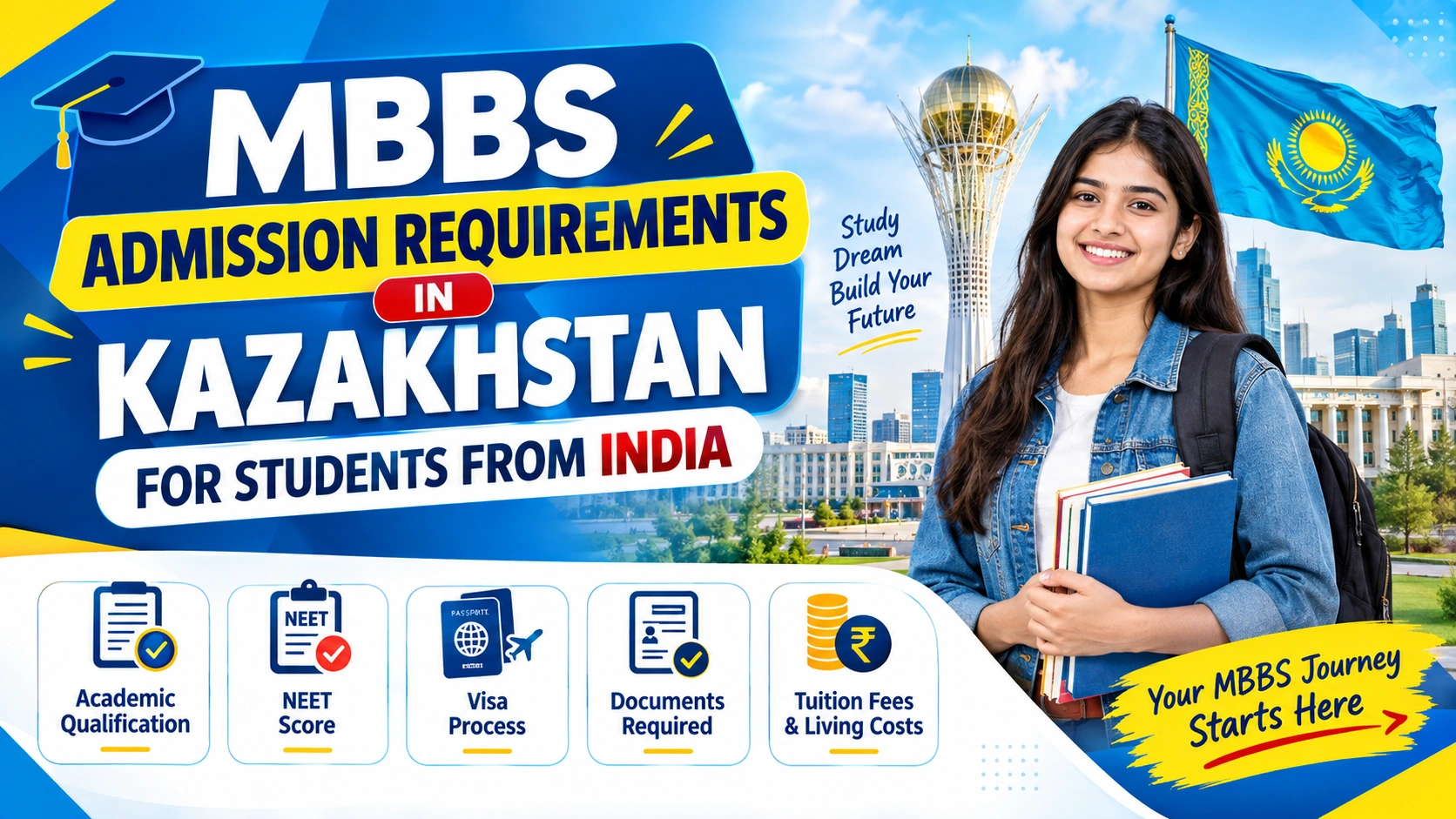
For an Indian student, getting admission to a medical university in Kazakhstan is usually not the difficult part. Choosing a course that will still keep you eligible to practise in India several years later—that is where the real homework begins. A student may have good Class 12 marks, a valid passport and enough budget, yet a poorly checked university or course structure can create problems after graduation. That is why anyone planning MBBS in Kazakhstan should look beyond the admission letter and check NEET eligibility, course duration, internship structure, English-medium teaching, clinical training and the current National Medical Commission rules before paying the first fee. Kazakhstan remains attractive because several universities offer six-year medical programs, comparatively manageable tuition costs and admission after secondary education. Some WDOMS-listed programs in Kazakhstan specifically show six-year curricula and English as a language of instruction. Still, university conditions differ. A course that suits one international student isn't automatically suitable for an Indian student who intends to return home. So, what exactly should you check before applying? Quite a few things. And some matter much more than a glossy university brochure.
Basic Eligibility for MBBS Admission in Kazakhstan
Start with Class 12. Indian applicants normally need to have completed 10+2 or an equivalent qualification with Physics, Chemistry, Biology/Biotechnology and English. Most universities expect students to meet their individual academic admission standards, while Indian students must separately ensure that their academic background satisfies the rules applicable to foreign medical education and their future registration pathway in India.
In practical terms, an applicant should normally be ready with:
- 10th and 12th certificates and mark sheets
- Physics, Chemistry and Biology/Biotechnology in the qualifying examination
- A valid NEET-UG result as applicable to Indian students pursuing medical education abroad
- A valid passport
- University-specific application and eligibility documents
- Medical fitness documentation where requested
- Passport-size photographs and visa-related documents
- Any required document translation, notarisation or authentication
Some universities may apply their own admission test, interview or academic screening. WDOMS, for example, records an entrance examination requirement for at least some six-year medical programs in Kazakhstan. So don't assume that every university follows exactly the same process.
Is NEET Required for Indian Students Going to Kazakhstan?
Yes, this is one requirement you shouldn't casually ignore. Indian students planning medical education abroad with the intention of returning to the Indian medical system need to pay close attention to the applicable NEET and NMC rules. The official NEET-UG portal should be the first place to verify the current examination information rather than relying on an admission agent's WhatsApp message.Here's the distinction that often causes confusion: qualifying NEET and obtaining an Indian government MBBS seat are two completely different things. A student may fail to secure an affordable seat through Indian counselling but still satisfy the applicable NEET requirement for studying medicine overseas.The qualifying criteria and scores can change from one examination cycle to another, so students should verify their own year's official result and eligibility instead of relying on an old cutoff screenshot. The official NEET website currently provides the 2026 information bulletin, score-card information and related examination updates.Honestly, this is one place where shortcuts aren't worth it.
Minimum Age and Academic Requirements
Age sounds like a small detail until an application reaches document verification. Students generally need to satisfy the minimum age requirement applicable under the current medical admission rules, including being at least 17 years old within the prescribed admission-year framework.Academic requirements need a little more care because universities can set their own thresholds. You may see consultants quoting figures such as 50% in PCB for general-category applicants, but don't treat a generic percentage on a consultancy page as universal admission law for every Kazakh university.Check three things separately: the university's current entry requirement, Indian eligibility requirements and the requirements that will matter for registration after graduation.That extra ten minutes of checking can save a serious problem later.
The NMC Rules Matter More Than the Admission Letter
Here comes the part many students read too late. The National Medical Commission requirements aren't simply about whether the foreign university has a familiar name.Under the Foreign Medical Graduate Licentiate Regulations, the foreign medical course relevant to Indian registration must include at least 54 months of education, followed by a minimum 12-month internship in the same foreign medical institution. The degree must be taught in English, include the required subjects, and satisfy other conditions concerning clinical education and eligibility for professional registration/licensure in the country where the qualification is awarded. NMC has also recently warned students about foreign institutions whose curriculum, training, course duration or internship arrangements don't comply with its requirements. Its advisory specifically highlights course duration, English-medium instruction, syllabus, clinical training and internship/clerkship arrangements as areas students need to verify.So while evaluating MBBS in Kazakhstan, don't ask only, “Is this university recognised?”Ask something more useful: Does the exact program offered to Indian students satisfy the current FMGL requirements?Big difference.
Course Duration: Why a Six-Year Program Needs Checking
Six years sounds straightforward. Sometimes it is. But the words “6-year medical course” alone don't tell you how those six years are divided between academic study, clinical education and internship.WDOMS currently shows six-year curricula for multiple medical programs in Kazakhstan, including programs where English is listed among the languages of instruction. That is useful information, but it isn't the end of your verification.For an Indian applicant, the safest approach is to obtain the university's written curriculum showing the duration of classroom education, clinical rotations and internship. Check where the internship occurs too. NMC regulations require the foreign internship to be at the same foreign medical institution for students covered by the FMGL framework.Here—well, this is exactly where students often make an expensive assumption: six calendar years doesn't automatically prove NMC compliance.
Recognition, WDOMS and WHO: Don't Mix Up the Terms
A familiar logo can create false confidence. The World Directory of Medical Schools is useful for checking whether a medical school and its program details appear in the global directory, including information such as curriculum duration and language where available.
But WDOMS itself clearly states that inclusion in the directory does not mean recognition, accreditation or endorsement of a medical school. That's a crucial distinction.The World Health Organization is another authoritative global health source, but students shouldn't treat phrases such as “WHO approved” as a substitute for checking the actual regulatory conditions applicable to an Indian foreign medical graduate.For MBBS in Kazakhstan, verify the exact institution, exact medical program, accreditation status, language, duration, clinical training and licensing eligibility separately. One badge isn't enough.
Admission Process for Indian Students
The process itself is usually less complicated than students expect. First shortlist universities based on compliance, academic quality, clinical exposure and budget—not simply whichever institution promises the fastest invitation letter. Then submit your academic documents and passport for university assessment.
Once eligibility is confirmed, the sequence generally looks like this:
- Select a suitable medical university and verify its program.
- Submit Class 10 and 12 academic documents.
- Submit passport and NEET-related documents.
- Complete the university's application or admission assessment.
- Receive an admission/offer letter after approval.
- Pay the required initial tuition or registration amount according to official university instructions.
- Complete invitation and student-visa formalities.
- Arrange medical, insurance and travel documentation.
- Travel to Kazakhstan and complete university registration.
Admissions commonly build up during the months before the autumn academic intake, but deadlines vary substantially between institutions. Don't wait until the last few weeks. Visa processing, document correction or an invitation-letter delay can easily disrupt travel plans.
What Does MBBS in Kazakhstan Cost?
Budget is one reason Indian families consider Kazakhstan. Depending on the university, city, exchange rate and hostel choice, tuition can broadly fall around ₹3 lakh to ₹6 lakh per year at many commonly considered institutions, though some programs can cost more.
A realistic family budget shouldn't stop at tuition.
|
Expense |
Approximate Range |
|
Tuition fee |
₹3–6 lakh/year |
|
Hostel |
₹50,000–₹1.5 lakh/year |
|
Food & personal expenses |
₹10,000–₹20,000/month |
|
Medical insurance |
Varies by university/provider |
|
Visa/documentation |
Variable |
|
Air travel |
Depends heavily on season |
|
Total multi-year budget |
Often ₹20–35+ lakh |
These are planning ranges, not official fee quotations. Currency movements can change the INR cost as well. Before making payment, verify the latest university fee schedule directly.A detailed university and cost comparison can also be checked through MBBS in Kazakhstan before creating your final shortlist.
Hidden Requirements Students Often Miss
The biggest surprises aren't always tuition-related. Document translation, residence registration, health insurance, visa renewal, medical tests, university administrative charges and local transport can slowly increase the actual annual budget.Then there is language.An English-medium program doesn't mean every patient in a teaching hospital will speak English. During clinical years, learning basic Kazakh or Russian can become genuinely useful for patient interaction. For medical students, that's not a cosmetic issue. Clinical communication matters.Also ask the university whether clinical training is conducted at its own or properly affiliated teaching hospitals, when hospital exposure starts and whether Indian students follow the same clinical structure described in the official curriculum.
FMGE/NExT and Returning to India
Think six years ahead before signing up. An Indian student choosing MBBS in Kazakhstan today should select a university with the future Indian registration pathway in mind, not merely admission convenience.Under the NMC's FMGL framework, eligible foreign graduates must satisfy the prescribed foreign-course and internship conditions, meet licensing-related requirements, clear the examination mandated by the Commission and complete the required supervised internship in India. The regulations specify a minimum 12-month supervised internship in India as part of the permanent-registration pathway.The exact examination mechanism applicable when today's student graduates may evolve, so don't build a six-year plan around a coaching centre's prediction about FMGE or NExT. Follow current NMC rules and notices throughout the course. NMC's regulations page currently includes the FMGL Regulations and updated FMGL FAQs.
Pros and Cons Indian Applicants Should Consider
Kazakhstan can make sense for a student who has qualified NEET, wants an overseas medical education option and has carefully verified the university. Costs can be lower than many private medical options, several universities admit international students, and six-year medical programs are available.But there are trade-offs. Climate adjustment can be difficult, Russian or Kazakh becomes useful during clinical interaction, exchange rates affect expenses, and the responsibility for verifying NMC compliance sits heavily on the student and family.Cheap admission isn't the same as a good medical education. That's worth repeating.
FAQs About MBBS Admission in Kazakhstan
Can an Indian student take MBBS admission in Kazakhstan without NEET?
Indian students intending to return and practise medicine in India should follow the applicable NEET/NMC eligibility rules for foreign medical education. Always verify the current year's requirement through the official NEET and NMC portals before admission.
How many years does medical education take in Kazakhstan?
Many programs considered by international students run for around six years, but program structures differ. WDOMS records six-year curricula for several Kazakhstan medical programs. Indian applicants must separately confirm that the exact course and internship arrangement satisfy current NMC requirements.
Is every WDOMS-listed Kazakhstan university valid for Indian students?
No. WDOMS explicitly says that a directory listing does not itself constitute recognition, accreditation or endorsement. Students must check the individual program against NMC requirements.
How much money is required for MBBS in Kazakhstan?
A broad planning estimate can be around ₹20–35 lakh or more across the full study period, depending on tuition, hostel, food, airfare, exchange rates and personal spending. Get a current written fee structure before admission.
Is the medical course available in English?
English-medium options are available at some Kazakhstan medical universities; WDOMS records English instruction for certain programs. Still, verify the language of the entire program, especially clinical years, rather than accepting a verbal assurance.
Can I practise in India after completing MBBS in Kazakhstan?
Potentially, yes, provided you satisfy the NMC rules applicable to your admission batch and graduation pathway, including requirements relating to course duration, internship, subjects, English-medium instruction, clinical education, foreign licensure eligibility, the prescribed licensing/screening examination and internship in India.
Conclusion
Getting into a Kazakhstan medical university may be relatively straightforward. Getting into the right one requires more patience. Before choosing MBBS in Kazakhstan, verify NEET eligibility, the exact six-year course structure, 54-month academic requirement, 12-month foreign internship, English-medium instruction, clinical training, local licensing eligibility and current NMC regulations. Don't choose purely because one university is ₹1 lakh cheaper or promises admission in three days. Compare the complete six-year cost and, more importantly, ask for written proof of the academic and internship structure. Once those checks are clear, MBBS in Kazakhstan can be considered with far more confidence—and with fewer unpleasant surprises after graduation.