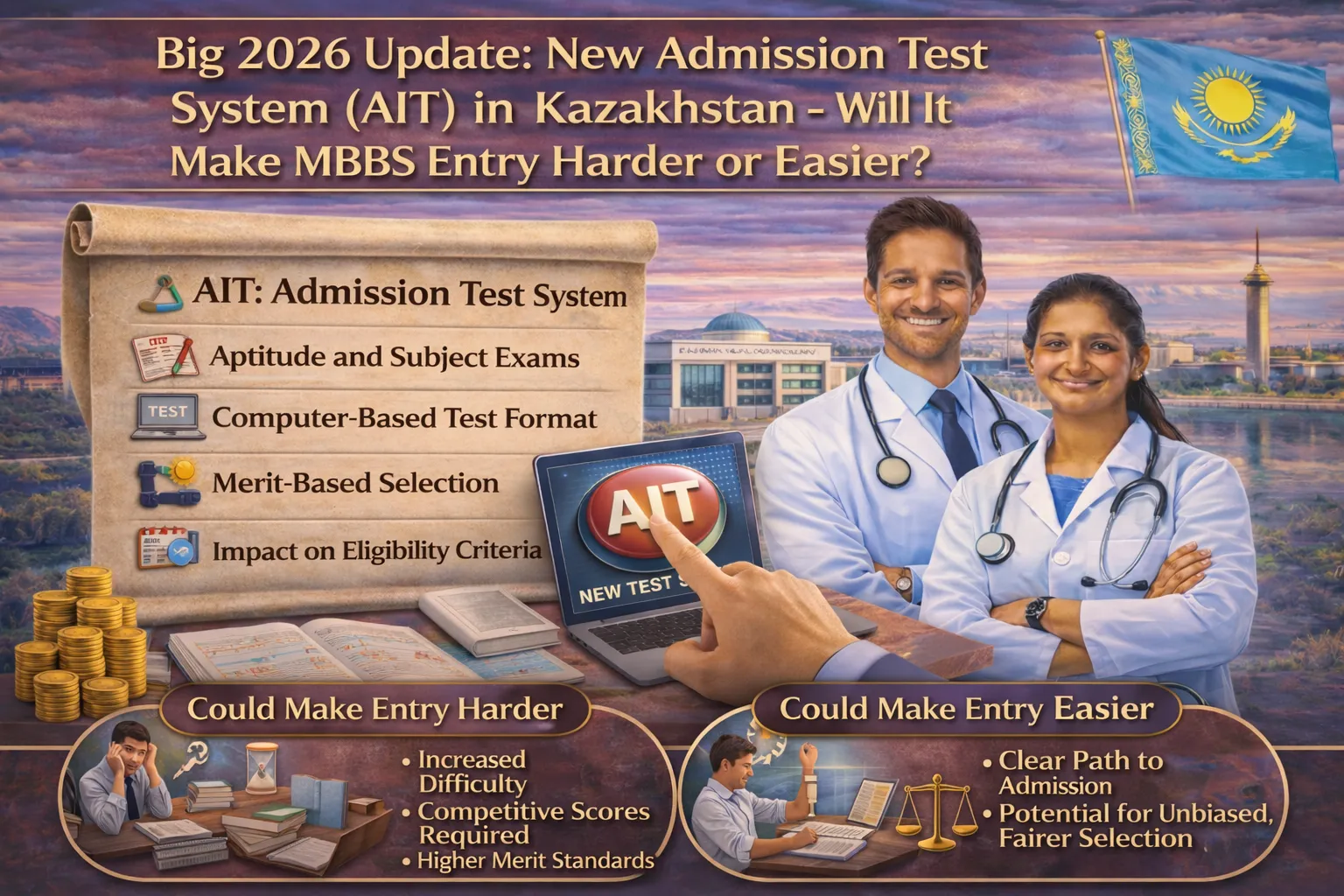
As of 2026, the domain of MBBS in Kazakhstan is going through a transformation, witnessing one of the most notable changes which is being brought to fruition through a new admissions structure called -- Admissions Insight Test (AIT). For Indian students and parents, who are already grappled with so many requirements from NEET requirements to NMC rules and global recognition criteria such as WDOMS and WHO, this update has brought in both excitement and confusion.
Whether AIT will complicate MBBS admission process or not? Or will it once be improved upon and made more globally aligned?
Here’s how to unpack it in a straightforward, practical and student-centered way.
What Is AIT (Admissions Insight Test) In Kazakhstan?
Kazakhstan developed the Admissions Insight Test (AIT) in 2026 as a key reform of its higher education system. The aim is straightforward: conversion from rote-learning oriented admissions to a skills-based evaluation system.
AIT is different than traditional entrance tests in:
- Critical thinking
- Problem-solving ability
- Academic writing
- Communication skills
- Quantitative reasoning
- Digital literacy
This means that while traditional testing only examines a student on how much they have memorised, AIT tests the ability of students to apply knowledge in real-world situations.
This reform brings Kazakhstan in line with modern global education standards, rendering its degrees more finagled on an international stage.
Why Did Kazakhstan Introduce AIT?
The old system (derived from conventional testing models) had its shortcomings:
- Heavy focus on memorization
- Single-score evaluation
- Limited assessment of real skills
Kazakhstan substituted this with AIT to:
- Improve transparency and fairness
- Match international education systems
- Focus on skill-based learning
- Enhance global recognition of degrees
This initiates a big step towards quality-driven admissions for students pursuing MBBS in Kazakhstan.
Before AIT Impact Current MBBS Admission System
Earlier, MBBS in Kazakhstan was regarded as one of the easiest options for Indian students who studied abroad.
Key Requirements:
- Convert Neet Is For Indian Students (Compulsory)
- PCB (Physics, Chemistry, Biology) with 50% marks
- Age ≥ 17 years
- Basic documentation
No entrance exam, no donation, and admissions were primarily merit- and document-based.
This ease attracted a lot of middle-class Indian families toward MBBS in Kazakhstan.
Are MBBS Students from Kazakhstan Need AIT?
Here’s the most important clarification:
👉 Currently, AIT is primarily targeted towards local students in Kazakhstan and has not yet expanded to serve international MBBS applicants.
This means:
- For Indian students, the NEET-based admission process is still in place
- No AIT exam required for most colleges (2026 date)
- Entry remains mostly straightforward and uncomplicated
But that could change in coming years.
AIT effect on MBBS in Kazakhstan
Whether AIT has been fully implemented for international students or not, it is already making its mark on the system.
Shift Toward Skill-Based Selection
Medical education requires:
- Analytical thinking
- Clinical reasoning
- Decision-making
Not only do students meet the eligibility criteria to enter MBBS but are academically and mentally prepared as well.
Increased Competition (Indirect Effect)
Kazakhstan: Part of a topical alignment with global grounds:
- More international students may apply
- Universities may become more selective
- Academic quality expectations may rise
This indicates that the MBBS in Kazakhstan may become a bit competitive in coming years.
Better Global Recognition
Kazakhstan medical universities has a recognition of already:
- NMC (National Medical Commission)
- WHO (World Health Organization)
- WDOMS (World Directory of Medical Schools) Listed
These recognitions guaranteed the graduates will be able to:
- Appear for FMGE/NExT in India
- Practice globally (after licensing exams)
Kazakhstan intends to further enhance this global credibility with AIT.
Improved Quality of Medical Education
AIT indirectly ensures:
- Better student intake quality
- Stronger academic environment
- Improved clinical training outcomes
In the long run, this is advantageous for students pursuing MBBS in Kazakhstan.
This raises a pertinent question — “Will AIT make MBBS entry tougher?”
Short answer: not yet — but a small amount in the future
Current Scenario (2026):
- It is still easy and simple to get in
- Only NEET qualification is required
- No entrance examination such as the AIT for most foreign students
Future Scenario:
- Universities may adopt AIT-like evaluation
- Admission may include skill-based screening
- Competition may increase
So yes, entry could grow somewhat more difficult — but also more valuable.
Will MBBS Entry Be Easier After AIT?
Surprisingly, yes—in some ways.
Here’s how:
Fair Evaluation System
Skills are the parameter for judging students, rather than marks.
Meaning to Less Reliance on High Scores Alone
Even an average student with good analytical skills can do well.
Better Career Outcomes
Skill-based education produces better doctors.
So while the AIT may raise standards, it is also a leveler for capable students.
NEET, NMC, WHO & WDOMS- Role in 2026
And with the AIT, Indian students should bear in mind:
NEET: National Eligibility cum Entrance Test
- Mandatory for studying MBBS abroad
- Required for practicing in India
NMC (National Medical Commission)
- Regulates foreign medical education eligibility
- Degrees from universities not recognized by NMC are invalid
WHO & WDOMS
- Make sure that medical degrees are recognized around the world
- Important for international career opportunities
The requirements are already at the level of Kazakhstan universities, which are safe and reliable in these aspects.
What Should Students Do Now?
For this reason, if you intend to pursue an MBBS program in Kazakhstan 2026 or 2027 then follow the intelligent strategy:
Focus on NEET First
The prerequisite of NEET qualification still holds the primary essence.
Build Conceptual Understanding
Even in the absence of mandatory AIT:
The revolutionizing of life sciences with the great impacts on environment and around have to be understood clearly, so just keep in mind some basics.
Develop Analytical Thinking
Apply Early
Admissions are still:
- First-come, first-served
- Fast-moving after NEET results
Choose NMC-Approved Universities
Ensure the university is:
- Recognized by NMC
- Listed in WDOMS
- Approved by WHO
Stay Updated
AIT may be available to study for international student in the future — so please stay tuned.
Final Verdict: Harder or Easier?
Let’s conclude clearly:
✔ Easier (Currently)
- No entrance exam
- Simple NEET-based admission
- Affordable fees
- High acceptance rate
✔ Harder (Future Perspective)
- Skill-based filtering
- Increased competition
- Higher academic expectations
⭐ Final Answer:
👉 AIT will not make MBBS entry difficult straight away, it will only ensure that the system gets better and tougher over time.
Conclusion
AIT that was launched in 2026 brought a new paradigm shift in Kazakh education system. Though the UK’s changes do not directly impact international students at present, it foreshadows a future where quality, skills and global standards will govern admissions.
This is relatively good news for Indian students.
Because ultimately, it’s not just the Admission that you should be aiming for — it’s becoming a competent physician & doctor, worldwide.
NEET, NMC or WDOMS provide strong support and endorsement for MBBS in Kazakhstan 2026 remain one of economical and rewarding alternatives.