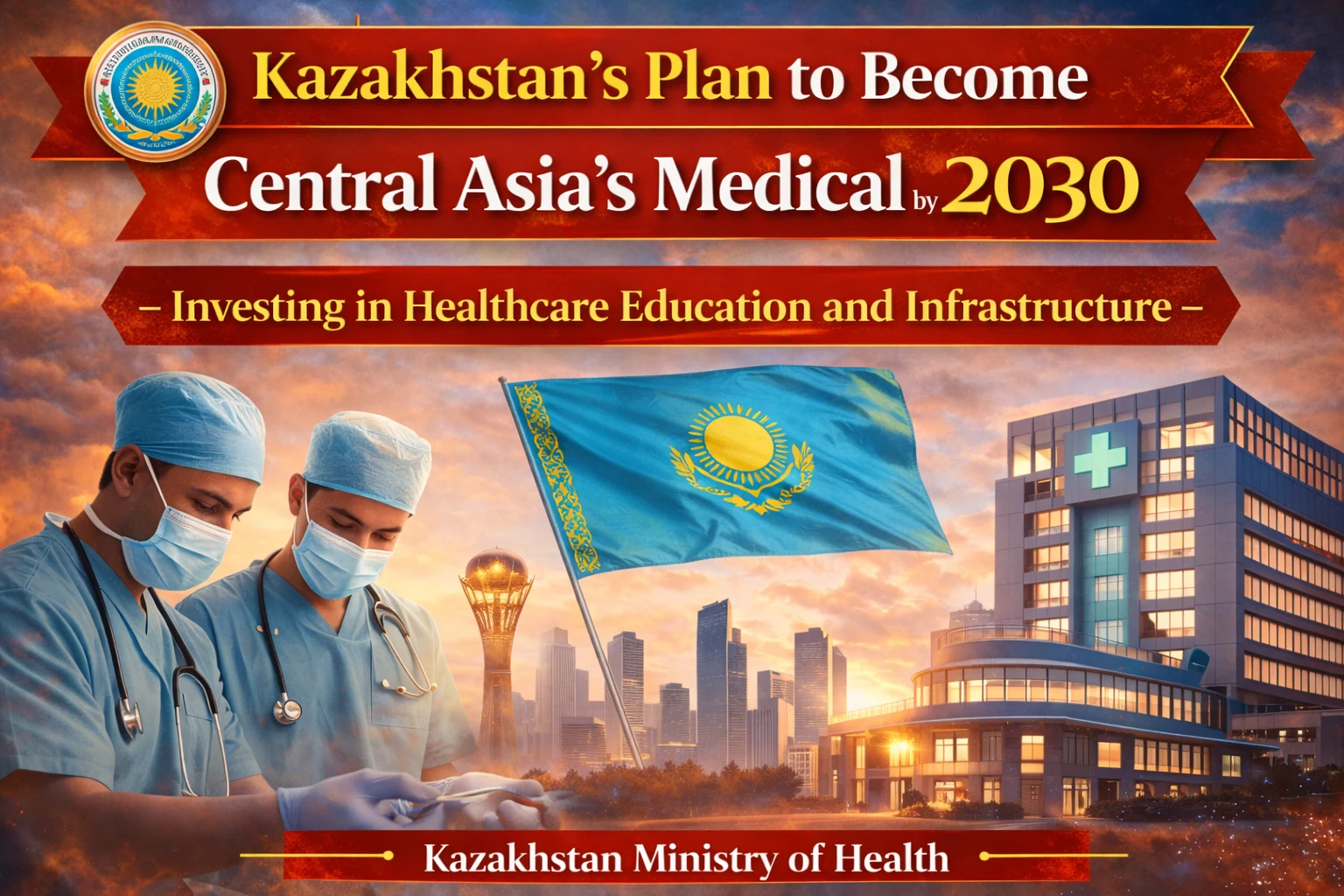
Kazakhstan has quietly started to transform its higher education system over the past decade. It invested heavily in universities and research facilities, international partnerships and global collaborations on academic programs. Kazakhstan's goal to become the education hub of Central Asia by 2030 is one of the most ambitious goals announced by the government.
It is not just about bringing more foreign students here—this vision is about forming a strong ecosystem that integrates education, research and innovation, and healthcare training. This advancement has the potential to transform the landscape of medical education in Kazakhstan, offering new opportunities for students pursuing MBBS in the country.
Armed with modern universities, English-medium programs and increasing international profile, Kazakhstan is taking its place as a serious choice amongst medical students in other countries, with thousands from India.
Kazakhstan’s Desire to Have an Education Frontier
The increasing globalization of students — an expression from all over the world providing academic diversity, research collaboration, and economic benefits to a local economy — has caused many countries to aspire to be a center for international education. Kazakhstan has identified this opportunity and is investing in higher education to compete with the traditional study destinations.
The national strategies implemented by the government include a modernization of universities, an expansion in academic programs, and bolstered partnerships with foreign institutions. A key goal is to raise the number of foreign students significantly by 2030, making this country a leading academic destination in the region.
Thousands of international students are already studying in Kazakhstan, including over 12,000 students from India mostly pursuing medical education.
Strengthening its higher education system will help the country attract talent from throughout Asia, the Middle East and Africa, a government spokesman said.
For students aiming for the medical profession, MBBS in Kazakhstan is a component of a massive cultural turning point.
Expansion of International University Partnerships
A major pillar of Kazakhstan’s strategy is the expansion of international university collaborations and branch campuses.
The government has welcomed foreign universities to open campuses and other joint programs in Kazakhstan. It offers tax breaks, land and funding to encourage international institutions to set up branches in the country.
Thanks to dual-degree programs, joint research projects, and international faculty exchange made possible by these partnerships, Kazakh universities are becoming more important players on the global stage.
Thus, collaborations of this type are invaluable for medical education. When institutions work together on an international basis, universities can provide better curriculum delivery, upgrade labs and extend global exposure to students.
These partnerships can benefit students pursuing MBBS in Kazakhstan as they enhance clinical training, provide access to modern research facilities, and offer opportunities for international collaboration.
Central Asian Higher Education Area Development
Kazakhstan is also collaborating with its neighbors to create a regional academic landscape called the Central Asian Higher Education Area.
It was intended to build a regional education network that allowed universities, students and researchers to work across borders. The aim is to enhance academic mobility, research collaboration and student exchange initiatives throughout Central Asia.
Such regional partnerships can boost the prestige of Kazakhstan’s universities and help them become a more attractive option for international students.
For medical students, this may translate into wider clinical exposure and collaboration with health institutions in the area.
This project aims to strengthen the popularity and demand of MBBS in Kazakhstan globally.
Investment in Research and Innovation
A further key element of Kazakhstan’s education reform is investment in scientific research and innovation.
The government has raised spending in education and research programs, specifically on medicine, AI, biotechnology and healthcare tech.
Kazakhstan’s leadership has particularly emphasized the necessity of international academic cooperation to enhance research capacity and innovation.
Having strong research infrastructure is extremely useful for medical students. It enables them to contribute to medical studies, public health research and scientific projects while they are still in school.
These developments would be fruitful for students who are pursuing MBBS in Kazakhstan as they will be able to extract the best laboratory, research center and training outputs.
Growth of English-Medium Medical Programs
A major driving force behind the international student influx to Kazakhstan is undoubtedly a growing number of medical programs offered in English.
There are now MBBS available in English medium in many countries so, medical students from India, Pakistan and Nepal can complete medicine graduation without language barrier.
Some institutions, like Karaganda Medical University have began offering multilingual education systems that encompasses English-based programs and Kazakh as well as Russian ones.
Kazakhstan wants to become a destination for students from allover the world, and that requires English-medium programs.
International medical schools help students study comfortably around the world.
Consequently, MBBS in Kazakhstan has gained widespread popularity amongst global applicants.
Global Recognition and Medical Accreditation
International Recognition– For medical students, its one of the important parameter while selecting any study destination.
Kazakhstan’s medical universities are now increasingly not conforming their programs to be in line with global standards and accreditations frameworks.
Although the WDOMS is not exhaustive, most universities can be found in it and it allows graduates to obtain medical licensing and postgraduate training in multiple places.
Indian students must check if the university is recognized by the National Medical Commission (NMC), as universities not approved by NMC cannot take licensing exams or practice medicine in India.
International medical education standards likewise are contingent on various global healthcare organizations, like the WHO, which seek to strengthen university academic quality and the training of healthcare personnel.
This globalisation of medical education reflects increases in international collaboration and regulatory alignment, and soviet kazakhstan educational system gradually acquires wider recognition.
Foreign Students Pay Only $40,000 a Year for Medical College
Reasons why Kazakhstan is a popular country for medical education
- Kazakhstan provides comparatively lower tuition and living expenses than private medical colleges in various nations.
- This is an attractive option for students who desire a quality education without exorbitant costs.
- The prospect of studying medicine abroad can be commercially challenging for numerous Indian families.
- In terms of cost, Kazakhstan offers a viable education option for those looking to complete a recognized medical degree in other countries at an affordable price.
This, allied to developing academic infrastructure strong interest in MBBS in Kazakhstan has surged significantly.
Increased Number of Indian Medical Students
India is one of the largest sources of medicine students for Kazakhstan.
Students who don't get the desired medical seat in government colleges of India often look for overseas options. Kazakhstan is one of the friendly countries for locals, and high education institutions offering affordable education in English-medium programs and internationally recognized universities have been established there.
Kazakhstan's higher education sector is also on the rise, and this means that thousands of Indian students are now studying medicine in Kazakhstan.
As the country inches closer to its 2030 education hub vision, international students may have access to even better facilities, modern campuses and improved clinical training opportunities.
Implications of the Foregoing for MBBS Students
Kazakhstan’s aspirations to emerge as the education hub of Central Asia go well beyond a government strategy; it encapsulates an enduring metamorphosis of the nation’s academic setting.
Kazakhstan targets international collaborations, boosts investments in research and strengthens its medical universities to create a competitive educational landscape within the global setting.
It implies better academic resources and acknowledgment from the world in terms of enhanced medical education for those students who intend to study MBBS under Kazakhstan education.
With its 2030 vision, Kazakhstan can establish itself to become one of the leading hubs of Medical education, not just in Central Asia but for students from across Asia and around the world.
With increasing world-class options for aspiring doctors with more affordable and globally-oriented medical education on the tables in Kazakhstan, opportunities could be beckoning even further down the road.