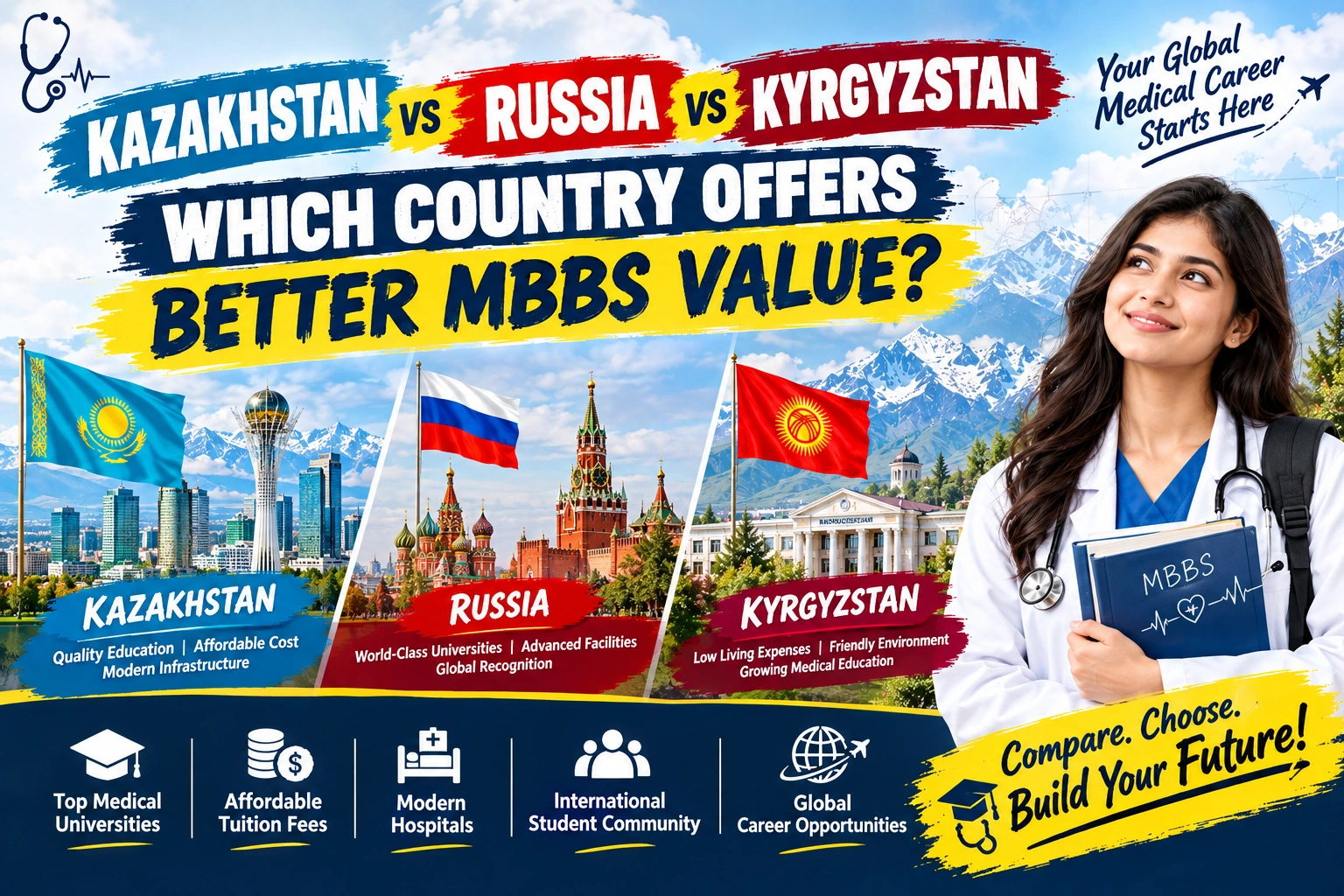
Three countries. Similar-looking fee packages. Completely different student experiences. A counsellor may describe Kazakhstan as affordable, Russia as academically stronger, and Kyrgyzstan as the cheapest. That sounds neat, but real medical education doesn’t fit into three sales lines. The university matters. Course duration matters even more. Then come clinical exposure, language, internship structure, Indian licensing rules, travel costs, and the amount your family will actually pay over six years. Students researching MBBS in Kazakhstan often compare it with these three lower-cost destinations. Fair comparison. Georgia generally sits in a higher fee bracket, while Kazakhstan, Russia, and Kyrgyzstan attract families working with tighter budgets. Still, the cheapest admission isn’t automatically the best value.
Quick Comparison: Kazakhstan, Russia and Kyrgyzstan
Let’s begin with the numbers. The following ranges are approximate planning estimates for 2026, not fixed university quotations. Exchange rates, cities, hostel categories, and university policies can change the final amount.
|
Factor |
Kazakhstan |
Russia |
Kyrgyzstan |
|
Typical tuition per year |
USD 3,500–6,000 |
USD 3,000–7,000 |
USD 3,000–5,000 |
|
Estimated living cost per month |
USD 150–350 |
USD 180–400 |
USD 130–300 |
|
Common advertised duration |
5–6 years |
Usually 6 years |
5–6 years |
|
Main local languages |
Kazakh and Russian |
Russian |
Kyrgyz and Russian |
|
English-medium options |
Available at selected universities |
Available at selected universities |
Available at selected universities |
|
Climate |
Very cold winters |
Cold to extremely cold |
Cold winters, varies by city |
|
Main advantage |
Balanced cost and infrastructure |
Wider university choice and established system |
Lower overall budget |
|
Main concern |
Programme structure must be checked carefully |
Language, climate and higher city-wise variation |
Clinical exposure and course compliance vary widely |
A basic six-year estimate, including tuition, hostel and ordinary living expenses, may fall around ₹22–35 lakh in Kazakhstan, ₹24–45 lakh in Russia, and ₹20–32 lakh in Kyrgyzstan. These aren’t guaranteed package prices. Flights, insurance, visa renewal, food preferences, exchange-rate movement, coaching, and personal travel can push the total higher. For context, MBBS in Georgia frequently costs more—often around ₹30–50 lakh or beyond across the full programme, depending on the university and lifestyle.
Kazakhstan: A Balanced Option, If the Course Is Verified
At first glance, Kazakhstan occupies the middle ground. Fees are generally lower than many Georgian programmes, several universities enrol Indian students, and cities such as Almaty, Astana, Karaganda, and Shymkent offer different cost and campus environments. Popular names considered by international applicants include Kazakh National Medical University, Astana Medical University, Karaganda Medical University, Semey Medical University, and West Kazakhstan Marat Ospanov Medical University. Availability of an English-taught programme, tuition, internship arrangements, and admission conditions should be confirmed directly for the 2026 intake. The catch? Programme duration. Some courses are marketed as five years, others as five years plus internship, and some as six-year medical programmes. Those descriptions need document-level checking. Indian students must confirm that the full course and internship structure satisfy the applicable National Medical Commission regulations. A low-cost five-year offer can become a poor decision if it doesn’t meet Indian registration requirements.
Where Kazakhstan Performs Well
The strongest point is balance. Tuition remains within reach for many middle-income families, living expenses are manageable outside premium areas, and established public medical universities may provide a structured academic setting. Indian food and student communities are available around several campuses. That helps during the first year. Kazakhstan is also better connected than some families expect, although direct-flight availability and fares can change by season.
Where Students Struggle
Clinical communication can be difficult because patients may speak Kazakh or Russian. English-medium lectures don’t remove this problem. Students who avoid learning basic Russian may understand theory but struggle during patient interaction. Winters are another adjustment. Serious cold, short daylight hours, and heating expenses—not impossible, just different. Honestly, students from warmer Indian states often underestimate this part.
Russia: More Universities, Wider Differences
Russia has been educating international medical students for decades, and its university choice is much broader. That’s useful. It’s also confusing. A well-established state medical university with busy hospitals can offer stronger academic depth than a newly promoted institution selected only for low fees. But Russia is huge. Studying in Moscow, Kazan, Kursk, Ufa, Orenburg, or a smaller regional city won’t produce the same cost or living experience. Universities frequently considered by Indian applicants include Kazan Federal University, Bashkir State Medical University, Orenburg State Medical University, Kursk State Medical University, and several regional state institutions. Don’t select from reputation alone. Verify the exact English-medium General Medicine programme offered to your batch.
Why Russia Can Offer Better Academic Value
Russia’s established medical education system, large teaching hospitals, specialist departments, and six-year General Medicine programmes can make it a strong option for students who choose carefully. Laboratory infrastructure and academic teaching may be better at certain universities than at very low-cost alternatives elsewhere. There’s no universal winner, though. One Russian university may have good clinical exposure and organised teaching; another may place large international groups in classes with limited English support. Country reputation can’t replace university research. Compared with MBBS in Georgia, Russia may offer a lower tuition option and a greater number of public universities. Georgia, on the other hand, may feel easier for students seeking a more English-friendly daily environment at selected institutions. You pay more for that convenience.
The Russian-Language Reality
No avoiding it. Russian becomes important during hospital postings. Students should check whether Russian is formally taught throughout the early years, how many language classes are provided, and whether clinical examinations involve patient communication. If a university claims that students can complete all bedside learning without using Russian, ask current final-year students for the real picture. Travel logistics also require planning. Flight routes, payment facilities, money transfers, visa conditions, and geopolitical developments can change. Families should check official advisories before admission and maintain more than one lawful method of accessing funds.
Kyrgyzstan: Lowest Cost, But Selection Matters Most
Here is the attraction: Kyrgyzstan often presents the lowest entry budget of the three. Tuition can start near USD 3,000–4,000 annually at certain institutions, hostel charges are usually modest, and everyday expenses in Bishkek or Osh may remain manageable. For families unable to stretch toward MBBS in Georgia or higher-fee Russian universities, that difference is meaningful. Very meaningful. Medical institutions frequently researched by Indian students include Kyrgyz State Medical Academy, International Higher School of Medicine, Osh State University, Kyrgyz Russian Slavic University, and other private or international medical institutions. Yet course structure, hospital access, accreditation, faculty stability, and clinical exposure can differ sharply.
The Main Advantage: Affordability
A disciplined student living in shared accommodation may keep monthly spending around USD 130–250, excluding tuition and major travel. Indian mess facilities and student support networks are common near popular campuses. Admission requirements may also appear less complicated than in some other destinations. But cheap fees shouldn’t end the discussion. Ask what is actually included. Hostel? Mess? Insurance? Visa renewal? University registration? Invitation charge? Clinical fee? A USD 3,500 tuition quotation can turn into a much larger annual payment after compulsory charges are added.
The Main Risk: Uneven Quality
This is where extra caution is needed. Some institutions have established teaching arrangements, while others are promoted aggressively despite limited hospital exposure or unclear programme details. The NMC has previously issued an advisory specifically drawing attention to students seeking admission in Kyrgyzstan or other foreign countries. That doesn’t mean every Kyrgyz university is unsuitable. It means students must personally verify the medical qualification, duration, internship, subjects, training location, and local licence eligibility. Never accept “NMC approved” as the full answer. There is no substitute for checking the current regulations and university documents.
Recognition: The Country Doesn’t Decide Eligibility
A surprising number of parents ask, “Is Kazakhstan recognised?” Recognition doesn’t work at the country level like that. Students must examine the specific university, programme, degree and internship. A medical school may appear in the World Directory of Medical Schools, but WDOMS clearly states that inclusion doesn’t itself mean recognition, accreditation, or endorsement. Useful directory. Not a registration guarantee. The World Health Organization also doesn’t issue the type of individual college approval often suggested in advertisements. Claims such as “WHO approved, therefore valid everywhere” should be treated cautiously.
For Indian applicants, the safer checklist is:
- The student satisfies Indian eligibility and NEET requirements.
- The programme covers the subjects required under Indian regulations.
- Instruction is in English as required.
- Academic and clinical training meet the prescribed duration.
- Internship conditions comply with applicable rules.
- The qualification permits local registration or licensing in the awarding country.
- The entire training structure is documented before admission.
The same checks apply to MBBS in Georgia, Russia, Kazakhstan, Kyrgyzstan, or any other destination.
NEET Requirement and Admission Cutoff
What score do you need? Not necessarily the score required for an Indian government medical college. Indian students seeking a primary medical qualification abroad generally need to qualify NEET-UG under the applicable rules. The category-wise qualifying score changes each examination cycle, so use the official NEET website for the declared result and cutoff. Don’t trust a predicted 2026 number presented as final before NTA releases it. Foreign universities may have separate academic requirements. Most commonly, applicants need Class 12 Physics, Chemistry, Biology or Biotechnology, and English, with the prescribed PCB percentage under Indian and university eligibility rules. Certain institutions may also conduct an interview or internal assessment. Admission activity commonly runs between May and September for autumn intakes, though some universities continue later. Earlier is usually safer. Visa invitations and document verification take time.
Course Duration and Internship: The Deciding Factor
The brochure says “six years.” Fine. Now ask what happens inside those six years. NMC’s Foreign Medical Graduate Licentiate Regulations include detailed conditions related to academic study, clinical subjects, internship, training location, medium of instruction, and local licensing eligibility. NMC also published updated FAQs in June 2026, so students should read the latest guidance instead of relying on old videos or admission presentations. Russia commonly offers six-year General Medicine programmes. Kazakhstan and Kyrgyzstan show greater variation in advertised structure, making individual verification critical. Get a semester-wise curriculum and written internship explanation. Families comparing these options with MBBS in Georgia should do the same exercise. Georgia’s six-year MD programmes may look clearer at some universities, but the programme must still be checked against Indian requirements. Higher fees don’t automatically mean compliance.
Clinical Exposure and FMGE Preparation
A busy hospital doesn’t guarantee that international students will examine patients. Sounds odd, but true. Ask how many students attend each clinical unit, when bedside training starts, whether students take patient histories, and how local-language barriers are managed. Speak with fifth- or sixth-year students. Freshers can describe hostel food; they usually can’t judge clinical medicine yet. For Indian students, FMGE preparation should begin gradually during the course. NExT regulations exist, but NMC’s published information also records that NExT implementation was deferred. Students should follow current notices because the licensing pathway may change before graduation. Country-wise FMGE pass rates can offer background, but they shouldn’t be used as a clean university ranking. Student preparation, batch quality, university selection, coaching, and eligibility screening all affect results.
Hidden Costs That Change the Final Comparison
Now comes the part most fee tables skip.
A proper six-year estimate should include:
- Annual tuition and university registration
- Hostel deposit and yearly accommodation
- Food or Indian mess charges
- Medical insurance
- Visa issuance and renewal
- Immigration registration
- Document translation and notarisation
- Air tickets and airport transfers
- Winter clothing
- Local-language classes
- FMGE preparation resources
- Currency-conversion and bank charges
Russia may become expensive in a major city. Kazakhstan may look affordable until private accommodation and annual flights are added. Kyrgyzstan can remain cheaper, but premium mess and consultancy packages narrow the gap. For MBBS in Georgia, higher tuition and rent may be partly offset by easier international travel or an English-friendly campus at certain universities. Again, university and city—not just country.
Pros and Cons at a Glance
Kazakhstan
Pros: Moderate fees, several established universities, manageable living costs, and a reasonable balance between budget and facilities.
Cons: Variable programme duration, local-language needs, harsh winters, and the need for careful internship verification.
Russia
Pros: Wide university selection, established public institutions, six-year programmes, large hospitals, and potentially stronger academic infrastructure.
Cons: Major differences between universities, Russian-language dependence, cold climate, variable city costs, and changing travel or payment conditions.
Kyrgyzstan
Pros: Usually the lowest overall cost, sizable Indian student communities, affordable daily life, and relatively accessible admission.
Cons: Uneven university quality, possible crowding in international batches, variable clinical exposure, and greater need to verify course compliance.
Which Country Offers the Best Value?
If your priority is the lowest possible budget, Kyrgyzstan may come first—but only after selecting a credible university with a compliant course and adequate clinical training. If you want a middle path between cost and institutional choice, Kazakhstan deserves serious consideration. It can offer decent value without reaching typical MBBS in Georgia fee levels, though course duration must be checked very closely. If academic infrastructure, established universities, and wider selection matter more than finding the absolute cheapest package, Russia may provide better overall value. Pick the institution carefully because the gap between two Russian universities can be huge. There isn’t one answer for every student. That’s the honest version.
Frequently Asked Questions
Which country is cheapest for MBBS among the three?
Kyrgyzstan is generally the least expensive, followed by Kazakhstan, while Russia’s cost varies widely by university and city. A complete six-year calculation is more useful than comparing first-year tuition.
Is Russia better than Kazakhstan for medical studies?
Russia may offer a wider choice of established universities and larger teaching hospitals. Kazakhstan can be more affordable and simpler for some families. The better option depends on the individual programme, clinical exposure, language teaching, and total cost.
Is NEET compulsory for Indian students?
Indian students planning to return and seek medical registration in India generally need to qualify NEET under the applicable rules before taking foreign medical admission. Always check the current NMC and NTA requirements.
Can I practise in India after studying in these countries?
Yes, provided your eligibility, foreign qualification, course, internship, and clinical training meet current Indian regulations, and you complete the licensing and registration pathway applicable when you return.
Is English-medium teaching available?
Selected universities in all three countries offer English-medium medical programmes. Still, local languages are commonly needed for clinical communication with patients. Ask how language training is built into the curriculum.
Should I choose a university based on WDOMS listing?
Use WDOMS as one verification step, not the final decision. Directory inclusion alone doesn’t guarantee accreditation, NMC compliance, or eligibility to practise in India.
Conclusion
Kazakhstan offers balance. Russia offers range. Kyrgyzstan offers lower costs. Each can provide value, and each can become a bad choice if the programme is selected from an advertisement without checking the details. Compare the curriculum, internship, teaching hospitals, total six-year cost, local licence eligibility, and current NMC conditions. Then speak to senior students. Not paid promoters—actual students in clinical years. Families who are also comparing these destinations with MBBS in Kazakhstan should calculate the full financial and academic picture before deciding. A slightly cheaper country isn’t always better. The right compliant university, with genuine clinical training and costs your family can sustain, usually is.