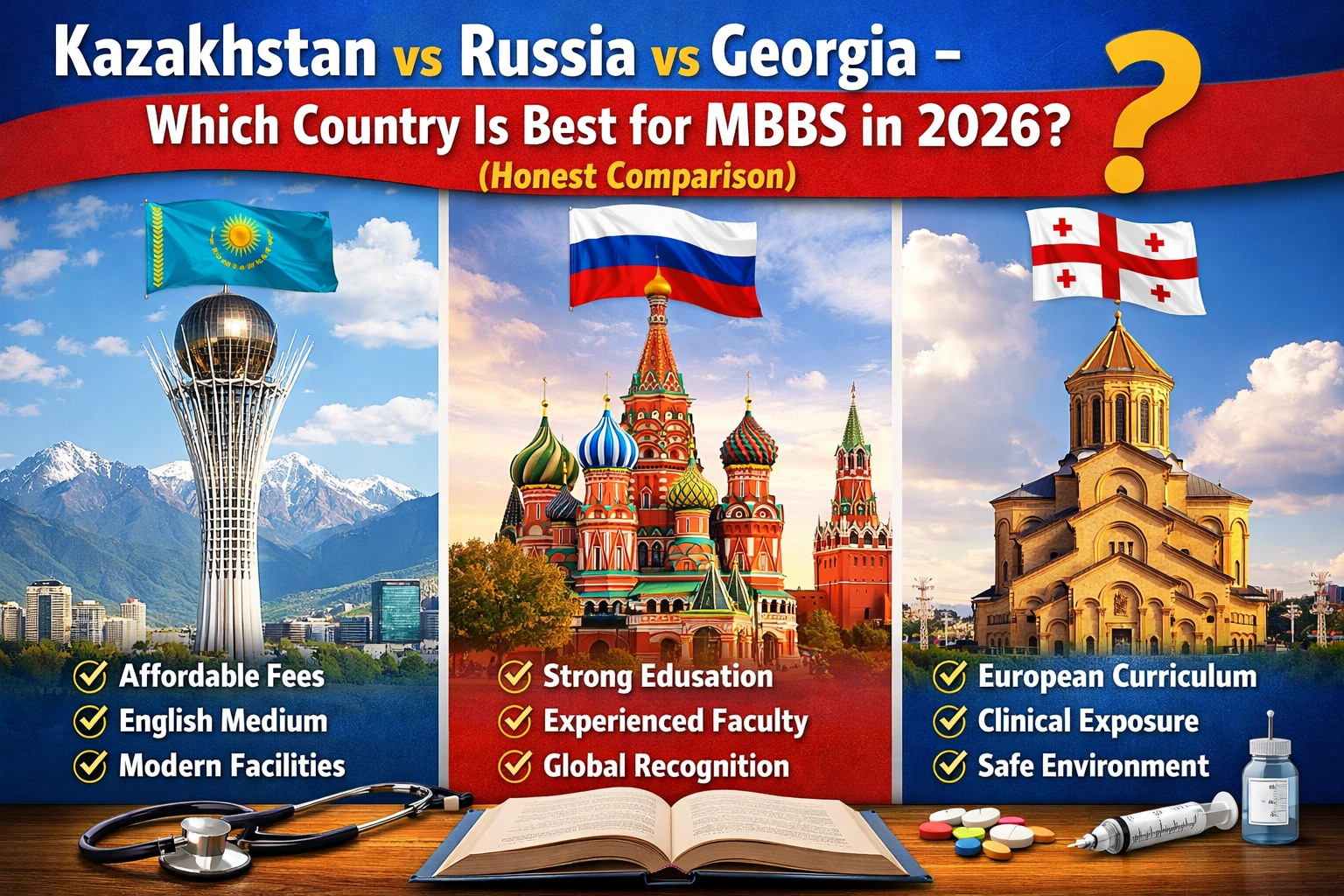
This is a critical decision for students and parents alike. When it comes to where Indian students want to pursue MBBS in 2026, the three nations that are part of this list constantly are Kazakhstan, Russia and Georgia.
All these three destinations provide medical degrees which are globally accepted, recognized by both NMC and WHO, also listed in WDOMS. In these nations, a candidate can be admitted ONLY after qualifying NEET and NO donations are needed.
But the key differences are also in cost, quality of education, clinical exposure, lifestyle and long-term career outcomes. This article compares the two fairly and honestly so that you can make the right choice.
Understanding the Core Differences
Kazakhstan, Russia and Georgia may appear similar at a basic level as they all provide English-medium MBBS programs and have easy entry rules for Indian students. But if you dig into the individual countries, each nation has its strengths and its limitations.
Kazakhstan has the sleeping beauty of affordability, Russia has a serious academic depth and Georgia suitable for modern infra while being comfortable. It all comes down to what you care about most.
Cost of Living: Which Country Is More Expensive
Cost is the most important factor for most Indian families.
Compared to others, MBBS In Kazakhstan is the cheapest. The overall expenditure is more often than not between ₹15 to ₹25 lakhs, hence it is ideal for middle-class families.
The second most expensive country is Russia, where the expense can be anything between ₹18 to ₹35 lakhs depending upon the university and city.
Georgia is the costliest option, where the total expenses can be ₹40 lakhs or beyond because of its European-like education system and higher living expenses.
Kazakhstan, by pure financial metrics, is the obvious value choice.
Education Quality and Clinical Exposure
Russia: Strong Academic Foundation
Russia has had a well-entrenched system of medical education. “Universities receive government funding and have big hospitals affiliated with them. This ensures good clinical exposure and practical training.
In Russia, students get more patient interaction, which is necessary for building real medical skills.
Kazakhstan: Equilibrium but University Dependent
Kazakhstan has an education system that meets international standards. Many provide good theoretical knowledge and on how to improve the exposure clinically.
However, quality varies between institutions. Higher rank universities provide a good bunch of facilities, but the lower-ranked colleges do not give such an extensive training.
Applying to the right university is a critical task in Kazakhstan.
Georgia: Contemporary, but Few Clinical Options
Georgia also has a very modern European education system with great infrastructure. This would be a big advantage, since classes are taught entirely in English.
But there may be lesser clinical exposure as patient flow in hospitals is lower.
Language Factor: Ease of Communication
Language matters a lot when it comes to comfort and learning for students.
Classes are taught in English in Kazakhstan, yet students should have basic local language to practice locally.
In Russia, students have English-medium education by default until they need to speak the local lingo to go to the hospital.
In Georgia, the whole stage is in English and is thus the simplest option as far as language goes.
Georgia is the easiest for students wishing to avoid language barriers.
NEXT Preparation and Career in India
Indian students need to clear NEXT in order to practice in India after MBBS abroad.
That gives Russia a distinct edge in this regard. Its academic organization and clinical exposure allow students to prepare more effectively for licensing examinations.
Compared to MBBS in India, MBBS In Kazakhstan requires more self-study. Universities are doing better, but it's ultimately up to students to prepare for exams.
Georgia emphasizes conceptual learning more than other states do, but students might require extra coaching in order to be ready for NEXT.
Lifestyle and Living Conditions
Kazakhstan
Kazakhstan is a destination for those that love the simple, cheap life. Cost of living is low, and students can maintain their expenditure. It is student-friendly, not luxurious.
Russia
Many of the social adjustments are helped by the size of Indian students in Russia. But it does get quite cold in winters, and living conditions in various city and university can also differ.
Georgia
Georgia is a bit easier and more up to date lifestyle. Respectively, accommodation and city life is much more European. But this comfort means living at a higher cost.
Safety and Environment
All of these three countries are considered safe for international students.
- Kazakhstan is controlled and peaceful, with calm campuses
- Russia maintains strong law enforcement systems
- Georgia is known as one of the safest and most hospitable countries
It should not be a major safety concern in any of these countries as long as students take basic precautions.
Admission Process and Difficulty Level
All three countries are also relatively easy to access.
Students need to qualify NEET and fulfill basic eligibility criteria in science subjects.
Kazakhstan and Georgia is easier and faster to get in. Russia might require a little more paperwork and bureaucracy, but it is doable.
Not one of these countries demands donation and this makes the system crystal clear.
Climate Conditions
Climate is a key consideration — though often ignored.
- Kazakhstan has cold winters, but manageable with facilities
- Russia has very severe winters, which can be challenging
- Georgia has a more pleasant climate, making adjustment easier
Which Country Should You Choose
The right one for you comes down to what you value, not generalized rankings.
- Choose Kazakhstan if you are looking for affordable medical education without donation
- Choose Russia if strong academic training and better clinical exposure are your priority
- Choose Georgia if you want comfort, English-only environment and can afford higher costs
Mistakes Parents and Students Make
Most families base their judgement solely on low fees or which agent is told to them.
Instead, they should focus on:
- University recognition under NMC
- Listing in WDOMS
- Approval by WHO
- Quality of clinical exposure
- Student support systems
No matter the country, the university selection matters more.
Final Verdict
There is no best country for everyone.
Doing MBBS In Kazakhstan is the most affordable and pocket-friendly option.
Russia offers the best academic and clinical training.
Georgia is suitable for comfort, lifestyle and ease of communication.
All options are valid, fulfilling NEET qualification criteria and recognized globally under NMC, WHO and WDOMS.
Conclusion
Also, in 2026, there are several international medical education options for students. The essence is to choose according to individual priorities, not trends.
Kazakhstan, Russia and Georgia each have their own benefits. Long term success in the field of medicine will truly be a combination of an informed decision plus hard work and planning.
The end goal for parents and students shouldn't just be admission, but creating a stable and successful career in medicine.