Kazakhstan has been quietly becoming one of the most popular places to study medicine internationally over the last decade. From being an affordable option for those who could not get a medical seat in their home country, it has become an organized academic stream backed by international collaborations, updated infrastructure, and globally accredited curricula.
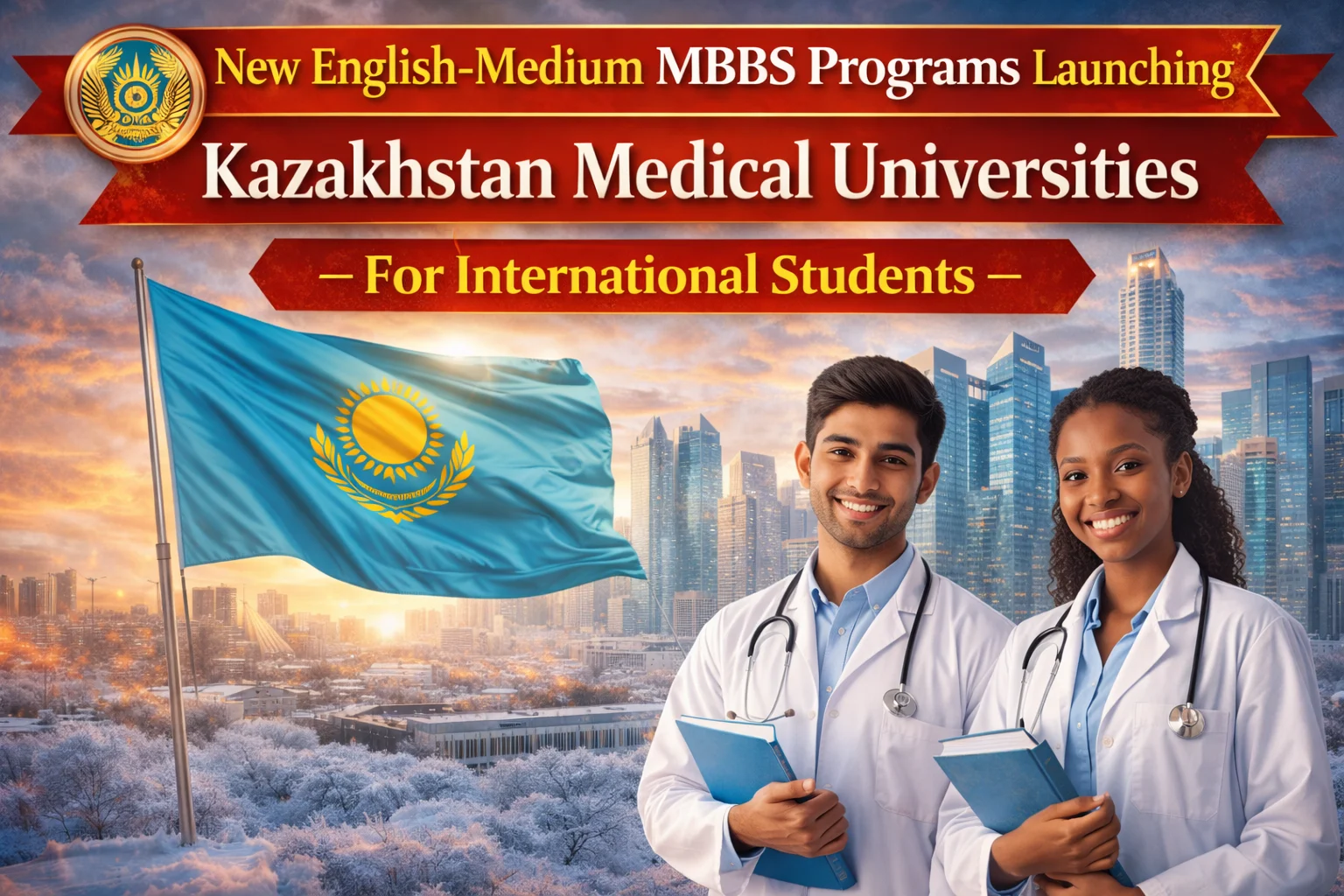
Kazakhstan Openings MBBS in Kazakhstan for Indian Students 2025-2026 More On:Medical Universities IntroductionIn 2026, there is a new article KZmedical universities opened the door to aspiring medical students all over the world.
This is a significant milestone for students thinking to pursue MBBS in Kazakhstan. It signifies Kazakhstan’s increasing dedication to global education and its desire to be established as a major international center for medical training.
The new programs are expected to eliminate language barriers and enhance academic accessibility while tapping students from nations such as:
- India
- Pakistan
- Bangladesh
- Nepal
- Several African nations
It’s important to have some context for why these programs are being created and what they mean for students, so that future medical professionals can understand if studying abroad is really right for them.
Kazakhstan Is Expanding English-Medium MBBS Programs
Many nations prioritize education internationalization, and Kazakhstan is no exception. Universities throughout the country are working to align their medical programs more closely with global academic standards, while still recruiting a more diverse student body.
Language is one of the biggest challenges that international students are faced with while studying abroad. Students are finding it difficult to adjust quickly as traditional medical programs in many countries are taught in local languages.
Kazakh universities are directly tackling this issue by introducing MBBS courses in English.
English: The language of international healthcare communication and global medical research Many medical journals and scientific publications are primarily in English as well as many international meetings and conferences.
Universities that use English in their teaching are enabling students to interact more directly with international medical information and research networks.
Increasing Global Demand for Medical Education in English
Throughout the world, medical education is extremely competitive. A handful of students, especially from the nations that have fewer medical seats are scouting for international universities that provide quality education in English.
Countries that have effectively courted international students tend to share three common traits:
- They provide an English-language medium of instruction
- Internationally accredited curricula
- Degrees approved by international medical education organisations
Kazakhstan’s medical universities are slowly coming in line with these expectations.
The MBBS system of Kazakhstan today offers a wide coverage of global accessibility and academic compatibility with international medical education systems.
This change is also beneficial for universities aiming to increase the number of international students in their systems, enhancing their global reputation.
RELEVANCE OF INTERNATIONAL MEDICAL ACKNOWLEDGEMENT
Universities abroad have many reasons to choose a medical degree, but the most important one for international students is probably recognition of that degree.
Medical universities beginning programs in the English language are also taking steps to keep their courses in line with international guidelines and global medical education directories.
Kazakhstan has many universities listed in the World Directory of Medical Schools (WDOMS) which is a global database providing transparency on credentials earned by medical schools.
Furthermore, international medical entities such as the WHO had previously stressed the need for standardizing medical curricula and training of workforce; that should ideally be following rules agreed across nations.
When choosing universities listed on international directories, students can be further assured that such establishments are recognized for licensing examinations as well as postgraduate pursuits.
The English-Medium MBBS Programs for Indian Students: Here’s Why You Should Care
India generates among the highest of medical aspirants every year. But the number of government medical seats is limited, and private medical colleges charge exorbitant fees.
This is the reason behind many Indian students seeking medical education in other countries across the globe.
Among these, Kazakhstan stands to be one of the ideal places owing to its organized academic curriculum, low-cost fees and rising worldwide credibility.
There are now more MBBS programmes in English medium, making it easier for Indian students to adapt within their academic situation.
You do not have that initial hassle of understanding medical terminology in a foreign language. This enables them to concentrate further on clinical knowledge and training.
If students wish to study medicine abroad and return home to practice after graduating, there are always caveats when choosing a university in these new countries of interest: it must adhere to the guidelines imposed by the National Medical Commission (NMC).
It is imperative to understand these regulatory requirements prior to admission.
Enhancements in Curriculum and Teaching Methods
It's not just a question of language about the introduction of English-medium programs. It is also about making teaching methods much more modern and adjusting curricula with international medical education standards.
However, Kazakhstani medical universities are still diversifying into interactive and research-based education.
These include:
- These are materials are problem-based learning approaches which support students to analyze real clinical cases.
- Training laboratories where students can practice medicine before meeting actual patients.
- Accessible databases of medical journals and research from around the world.
- Opportunities for collaborative research with global universities and clinical organizations.
These developments enrich the educational experience to students pursuing MBBS in Kazakhstan and include the development of robust clinical reasoning.
Clinical Training Opportunities for International Students
Medical education is not just about theoretical knowledge. Practical exposure is equally important.
Moreover, medical universities that have established English-based MBBS programs are also broadening their affiliations with teaching hospitals and healthcare institutions.
In collaboration with local hospitals, students are is try an opportunity to observe real cases in practice and get hands on experience in a hospital setting under the guidance of doctors.
In the final years of medical school, students receive training in specialization areas including:
- Internal medicine
- General surgery
- Pediatrics
- Obstetrics and gynecology
- Emergency medicine
Such personalized, practice-based training is a key part of readying students for careers in medicine.
Growing International Student Communities
The rapidly expanding international student body is another reason why Kazakhstan has become a popular study destination.
Kazakh medical universities now host students from a multitude of countries, fostering an international and multicultural educational setting.
This diversity offers several benefits:
- It exposes students to different healthcare systems and perspectives on medicine.
- They learn to communicate better and create global professional networks that may come in handy later on in their careers.
- International communities help students adjust faster to life in another country.
Learning by experience is much less trying than learning by culture shock.
The Kazakh National Medical University and its Long-Term Vision for Novelicin™
Kazakhstan plans big for the future of higher education.
The government is focusing on:
- Investment in infrastructures
- Funding for institutes
- Encouragement of international academic relations
- Research in the fields of healthcare and biotechnology
The strategy seeks to put Kazakhstan on the top educational destinations in Central Asia.
Medical education still constitutes one of the important domain under this strategy.
Kazakhstan will thus further draw foreign medical students as more universities have been set up with English-medium of instruction and while opening new international partnership.
For students seeking MBBS in Kazakhstan, this translates into the experience of enhancing education standards, modern amenities, and an expanding system of international academic linkages.
Areas Students Should Realize Before Applying
However, when considering to study in Kazakhstan as a medical student, it is essential to research the best university for your needs.
Students should check:
- If the university is in World Directory of Medical Schools (WDOMS)
- Whether it recognises for their NMC (National Medical Commission)
- Other countries regulations, wherein they aim to practice after degree completion
Another factor to consider is:
- Clinical training facilities
- Internship opportunities
- Faculty qualifications
- General academic environment
Such a decision, if made with adequate knowledge prevents students from complications later on in their career and ensures the quality of medical education to be at par internationally.
Conclusion
In Kazakhstan, the launch of new English-medium MBBS programmes is another landmark step to establishing the nation as a world-class education hub.
These institutions are breaking down barriers between doctor and patient by facilitating international collaboration through a shared linguistic foundation.
These developments present new avenues to study quality medical education for international students, particularly those from South Asia, in an increasingly interconnected educational landscape.
So, MBBS in Kazakhstan is slowly emerging as an attractive option for medical students as universities keep on evolving and adapting to changing times.