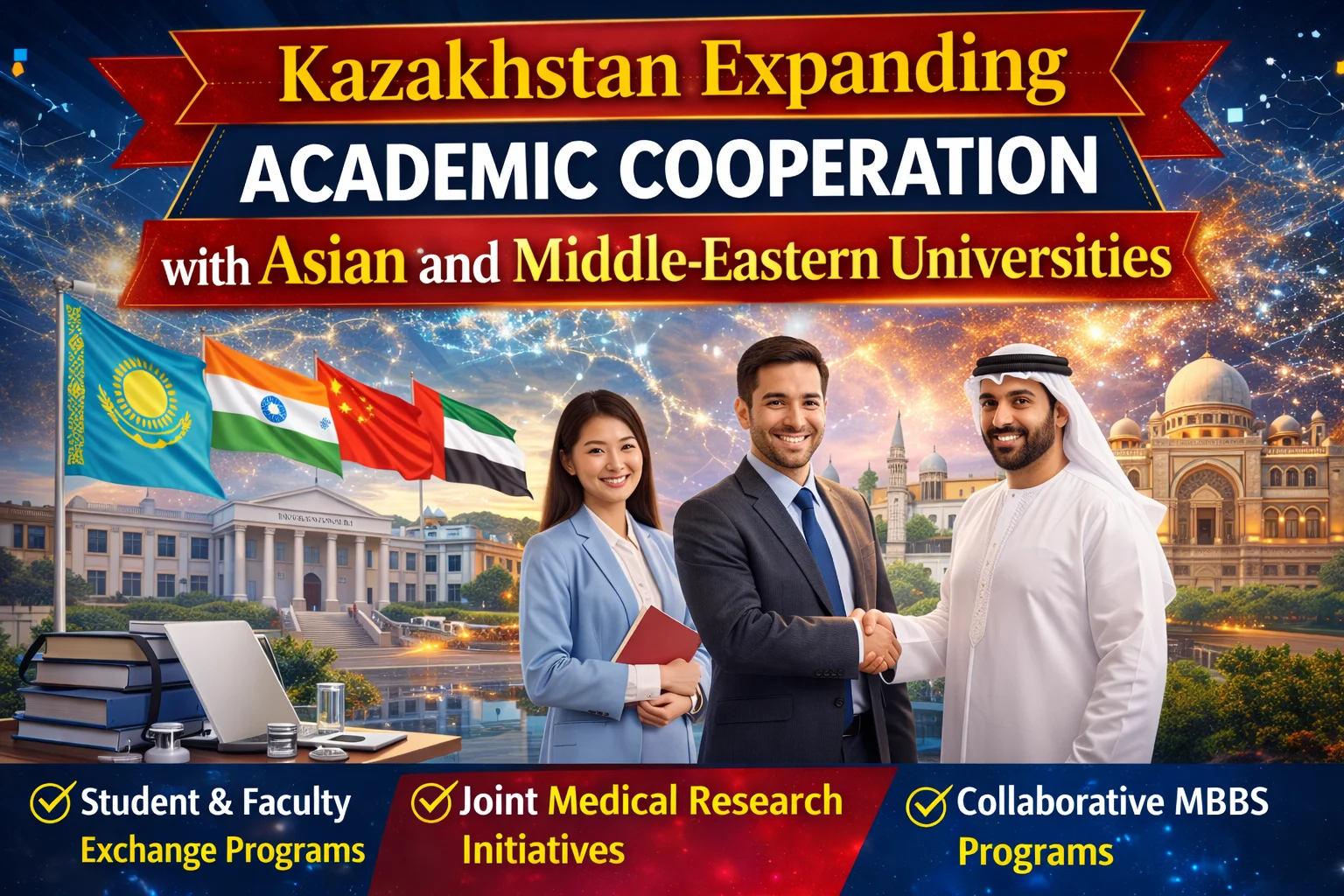
Kazakhstan: A rising star on the international education stageKazakhstan is steadily building its higher education system into an important player on the global scene. Central to this transformation is a push for academic cooperation with universities in Asia and the Middle East. Kazakhstan is on its way to becoming one of the leading academic hubs through collaborations, joint-research projects, student exchange programs and partnerships.
This significant development is very good news for aspirants of the medical field, especially if you are an international student! As universities enter new partnerships with institutions in countries like China, the United Arab Emirates, Turkey, Malaysia and a number of Middle Eastern countries, opportunities for cross-border learning and research are growing quickly.
These international partnerships can greatly improve academic exposure, research opportunities and career prospects on a global scale for students with MBBS in Kazakhstan.
Kazakhstan’s Plan to Globalize Higher Education
Kazakhstan has been strongly focused on education and internationalization in recent years. This passage encourages universities to work with international institutions to enhance quality in academics, knowledge sharing and joint educational ventures.
This method enables academic institutions to exchange their local academic standards globally, creating a wider approach for international students and faculty members.
Partnership agreements usually have initiatives, such as:
- Joint degree programs
- Faculty exchange programs
- Collaborative medical research
- Student mobility and exchange opportunities
- International academic conferences
Kazakhstan has positioned itself between the higher education systems of Europe and Asia through its partnerships with Asian and Middle-Eastern universities.
Studying in Kazakhstan for MBBS offers access to world-class medical institutions, innovative research facilities, and global networks.
Growing Partnerships with Asian Universities
Kazakhstan’s higher education sector is now a vital partner for Asian countries. Kazakh institutions are collaborating with universities in China, South Korea, Malaysia and India on research projects, academic training and exchange programs.
These partnerships will enable students and researchers to collaborate on global healthcare problems like infectious diseases, public health systems, and the creation of medical technology.
Kazakhstan's medical universities are becoming more active participants in international research, with increasing involvement of Asian partners. Such projects contribute to strengthening scientific research capabilities and give medical students the opportunity to engage in international academic work.
MBBS in Kazakhstan can benefit from these partnerships by having exposure to joint research programs, academic conference opportunities, and international clinical training experiences.
Expanding our reach to strategic Middle-Eastern educational institutions
Kazakh educational institutions are also extending their academic cooperation with universities of the Middle East. AI-based Outcomes Increasing Interest in Academic Infrastructure: Such as that of the UAE, KSA, Qatar and Jordan.
These collaborations cover a wide range of topics, medical research, health care training and biotechnology, public health studies.
Kazakh universities frequently partner with those in the Middle East to host international seminar programs, medical workshops, and collaborative research projects.
These kinds of partnerships allow students and researchers to learn and share knowledge about healthcare systems in other parts of the world.
These collaborations can open new avenues for international students pursuing an MBBS in Kazakhstan, providing opportunities for academic networking and global exposure.
Benefits for Medical Education
Kazakhstan must also involve medical universities in actively cooperating with international academic institutions.
With international collaboration, universities can modernize their curricula, adopt innovative teaching methods and create research-intensive medical education programs.
Medical students may benefit from international guest lectures, joint academic workshops and collaborative research projects.
There are two reasons international medical exposure helps.
Also, the medical universities which have engaged in such international bilateral partnerships for mutual recognition usually abide by the indexes accepted globally like World Directory of Medical Schools (WDOMS).
Moreover, the WHO and other international health organizations shape medical education standards worldwide, promoting global collaboration in healthcare training and research.
It is also important for Indian students that the university meets guidelines laid down by the National Medical Commission (NMC) so that they can practice as a doctor in India after graduating from there.
All of these factors contribute to international cooperation being central in increasing the credibility and recognition of MBBS in Kazakhstan programs.
Research Collaboration and Innovation
Joint research has emerged as one of the most important results of international academic cooperation.
Partnering through academia across international borders can provide shared knowledge, research labs and scientific information.
In the context of medical education, such collaborations typically address key areas including:
- Public health research
- Epidemiology and disease prevention
- Medical technology innovation
- Pharmaceutical research
- Global healthcare challenges
This combination of academic inquiry and research initiative preparation offers grazing experience for students which they can leverage into a strengthening of their academic profiles or as face-saving for potential careers.
The MBBS students of Kazakhstan can also take part in the global research collaborations providing exposure to cutting-edge medical technologies as well as discovering the world healthcare problems.
Cultural Exchange and Student Mobility
Academic cooperation also encourages cultural exchange between students of various countries.
The programs allow participants to spend a part of their years studying at partner universities abroad. This experience introduces students to different learning environments and cultural perspectives.
Working with patients from diverse backgrounds, cultural exchange is an unskipable part of medical training.
Students learn communication skills, cultural awareness and a more comprehensive view of global healthcare systems by engaging with peers from other countries.
Openings for international exposure via India partnerships are significant returns here, especially if you have a student pursuing an MBBS in Kazakhstan.
Expanding Opportunities for International Students
Kazakhstan is also increasing the number of international students attracted to the country through academic cooperation with Asian and Middle-Eastern universities.
Through these partnerships, Kazakh universities gain visibility in global academic networks and open doors for students from the partner countries to come study in Kazakhstan.
Universities are also launching new English…
This expanding global academic community contributes to a multicultural learning environment in which students from various corners of the Earth learn and work side-by-side.
For international students planning to study MBBS in Kazakhstan, these measures are a clear indication that the medical education sector of the country is increasingly becoming globalized.
What Kazakhstan’s Vision for Higher Education Could Look Like
Kazakhstan’s growing academic collaboration is more than just a sign of its renewed focus on higher education; it is the realization of Kazakhstan’s long-term Ziel as a leading Central Asian internationalization center for knowledge exchange.
The country has always been pursuing research development with universities all across Asia and the Middle East in an attempt to improve academic standards, boost talent from all over the globe.
Research infrastructure, contemporary campuses and international programs are helping Kazakhstan’s universities transition to global institutions.
This change is heart cleansing when for aspiring and existing medical professionals, studying MBBS in Kazakhstan now not only promises affordable education but also international academic networks and global learning opportunities.
Kazakhstan is likely to play a prominent role in the future of international medical education as it continues to develop and strengthen its partnerships in this area.