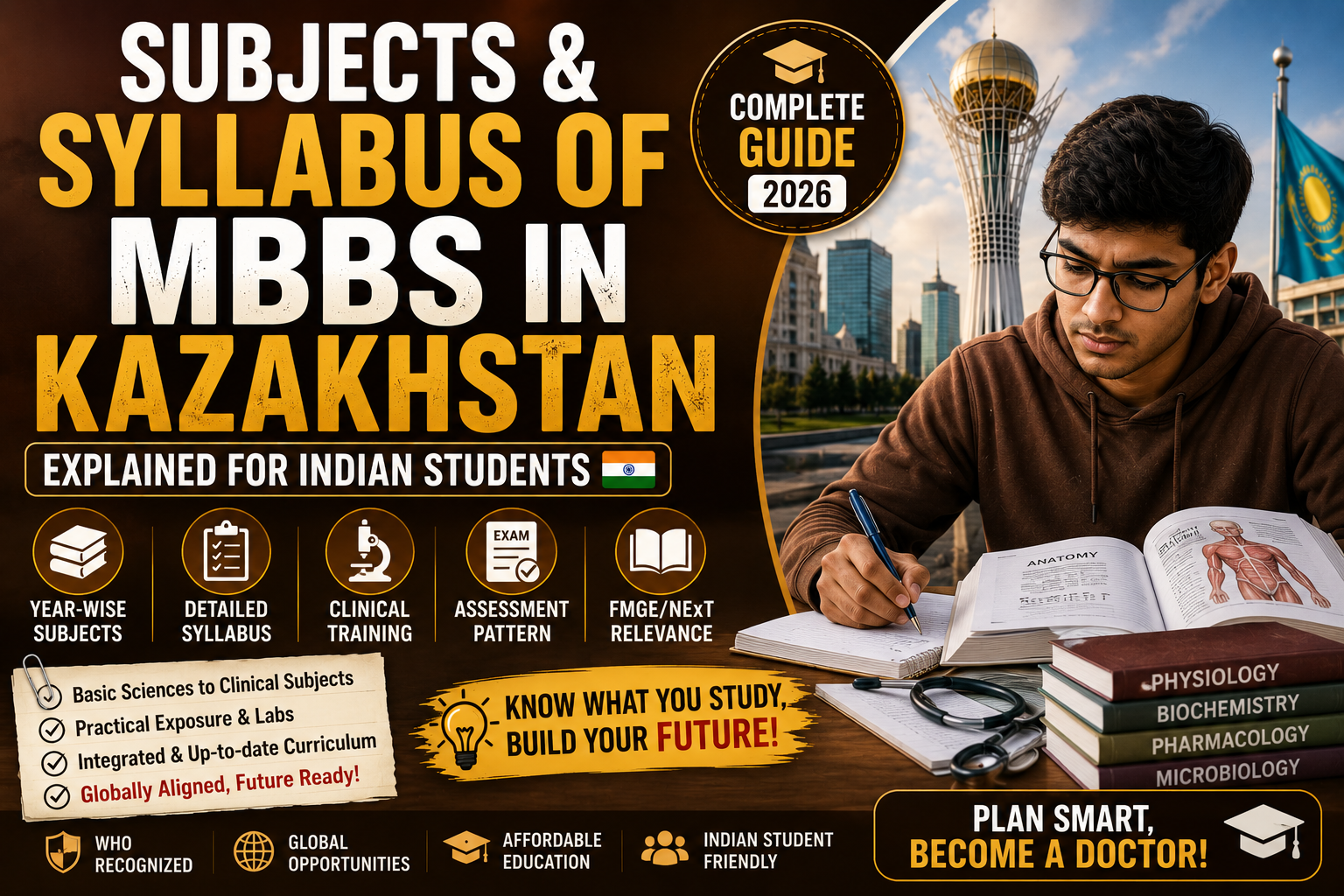
MBBS in Kazakhstan is not only affordable but also a perfect combination of education structure, subjects, and clinical exposure that helps you to develop into the doctor of tomorrow. Indian students need clarity on what is considered the syllabus as it directly relates to their preparation in licensing exams and general medical competency.
The MBBS study guide in Kazakhstan is systematically simplified and written according to the actual requirement of Indian students.
This is a typical 6-week curriculum structure by which an MBBS course is designed.
Kazakhstan is offering an Integrated 6 Year MBBS Program including internship. It adheres to a sequential medical education pattern, where theory is taught before actual patient care:
- Years 1–2: Pre-Clinical (Fundamentals)
- Year 3: Para-Clinical (Bridge Phase)
- Years 4–5: Clinical (Hospital-Based Learning)
- Year 6: Internship (Hands-on Practice)
The reason this evolution in learning happens over time is so students can not only learn the concepts, but apply them in a clinical setting.
Year 1–2: The Medical Foundation
These years are the core of your medical knowledge and involve a lot of studying.
Core Subjects:
- Anatomy (human body structure)
- Physiology (body functions)
- Biochemistry (chemical processes that occur in the body)
- Histology (microscopic anatomy)
- Genetics & Immunology (for some schools)
What You Actually Do:
- Attend lectures and lab sessions
- Perform dissections (in many universities)
- You will learn medical terminology and basics.
Student Insight:
This phase is in tenure with the first preclinical year of MBBS in India and does require more self-study, clearer concepts to get by.
Year 3: The Change Up (when shit gets real)
This is th emost significant change of you MBBS journey.
Subjects:
- Pathology (disease mechanisms)
- Pharmacology (drug action and usage)
- Microbiology (bacteria, viruses, infections)
- Forensic Medicine
- Community Medicine
What Changes:
- First exposure to hospitals
- Observation of real patients
- Basic case discussions
Student Insight:
This is the point where theory begins to merge with clinical reality. The more regular students are here, the better they do in future.
Year 4–5: Core Clinical Training
The most important years are when you will become a doctor.
Major Subjects:
- General Medicine
- General Surgery
- Pediatrics
- Obstetrics & Gynecology
- Orthopedics
Advanced Subjects (later phase):
- Cardiology
- Neurology
- Psychiatry
- Dermatology
- Emergency Medicine
What You Do Daily:
- Attend hospital postings
- Interact with patients
- Participate in ward rounds
- Present clinical cases
Student Insight:
Again, clinical exposure highly depends upon you and not your university. Active students are way more experienced.
Sr.6 – InternsGet to practice real medicine
The third and final year is totally hands on and gets you ready to practice medicine.
Rotations Include:
- Medicine
- Surgery
- Pediatrics
- Emergency & ICU
- Community health
Your Role:
- Assist doctors
- Handle patients under supervision
- Write case reports
- Learn hospital workflow
Student Insight:
This year is your entire confidence as a doctor. Take it seriously.
Teaching Style in Kazakhstan: What is Different?
Kazakhstan actually follows the European teaching model for University, which is comprised of:
- Lecture-based learning
- Practical lab sessions
- Problem-Based Learning (PBL)
- Clinical case discussions
- Continuous internal assessments
This is unlike India, where you are spoon-fed knowledge—here you have to learn and know for yourself (which can be challenging at first but helps in the long run).
Important Reality for Indian Students
Studying abroad comes with responsibility. You have to study with Indian requirements.
- Your University is bound by the guidelines of NMC
- FMGE (or NExT) — the screening exam for foreign medical graduates on graduation after MBBS
Key Advice:
- Get in to FMGE/NExT preparation from years 2 or 3 rather than post-graduation.
Pros of MBBS Syllabus in Kazakhstan
- Step-by-step structured learning
- Early exposure to clinical practice
- Strong emphasis on practical training
- Globally aligned curriculum (as per WHO standards and listing in WDOMS)
Final Verdict
Kazakhstan MBBS syllabus is well formatted and clinical oriented but your success totally depend on how you use it.
If you:
- Be consistent since year 1
- Actively participate in clinical training
- Prepare early for licensing exams like NEET
that can allow you to have a solid and aggressive position in the medical world
Kazakhstan is, in simple terms, the opportunity: we make you a platform and it is your discipline and strategy that will lead to winning.