I still remember a father at a Lucknow education fair, standing near the Kazakhstan stall, doing math on the back of an admission brochure. His daughter had missed a decent government seat by four marks in NEET, and he wasn't angry anymore, just tired, asking the same question every second parent asks me now: "Sir, per month kitna lagega, sach sach bataiye." Not the glossy consultancy number. The real one.
That question — the real monthly figure, not the marketing one — is what most agents dodge. They'll quote you an annual tuition fee, sometimes even a five-year "total package," and leave the rent, food, winter clothes, and flight tickets for you to discover after your child has already landed in Almaty in November with two t-shirts and a light jacket.
I've counselled families for over a decade now, and I've learned that Kazakhstan MBBS costs make sense only when you break them down monthly, the way a household budget actually works. So let's do that here, honestly, city by city, expense by expense.
What Tuition Actually Costs Once You Divide It by Twelve
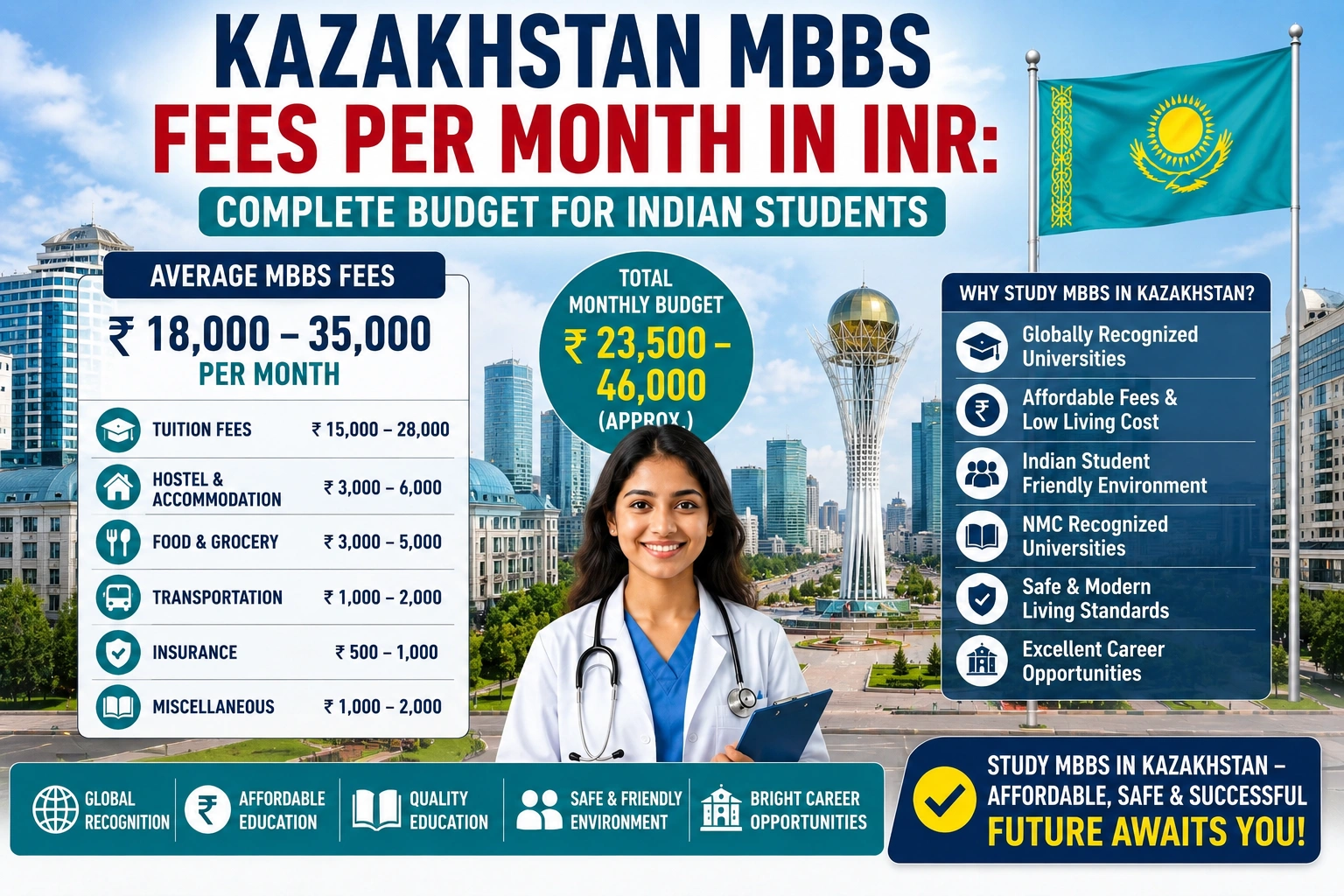
Most universities offering MBBS in Kazakhstan charge tuition annually, somewhere between USD 3,500 and USD 6,000 a year depending on the institution and city. Al-Farabi Kazakh National University in Almaty sits toward the higher end. Semey State Medical University and West Kazakhstan Marat Ospanov Medical University are noticeably cheaper. Divide that annual figure by twelve and you're looking at roughly ₹20,000 to ₹35,000 a month in tuition alone, once you account for rupee-dollar conversion swings.
That's the number nobody tells you upfront. Not because it's hidden. Because it's inconvenient to say out loud when you're trying to close an admission that week.
Rent, Food, and the Hostel Reality Nobody Photographs
Hostel accommodation in most Kazakh medical universities runs between USD 40 and USD 90 a month, so roughly ₹3,500 to ₹8,000. Karaganda and Shymkent are cheaper than Almaty or Astana, where private flat-sharing among four or five Indian students can push rent closer to ₹10,000-₹12,000 per head if they want more space and privacy.
Food is where I've seen budgets go sideways the most. A student cooking at home — dal, rice, roti, the basics — spends around ₹6,000 to ₹8,000 a month, including the Indian grocery stores that have quietly sprung up near university hostels in Almaty and Astana specifically to serve this demand. Eating out regularly, or relying on the hostel canteen for everything, can push that to ₹10,000 or more. I've spoken to seniors in Almaty who say the first three months are the hardest, because you're still figuring out which local market sells what, and homesickness hits harder over food than almost anything else. One girl told me she cried the first time she couldn't find proper turmeric.
The Cold Weather Bill Nobody Puts on the Fee Structure
Winters in Kazakhstan are brutal — temperatures in Astana regularly drop below minus 20 degrees Celsius between December and February. A proper thermal jacket, snow boots, and layered inner-wear will cost a fresh student anywhere from ₹15,000 to ₹25,000 in the first year alone. This is a one-time cost, not monthly, but it lands hard in September and October when families are already stretched from paying admission fees. I always tell parents: budget for winter gear the way you'd budget for a laptop. It is not optional.
Flights, SIM Cards, and the Small Costs That Add Up
A round trip between Delhi or Mumbai and Almaty typically costs between ₹28,000 and ₹45,000 depending on season and airline, and most students fly home once, sometimes twice, a year. Spread across twelve months, that's roughly ₹3,000 to ₹5,000 monthly if you're budgeting sensibly rather than getting surprised in June when ticket prices spike. Add a local SIM and internet at around ₹800-₹1,200 a month, local transport at ₹1,500-₹2,500, and you start seeing why the "total monthly cost" conversation matters more than the "annual tuition" one.
So What's the Realistic Monthly Number
Putting tuition, rent, food, utilities, and amortized annual costs like flights and winter wear together, most Indian students pursuing MBBS in Kazakhstan for Indian Student programs are realistically spending between ₹35,000 and ₹55,000 a month, all-inclusive. That's considerably lower than private medical colleges in India, where monthly costs at some deemed universities can cross ₹1 lakh easily. But — and I want to be blunt here — it is not the "₹15,000 a month" figure some agents throw around to close a sale fast. If someone quotes you that number, ask them what exactly it excludes. Usually, quite a lot.
Why the Degree's Recognition Still Matters More Than the Rent
None of this budgeting means anything if the degree isn't valid back home. Universities offering Study MBBS in Kazakhstan programs to Indian students need to be listed with the WDOMS directory and recognized under NMC screening test norms, and the medical curriculum itself should broadly align with standards the WHO recognizes globally. I've met students who chose a cheaper, lesser-known university purely on rent savings, only to struggle later with recognition paperwork. Saving ₹5,000 a month isn't worth it if it costs you a year sorting out eligibility for the FMGE.
Conclusion
Kazakhstan remains a genuinely viable, cost-sensible option for Indian students who didn't clear NEET cutoffs for government seats and can't stretch to private Indian college fees. But go in with real numbers, not brochure numbers. Talk to at least two or three current students in whichever city you're considering — Almaty, Astana, Shymkent, wherever — before you sign anything. Ask them what they actually spend, not what the university website says they should spend. The gap between those two figures is usually where the real story lives.
Disclaimer: Fee and cost figures mentioned are approximate, based on general market trends as of 2026, and may vary by university, city, and currency exchange rates — please verify current figures directly with the respective institution before making financial decisions.