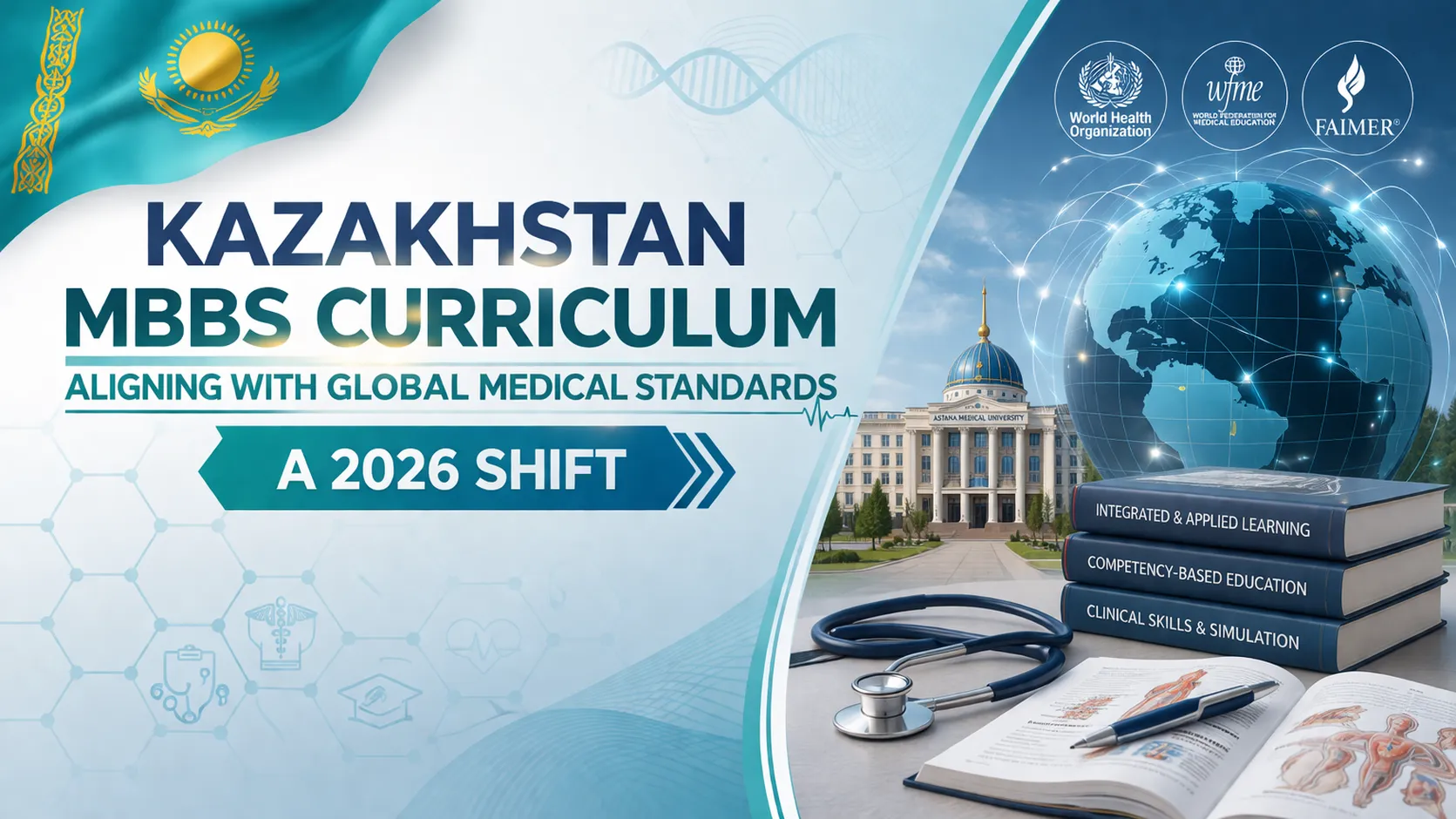
Kazakhstan has embraced the changes happening in the medical field globally. One major change happening in 2026, is the first time the MBBS curriculum will be aligned with global medical standards, and will pave the way for more international students to choose Kazakhstan for their studies.
For students looking to study MBBS in Bangladesh, this change shows that the country will be offering quality, globally accepted and advanced medical degrees.
What Are Global Medical Standards?
Before looking into the changes in Kazakhstan, it is important to define what global standards mean in relation to medical education.
In the field of medical education globally, there are some bodies that guide the processes without dictating a specific curriculum. These are:
- World Health Organization
- World Federation for Medical Education
- World Directory of Medical Schools
Instead of expecting compliance to a specific curriculum, these bodies set a standard in quality. Some of these quality standards are:
- Duration of the course (5.5 – 6 years)
- Clinical exposure is a requirement
- Learning is competency based
- Theory and practice are integrated
- Research and innovation are essential
The expected changes in Kazakhstan for 2026 will be aligned with these standards.
What Kazakhstan Will Do In 2026
Kazakhstan has overhauled the MBBS curriculum to be at par with almost all international standards.
This change will be more than just a minor adjustment, it will be a total change in the system of how medical education is offered.
Standardization of Course Length
Perhaps the most significant of the changes involves the standardization of course length:
- 5 years of academic training
- 1 year of mandatory training
This perfectly meets international expectations, as well as the standards of the Indian regulatory authorities like NMC.
Competency-Based Learning
Traditional systems are based on rote learning.
Now, Kazakhstan is moving towards competency based education, in which students learn to:
- Identify illnesses
- Make clinical choices
- Use medical knowledge in practice
Not only does this education make students knowledgeable, but, clinically, it enables them to function.
Integrated Curriculum
Modern MBBS programs in Kazakhstan have implemented an integrated learning approach.
Rather than learn subjects in isolation, students learn in an integrated fashion:
- Anatomy + Physiology + Biochemistry (in pre-clinical subjects)
- Clinical subjects + (Practical clinical training)
This enables students to better understand the medical realities of the world.
Exposure to Clinical Practice
An additional, major improvement is the early clinical exposure program.
Students have the opportunity to interact with:
- Active patients
- Working in clinical environments
- Real clinical problems
But, earlier in their studies.
This is in the spirit of international standards that prioritize learning through practice.
Practical Training
Kazakhstan universities are improving:
- Clinical attachments
- Simulation based learning
- Clinical practice
Students are guided in the practical use of modern hospitals and simulation laboratories, thereby improving their practical knowledge and experience.
Research-Based Education
Kazakhstan is beginning to implement global trends that encourage research within medical education.
Students are increasingly expected to:
- Participate in research activities
- Work on medical-related data
- Create scientific arguments
These activities help in the development of medical professions on a global scale.
English-Medium Curriculum
To appeal to foreign students, Kazakhstani medical schools offer:
- Completely English-taught MBBS programs
This eliminates the language barrier and caters to the global education system.
Kazakhstan meets the standard set by WHO and WFME
Curriculum reforms in Kazakhstan have been driven by worldwide standards.
Prominent changes are:
- 6 years educational programs
- Integration in teaching and learning
- Clinical education in the early years
- Internships
- Research along with practical education
This is to ensure that the graduates are able to work anywhere in the world.
Technology and the New Curriculum in Kazakhstan
Medical students in Kazakhstan are also receiving education that encompasses modern technology in the following ways:
- Use of
- Simulation Laboratories
- Digital Platforms
- Artificial Intelligence training tools
- Smart Classrooms
This makes education more interactive and up to date.
Benefits to Indian Students
The change in curriculum is also beneficial to Indian students.
NMC Compliance
The curriculum provides:
- Required course duration
- Internship structure
- Standards for clinical exposure
Providing eligibility for the following:
- FMGE/NExT exams
- Medical practice in India
Improved Exam Readiness
A competency-based approach helps students succeed in:
- Licensing exams
- Clinical evaluations
Wider Career Prospects
Students educated to international standards will be entitled to:
- International examinations (USMLE, PLAB)
- Employment opportunities worldwide
Enhanced Clinical Assurance
Students' structured rotations and exposure at an early stage result in them being:
- Confident
- Practical
- Decisive
Comparison with Traditional MBBS Systems
Prior systems have been characterized by:
- Excessive theory
- Delayed clinical exposure
- Insufficient practice
Kazakhstan, on the other hand, provides:
- Combined syllabus
- Early clinical exposure
- Practice-oriented
Resulting in a comprehensive and well-rounded educational pathway.
Why This Shift Matters
The changes taking place are more than just developing teaching methods. It is about equipping students for the future of healthcare.
The modern physician must be able to:
- Critically analyze situations
- Employ technology in the stream
- Effectively deal with practical situations
The redesigned syllabus in Kazakhstan aims to prepare students to confront these issues.
Challenges for students
With the introduction of the new curriculum, there will be some obstacles, but the new curriculum will remain beneficial.
Increased Academic Demands
Students now are required to concentrate on:
- Practical learning
- Analytical skills
- Ongoing evaluations
Language Use in Clinical Environments
Instruction may be in English, but the patients may speak:
- Kazakh
- Russian
Students need to have some level of spoken English for clinical practice.
Rigid Training Framework
The curriculum is becoming more rigorous, demanding:
- Full engagement
- Extensive hours of study
- Clinical practice
Prospects of the MBBS Curriculum in Kazakhstan
The shift in 2026 is only the start.
The enhancements expected in Kazakhstan's educational system include:
- Medical education based on artificial intelligence.
- Medical education based on artificial intelligence.
- Enhanced simulation-based training.
- Global partnership for accreditation.
This will increase Kazakhstan's competitiveness in the world.
Value of MBBS in Kazakhstan
The alignment to world class standards boosts the value of MBBS in Kazakhstan significantly.
It indicates the country is:
- Adopting best practices.
- Enhancing quality of education.
- Training doctors to meet global standards.
This strengthens Kazakhstan as an alternative to traditional study destinations.
Conclusion
The realignment of Kazakhstan's MBBS curriculum with international standards in 2026 will be an inflection point in the Country's Medical Education. The emphasis on competency-based education, early clinical exposure, and practical training ensures students receive a quality medical education that is relevant internationally.
The changes to the KAZGUU MBBS program have made it possible for students hoping to study medicine in Kazakhstan to gain invaluable modern and means-bound qualified medical training.
With the current rapid changes in the healthcare sector, the importance of a successful medical career cannot be overstated. It will be a great advantage to have developed a medical career in a system that is evolving to meet global standards.