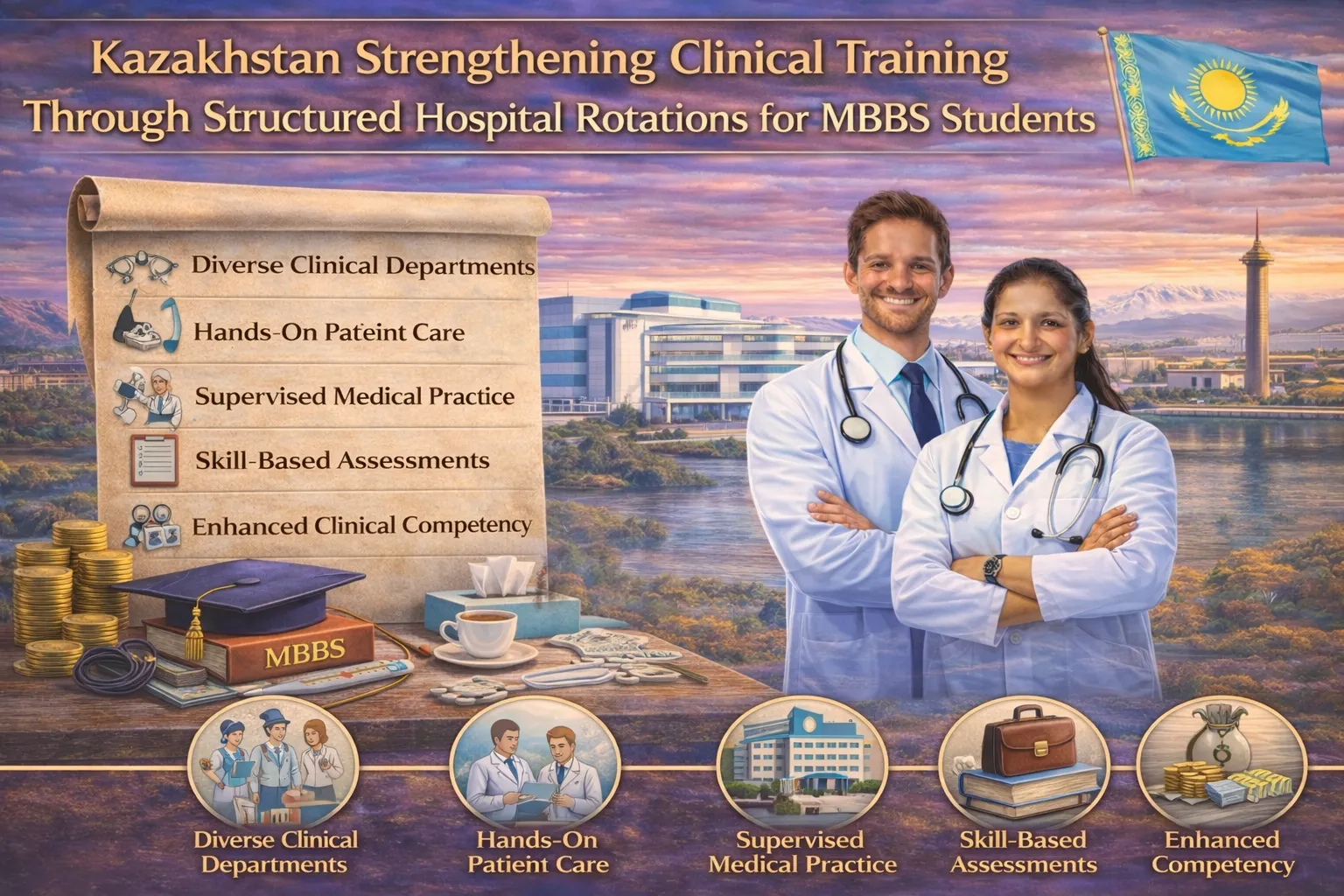
A modern medical education is no longer based just on having students read and learn from textbooks. Starting in 2026, Kazakhstan will be improving the clinical component of its MBBS program with organized hospital rotations.
For students wanting to do an MBBS in Kazakhstan
, this is of utmost importance, as it relates to students' practical abilities, self-assurance, and real-world, post-education, medical practice.
The Move Towards More Practical Medical Training
In the past, a considerable part of the MBBS curricula of Kazakhstan, and many countries, emphasized theory and textbooks during the first few years. That approach is no longer suitable for the modern world of medicine, as it requires new practitioners who are able to be:
- Clinically competent
- Make decisions on the fly
- Work with real, live patients
Kazakhstan has responded to this and is revising the country’s MBBS curriculum to increase the amount of clinical exposure students will have in the first few years of the program.
What Are Organized Hospital Rotations?
Organized hospital rotations create a structure where medical students:
- Move around various hospital units
- Work with real doctors
- Deal with real patients
Rather than having a random or a limited number of rotations, their rotations are planned to include a minimum number of patients in each a defined, and comprehensive as possible, number of medical fields, such as:
- Medicine
- Surgery
- Pediatrics
- Obstetrics & Gynecology
- Psychiatry
- Emergency Medicine
This guarantees complete clinical training.
How Kazakhstan Is Implementing This System
Medical universities in Kazakhstan have begun updating their MBBS programs to incorporate international standards of clinical training.
1. Early Clinical Exposure
Instead of waiting to the last year, clinical training starts early, from year 3.
Benefits to early exposure include;
- Understanding patient interaction early
- Connecting theory to practice
- Confidence building
2. Stepped approach
Kazakhstan MBBS programs structure their training in the following order;
- Years 1-2 -> Pre-clinical subjects
- Years 3-4 -> Clinical subjects, including hospital rotations
- Year 5 -> Clinical training
- Year 6 -> Specialty internship
This practice ensures that there is a seamless transition from theory to practice.
3. Compulsory Rotating Internship
An important aspect of the system is the obligation to undertake a 1 year rotating internship. During the internship, students;
- rotate through various clinical departments of a hospital
- Work under supervision to undertake clinical procedures
- Handle patients
This internship is a requirement to be licensed as a medical practitioner.
4. Educational Partnerships
The majority of medical universities in Kazakhstan have an educational partnership with a major teaching hospital. These host hospitals offer
- Exposure to patients
- Access to contemporary medical technology
- Instruction from practicing physicians.
Participation in clinical procedures is a requirement. However, students assume the role of an active clinician, rather than an observer.
Hospital Rotation Departments
Students undergo systematic clinical rotations to learn the fundamentals for the most important specialties.
General Medicine
Students focus on:
- The diagnosis of diseases
- Taking patient histories
- Creating management plans
Surgery
Training focuses on:
- The peri-operative phases
- Surgical assisting
- Participating in and observing surgical procedures
Pediatrics
Students learn child health and work with children on:
- The health of children
- The monitoring and management of the growth and development
- The management of childhood illnesses
Obstetrics and Gynecology
Students learn about:
- The care of pregnant women
- The process of childbirth
- The health of women
Emergency Medicine
Students learn about:
- The management of life-threatening conditions
- The response to emergencies
- The management of trauma
Benefits of the System for MBBS Students
The system of clinical rotations in hospitals has various positive attributes.
1. Excellent Clinical Skills
Students gain:
- The ability to make a diagnosis
- The ability to handle patients
- The acquisition of useful knowledge about the practice of medicine
2. More Self-Assurance
Repeated exposure to situations helps to eliminate apprehension and build confidence.
3. Better Preparation for Licensing Exams
Students with a good grasp of clinical practice perform well in the licensing exams:
- FMGE
- NExT
4. Preparedness to Work Anywhere in the World
Students who undergo this type of training are well-suited to take:
- The USMLE, PLAB
- Work anywhere in the world in the health care system
5. Fit with the Present Day Health Care System
Kazakhstan’s system helps to ensure that students are trained in a practical and technology oriented health care system.
Comparison with Other Systems
In most systems:
- Clinical exposure is late
- Practical training is non-existent
- There's an overreliance on theory
In Kazakhstan:
- Clinical exposure starts early
- There are structured rotations
- Internships are intensive
This offers a more balanced and effective educational experience.
Integration of Clinical Training and Technology
Kazakhstan is also using:
- Simulated environments
- Digital patient files
- AI
Students practice in simulation environments before moving on to real clinical work, which makes the transition easier and safer.
Value Addition to MBBS in Kazakhstan
Enhanced clinical training means an MBBS in Kazakhstan is more valuable.
It means
- The country is putting an emphasis on practical training,
- The country is improving, globally in terms of medical education
- The country is improving student outcomes
This increases the attractiveness of Kazakhstan than other destinations for MBBS abroad.
Potential Challenges for Students
Although the system has its merits, there are potential challenges that students will likely have to face.
1. The Language Problem
Patients may speak:
- Kazakh
- Russian
Basic local language is usually taught to students for communication purposes.
2. A Heavy Workload
Clinical training comes with:
- Long hours in the hospitals
- Expected to be very active
- High levels of commitment
3. Adjusting to the Real Hospital Environment
Managing real patients is generally seen as a tough task. However, it is one that is improved by experience.
The trend for clinical training in Kazakhstan
There are always new adjustments in the field of medicine, and Kazakhstan keeps finding ways to improve their medical training.
For the next few years, we can expect to see:
- New and updated medical training partnerships with hospitals and medical centers
- New opportunities for international clinical exchange
- New methods for training which includes AI diagnostic training
- New smart hospitals in Kazakhstan to be used for training
These adjustments will provide better and more effective clinical training for medical students in Kazakhstan.
Why This Is Important
Clinical training is one of the most important aspects of teaching medicine.
With an effective rotation system, students are able to:
- Not only learn the theory part of a specific medical specialty
- But they will also get to experience real life medical practice and apply their skills
The future of the quality of patient care services is highly dependent on this.
Conclusion
The structured rotations in hospitals system is a big step for Kazakhstan’s MBBS programs. With the most cutting-edge methods of teaching and the most modern training systems, Kazakhstan is the only country offering medical student graduates clinical training and real-world work experience.
Medical students from Kazakhstan will be guaranteed real clinical experience, making the country one of the most desirable for medical study.
It is also one of the most affordable destinations for real international clinical exchange opportunities for quality-based global training.
It is one of the best destinations simultaneously offering affordable international clinical exchange, practical quality-based clinical training, and globally relevant qualifications.