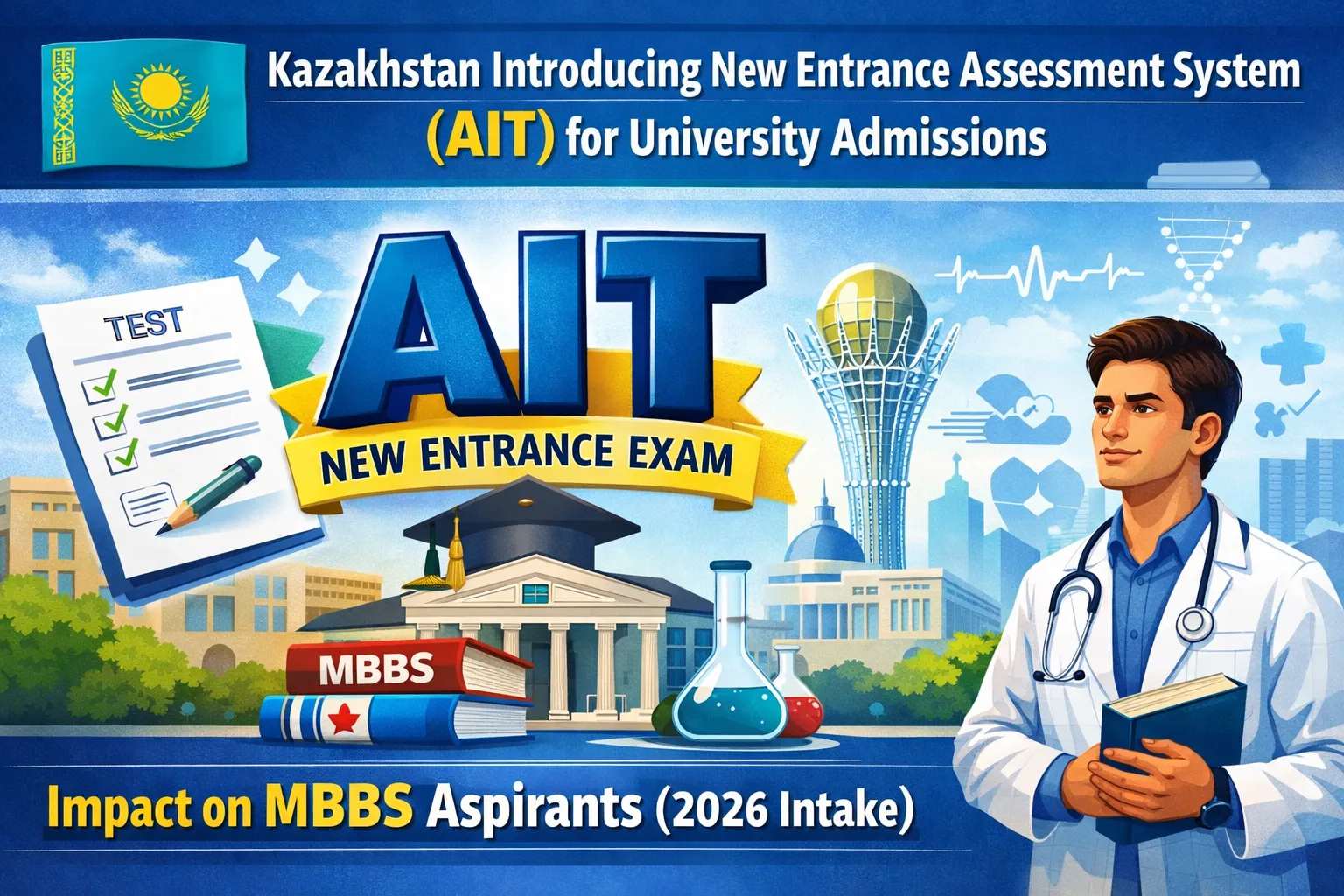
Kazakhstan's bold move to the future in the fast-changing global education landscape. In 2026, the country implemented a new college admissions framework known as the Admissions Insight Test (AIT) — a modern and skills-based assessment system meant to measure students' practical aptitude rather than old-school entrance exams.
This is great news for any students looking to study MBBS in Kazakhstan. It not only alters how students are graded and assessed but also signals Kazakhstan’s desire to be a major international player in education.
What’s the AIT (Admissions Insight Test)?
Kazakhstan's Ministry of Science and Higher Education partnered with global testing company ETS to create a new entrance system: the Admissions Insight Test (AIT).
Unlike traditional tests which primarily test rote memorization, AIT is intended to assess both academic knowledge and real-world skills.
The test includes:
- Subject-based modules (by chosen fields like, medicine)
Skill-based assessments such as:
- Critical thinking
- Academic writing
- Communication skills
- Quantitative reasoning
- Digital literacy
Compared to older entrance exams, AIT is thus a newer and more holistic evaluation mechanism.
Why Kazakhstan Introduced AIT
Kazakhstan’s previous admission process, which was based on the Unified National Testing (UNT), had existed for more than two decades.
Nevertheless, worldwide education trends are changing for:
- Skill-based learning
- Practical knowledge
- Holistic student evaluation
Kazakhstan decided to reform its admission system, so it could align with international standards.
Some of the underlying objectives of AIT are as below:
- Improving fairness and transparency
- Aligning with global education systems
- Getting Students Ready to Face an AI-Powered Future
- Enhancing international recognition of degrees
This reform fits into a broader strategy to elevate Kazakhstan’s status in the global higher education landscape.
The Differences Between AIT and Traditional Exams
The greatest difference is in the way students are assessed.
Previous systems that therefore fade compared to AIT include:
- Single score-based evaluation Each type of student was given a number.
- Memorization and theory Learning by heart, adhering to a set of rules, theory.
- Limited assessment of real skills The student’s skills were reduced to a single score.
AIT has shifted the hierarchy by
- S kill-based evaluation Formation of student skills, analysis of the acquired knowledge.
- Modular testing Not one thing but a set of sections.
- Field-specific subject focus Depth of study of student interests.
- Deeper analysis of student abilities Instead of “How much have you remembered?” ➡ “How well do you own your own knowledge and apply it?”.
Impact on MBBS Aspirants
Coming back to the impact of the academic ranking on students hoping to study MBBS in Kazakhstan, they include:
1. Stronger Academic Filtering
MBBS being a medical course fundamentally necessitates a robust foundation in science as well as analytical thinking.
Given AIT:
- The students are not just tested on biology and chemistry but on problem-solving and reasoning skills.
This means that only students academically prepared for MBBS are likely to join these programs.
2. Increased Competition
Since the system is now structured and integrated globally, competition is likely to stiffen.
- This will see students prepare conceptually and not just for the sake of passing.
- They will develop analytical thinking skills and logical thinking.
- More emphasis will be focused on academic development across board.
3. Better Quality of Medical Education
With this approach, the universities will now admit students based on skills + knowledge.
Students who want to come back to India also have to abide by the guidelines set up by the National Medical Commission (NMC) and an excellent academic grounding via AIT will help you clear licensing exams.
Does AIT Have Direct Impacts For International Students?
Currently, AIT is mainly developed for Kazakhstan’s domestic admission bodies system.
But its indirect effect on international students is significant:
- Like how universities may require similar assessment criteria
- Admissions will be more structured
- Academic expectations will increase
In other words, even international students who do not take AIT directly will feel the impact of the higher standards that it ushered in.
Technology and AI in AIT
What I find one of the most fascinating aspects of AIT is that it works in combination with:
- Artificial Intelligence (AI)
- Advanced data analytics
These technologies help:
- Create more accurate assessments
- Reduce bias in evaluation
- Get deeper insights into student performance
Kazakhstan is clearly positioning itself for a future-ready education system.
What MBBS Aspirants Should Do Now?
Now if you are about to study MBBS in Kazakhstan, now is the time to plan strategically.
Focus on:
Conceptual Understanding
Next, some advice about rote learning. Be solid on the fundamentals of biology, chemistry and physics.
Skill Development
Work on:
- Logical reasoning
- Critical thinking
- Problem-solving
Stay Updated
As an example, read about new or revised guidelines regarding admission processes.
Choose the Right University
Make sure your chosen university:
- Is recognized globally
- Up to October 2023 trains on the guidelines that meet the WHO
- Fulfills NMC requirements for Indian students
Data for Medical Admissions in Kazakhstan
AIT is a small part of a bigger revolution.
Over the next few years we can expect:
- Fully digital admission systems
- AI-based student evaluation
- Personalized learning pathways
- Stronger international collaborations
Kazakhstan aims to be a contemporary education center offering student-oriented programs.
Why This Change Matters
This reform is more than a matter of exams — it’s about transforming the entire mentality surrounding education.
Kazakhstan is moving from:
- Memorization-based learning to practical, or skills-based and analytical education
For MBBS students, this means:
- More representative of actual clinical practice
- Stronger clinical decision-making skills
- Improved global career opportunities
Final Thoughts
Kazakhstan is making a radical change to its entire education system with the advent of the Admissions Insight Test (AIT). It represents a pledge to quality, transparency and international standards.
This comes out as a closer viewpoint for students going to Kazakhstan MBBS. It guarantees the learning environment is much more competitive, and all close to practical work medical needs.
The system may take more prep and effort, but it makes good doctors — and that’s what is really important.