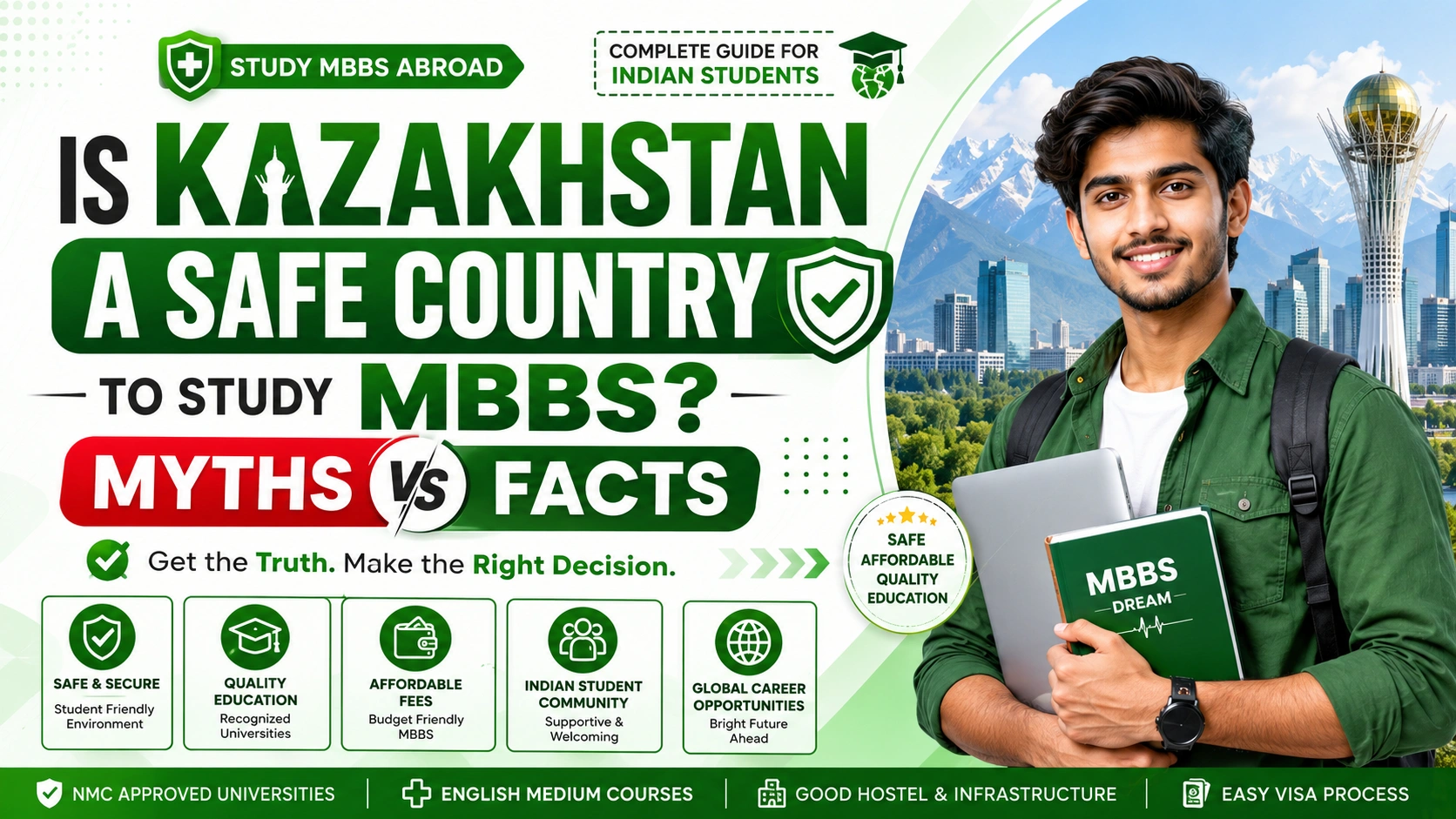
Pursuing higher studies is usually a big decision for Indian students. Of late, Kazakhstan has emerged as an attractive option for Indian students to study medicine abroad. With its increasing popularity, joining MBBS programs in Kazakhstan has led some Indian parents to be confused, and to be concerned and anxious. Validity of MBBS in India, Safety and adjusting of children in Kazakhstan.
Kazakhstan's Rise As a Hot MBBS Spot
Kazakhstan, straddling the intersection of Europe and Asia, has seen its medical universities grow in reputation amongst international students. For Indian students looking at MBBS in Kazakhstan, the major attractions relate to:
- Low costs in comparison to Indian private medical schools
- No capitation or donation fees
- English MBBS programs with international recognition
- Medical schools are part of World Medical School Directory
- An evolving Indian student community with a presence
- Teaching hospitals with modern infrastructure and adequate simulation labs
MBBS in Kazakhstan Consultancies assist thousands of students every year. The process has improved markedly in terms of transparency, when compared with five years ago. In terms of safety, it is the highest concern for parents, and therefore, it is appropriate to dedicate some time with a clear, honest answer.
Myth 1: Kazakhstan has the same reputation for being unsafe, politically volatile and unstable, as the other former Soviet Union Countries with long borders with Russia.
The Fact: At the heart of Central Asia, Kazakhstan is the largest country and one of the most economically developed and stable countries in the region. Given the strong diplomatic relations, active Indian embassy and organized international students in Kazakhstan, it is safe for Indian students to study in Kazakhstan. The medical universities in urban and student friendly cities of Almaty, Karaganda, Shymkent and Astana receive students from many South Asian countries including Pakistan. Regional or geo-political incidents on the other side of the world have no bearing on the safety situation in Kazakhstan.
Myth 2: Indian Students Will be Racially Discriminated Against
The Myth: Because Indian students are a visible minority, it is feared that they will be discriminated against.
The Fact: Kazakhstan, being a multi-ethnic and multi-cultural country, is home to many communities, including Kazakh, Russian, Uzbek, Uighur, Korean, and many others. The universities of Kazakhstan have hosted many international students over the years, and have well developed systems for mentoring and orienting new students. Though there may be occasional isolated incidents, it is not the true reflection of the situation, and the universities have adequate systems in place to address complaints including student affairs offices and Indian student associations.
Myth 3: The Weather and Living Conditions Are Intolerable
The Myth: People love to exaggerate Kazakhstan's cold winters as "extreme, unlivable conditions."
The Fact: Yes, winters may dip below freezing, but Kazakh cities are built to handle winter. Buildings, dorms, and public transport are heated centrally. Students adjust to the cold winters quickly within the first season, similar to South Indian students moving for the first time to North India. Dorms near medical universities have fully furnished rooms and have Wi-Fi, laundry, and Indian food prepared and served by Indian contractors at the universities' mess facilities in the most popular university towns.
Myth 4: Kazak Medical Degrees Are Internationally Unrecognized
The Myth: This is the most significant and damaging myth, and it discourages many great students from exploring Kazakhstan.
The Fact: This is plain false for the important universities. Prominent Kazak medical universities are in the World Directory of Medical Schools (WDOMS), which is co-operated by the World Federation for Medical Education (WFME) and the Foundation for Advancement of International Medical Education and Research. Being listed is the prerequisite for Indian graduates to qualify and sit for India's licensing screening test. Also, the WHO had its own medical school registry and its criteria for listing were incorporated into WDOMS. This assures students that the trajectory of the qualification is not nebulous and unrecognized, but in fact is measured and globally significant.
Before deciding on a medical school, students should check the status of the school on the World Directory of Medical Schools (WDOMS) instead of depending on their consultant.
Myth 5: Graduates Cannot Return to India to Practice Medicine After Graduating from Medical Schools in Kazakhstan
The Myth: Some people think that graduates from Kazakhstan medical schools cannot practice in India because their degrees are worthless.
The Fact: Graduates of MBBS programs from medical schools in other countries that are recognized by the National Medical Commission (NMC) can take the Foreign Medical Graduate Examination (FMGE) in India, which is conducted by the National Board of Examinations in Medical Sciences, to get a medical license and practice in India. This is the same process that other graduates of MBBS programs from other countries must go through to practice in India. This is the same process that other graduates of Kazakhstan must go through to practice medicine in India. Students should check the recognition status of a medical school in India on the NMC website before making a final decision on that medical school to ensure that the information is up to date.
The NMC also has proposed the National Exit Test (NExT), which would serve as a single licensing exam for medicine in India and for foreign medical graduates. As of now, NExT has not been implemented for foreign graduates, and FMGE is the only exam that is applicable — a piece of information that all potential students should check on the NMC and NBEMS website as they get closer to their graduation date.
Myth 6: MBBS Abroad Doesn't Require NEET Qualification
The Myth: Some agents are advertising that students can save NEET attempts if they study MBBS abroad.
The Fact: This is completely false. According to the latest updates from the Indian government, qualifying NEET (National Eligibility cum Entrance Test) will be mandatory for students who intend to study MBBS abroad and wish to practice in India. Any consultancy and/or online platform that guarantees MBBS admission in Kazakhstan without qualifying NEET is scam, and students should be aware of such fraudulent advertisements.
Myth 7: Studying MBBS Abroad is for Students with No Options
The Myth: There exists a social stigma for students who study abroad, claiming that these students are those who could not secure a government seat in India and are left with no options.
The Fact: Although students who do not secure a seat in one of the few government MBBS colleges in India often have to resort to other options, this does not reflect negatively on the education that they will have otherwise. The universities that conduct MBBS in Kazakhstan for Indian students are fully compliant with international education standards and offer affiliated clinical rotations in teaching hospitals. Many of their graduates go on to successfully clear the FMGE and have career opportunities in India and abroad. The geography of education has little relevance in the profession of medicine compared to an individual's commitment.
Myth 8: Safety of Female Students Most Concern for Kazakhstan
The Myth: Parents are most likely worried for the safety of their daughters who are studying and living abroad independently, and not other general safety concerns.
The Fact: Many Indian women are studying medicine in Kazakhstan's medical universities with the support of the large female student community in Kazakhstan. Most of these universities provide secured accommodation blocks for female students, while the cities housing these universities are relatively safe for women. There is a large, established Indian student community that adds a layer of support for first-time international students.
What Students and Parents Should Actually Verify
Avoiding both overly-negative and overly-positive assumptions, the following checklist would be helpful before finalizing the decision to study MBBS in Kazakhstan:
- Verification from the WDOMS if the university is listed.
- Verification of NMC recognition on the NMC's official site.
- Cross-check if the consultancy is rightly guiding you on the NEET eligibility norms.
- Verification on the hostel and mess arrangements by requesting them to connect you with students of the university.
- Contact Indian students studying in that university, not the testimonials provided by the agents.
- Have a clear understanding of the FMGE preparation and the pass percentage, and the support extended by the university for FMGE.
- Understand the university's affiliation to the teaching hospitals for the quality of clinical training.
Final Verdict: Myth vs Fact Summary
|
Myth |
Fact |
|
Kazakhstan is unsafe and unstable |
Kazakhstan is a safe, stable, and foreign‑student‑friendly country with an established Indian community. |
|
There is rampant racism |
As in most countries, there can be isolated incidents, but the overall environment for international students is largely multicultural and welcoming. |
|
Unbearable weather |
Winters are cold, but the cities have good heating and infrastructure, and most students adapt within one season. |
|
Degrees are not recognized |
Degrees from reputable universities that are listed in WDOMS (a WHO‑linked global directory) are recognized internationally, subject to each country’s licensing rules. |
|
Cannot practice in India |
After graduation, clearing the NMC’s FMGE/NExT screening exam allows you to register and practice in India. |
|
NEET can be avoided |
Qualifying NEET is mandatory for Indian students who want to pursue MBBS abroad and later practice in India. |
|
Only low scorers go abroad |
This is a stereotype; success depends on the student’s effort, clinical exposure, and preparation, not only on the country. |
|
Unsafe for female students |
University‑provided hostels, campus security, and existing support networks for women make it reasonably safe when standard precautions are followed. |
Conclusion
There are no shortcuts for studying abroad, and as a medical student, it is your responsibility to choose a WDOMS listed and NMC recognized university, the NEET eligibility path, and prepare for the FMGE with a purpose. Studying medicine abroad is also a risk. For those who are doing their research on MBBS in Kazakhstan for the 2026 intakes, this is the best way to ensure a worthwhile and safe experience.