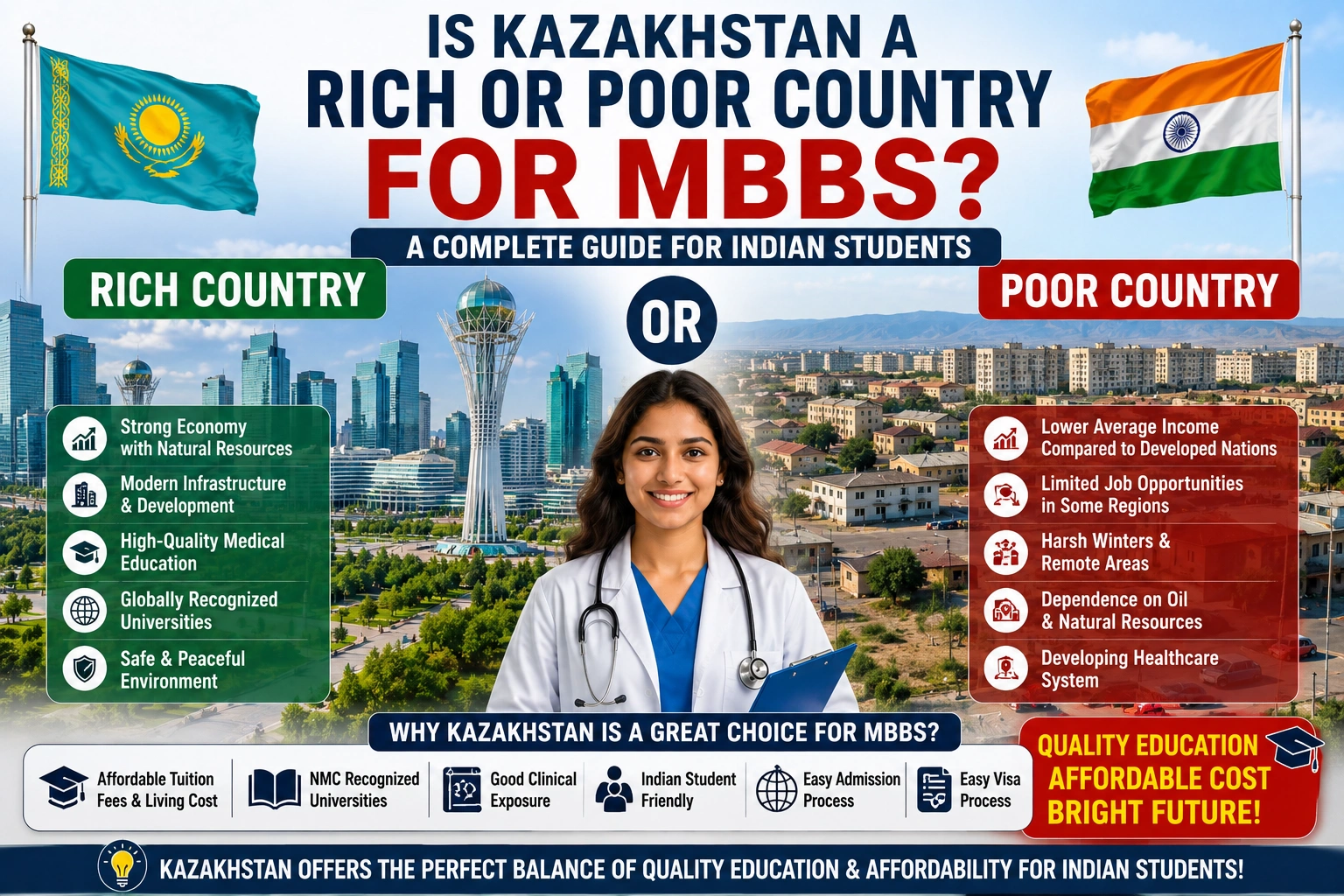
Many Indian students aspiring for MBBS abroad have the question: Is Kazakhstan a rich or poor country for MBBS? The answer to this is that Kazakhstan is not a poor country. Kazakhstan's economy is one of the biggest in Central Asia, and the country is classified as an upper-middle-income country. The World Health Organization classifies Kazakhstan as an upper-middle-income country, as well.
Even though the economic classification of Kazakhstan is an important factor, there are many other things that Indian students looking for MBBS need to consider. Some of the other factors include quality of medical university, clinical exposure, tuition fees and living expenses, the language of instruction, the country's recognition, the requirements for NEET, and the regulations of the NMC.
Kazakhstan has emerged as a feasible and logical alternative for Indian students looking for good and affordable medical education outside India. Going to an upper-middle-income country should not mean that the student will study in any medical university. Study quality should not be compromised for affordability.
Is Kazakhstan a Rich or Poor Country?
Kazakhstan has an upper-middle income economy. This is based on data published by the World Bank for 2025. Kazakhstan's GDP was approximately 306.24 billion US dollars and GDP per capita was estimated at 14,692 US dollars.
The country has a resource-rich economy, especially with regard to significant oil and gas resources, as well as uranium and mineral resources. Kazakhstan has also developed manufacturing, transportation, agriculture, finance, telecommunications, and services.
Kazakhstan's economy is much better than most low-income, developing countries, but it is not regarded as a high-income country like Germany, the UK, Canada or Australia. Therefore, calling Kazakhstan a “poor country” is not accurate; rather, it is an upper-middle-income, developing country with a strong economy in Central Asia.
For Indian medical students, it matters to understand the economy in Kazakhstan. This is because the economy of a country is a determinant of multiple things like university facilities, infrastructure, transportation, accommodation, and overall living conditions.
Why Do Students Consider Kazakhstan for MBBS?
The interest for MBBS in Kazakhstan is because of the affordability of this option as well as due to the presence of medical universities in Kazakhstan.
Cost of education plays more of a role than GDP when considering options for medical studies in Kazakhstan as well as in other countries when compared with Russia, Kyrgyzstan, Uzbekistan, Georgia, and other countries.
Some of the reasons Indian students consider Kazakhstan are:
- Affordable medical education.
- Presence of medical universities.
- Offering medical education conducted in English in some universities.
- There are hospitals and modern clinical facilities
- Well developed urban facilities
- International student communities
- Close to India when compared to western countries.
- There are student facilities and accommodation.
- Exposure to other healthcare systems.
Nevertheless, during admission to any university, students should know that not all universities mean the same in terms of academic environment. Clinical training, Indian law compliance, as well as the curriculum should be checked.
Is MBBS in Kazakhstan Cheap Because Kazakhstan Is a Poor Country?
This is a wrong assumption.
The lower cost of studying medicine in Kazakhstan does not indicate that Kazakhstan is a poor country or that its medical education is inferior.
Educational costs vary due to several factors, such as government policies, university policies, currency exchange rates, local costs, student demand, and the cost of living.
For example, the cost of medical education in Western countries is high because the living and tuition costs are high. Kazakhstan has a different economic and educational structure, which may help make its medical education more affordable to international students.
So, Indian students should investigate the value of medicine in Kazakhstan rather than assuming cheaper fees means inferior education.
Kazakhstan's Economy and Standard of Living
Kazakhstan has experienced a large-scale building of its economy and society following its gain of independence. In a recent analysis by the WHO, it states Kazakhstan has the largest economy in Central Asia, and that Kazakhstan has achieved upper-middle income status. The analysis points out changes that are ongoing in the health sector, the educational sector, and social changes.
Kazakhstan also has large metropolitan cities with infrastructures. A few examples of large cities are Almaty and Astana. These cities have universities, hospitals, shopping centers, transportation, and all the amenities international students need.
This is important for MBBS students, because learning the principles of medicine takes more than just classroom studies. Students spend many years in a given country and require, amongst others, the following:
- Safe places to live in
- Choice of well-connected public transport
- Presence of hospitals
- Presence of grocery stores
- Presence of pharmacies
- Choice of libraries
- Reliable internet
- Access to banks
- Choice of other amenities
The reality of living in big cities in Kazakhstan may be much more diverse and complex for students than what they may expect from a “poor country.”
How good is Kazakhstan for MBBS for Indian students?
For Indian students, Kazakhstan may be a good option as long as they follow due regulations and choose universities carefully.
The most important point is that Indian students should not enroll in universities “suggested” by agents as “NMC approved.”
The National Medical Commission (NMC) publishes regulations pertaining to foreign medical graduates. The Foreign Medical Graduate Licentiate Regulations and guidance are the latest Regulations.
It is important that students confirm the requirements and admissions at the time they enroll.
The NMC's foreign medical graduate framework focuses on the primary medical qualification, the status of the institution in the country of study, curriculum and other criteria pertaining to medical registration in India.
Consequently, the question should not simply be, “Is Kazakhstan rich or poor?”
A more useful question is:
“Does the particular Kazakhstan medical university meet the requirements applicable to Indian students who want to practice medicine in India?”
Importance of WDOMS When Choosing a Kazakhstan Medical University
Indian students should check the medical university through WDOMS. (World Directory of Medical Schools)
WDOMS is a global directory that provides information on medical schools and their respective programs. WDOMS is maintained by a collaboration of the World Federation for Medical Education and FAIMER/Intealth.
However, students should understand that WDOMS does not mean that a medical university is automatically approved or endorsed by WDOMS.
WDOMS states that listing does not mean recognition, accreditation, or endorsement.
Therefore, WDOMS should not be the only criterion, but should be used as one of the many verification checks.
Students should verify the following:
- Whether the university is listed in WDOMS
- Whether the medical program is recognized in Kazakhstan
- Whether the qualification enables the graduates to apply for medical registration in Kazakhstan if necessary
- Whether the course curriculum is in line with Indian FMGs
- Whether the university provides clinical training
- Whether the program duration and internships fulfill the requirements of Indian laws
Does WHO Recognition Make Kazakhstan Good for MBBS?
The World Health Organization (WHO) considers Kazakhstan as a member country and maintains health data for Kazakhstan at the country level. WHO currently considers Kazakhstan as an upper-middle-income country.
Kazakhstan has made progress in its health regulatory system. In April 2026, the WHO reported that Kazakhstan became the first country in Central Asia to reach Maturity Level 3 for the regulation of medicines and imported vaccines within the WHO's global classification system.
Students should be careful not to think that WHO country recognition indicates approval of an individual medical college.
WHO country-level recognition or membership should not be confused with the accreditation of a university.
Each medical college needs to be assessed in an independent manner.
Is Kazakhstan MBBS Affordable for Indian Students?
One of the most important factors for students considering pursuing MBBS in Kazakhstan, is affordability.
The cost of the entire process usually consists of:
- Tuition
- Hall fee, hostel, or residential accommodation
- Food
- Transport
- Insurance
- Visa
- Documentation costs
- University
- Personal expenses
- Travel to and from India and Kazakhstan
The total cost varies depending on the university, as well as the city the university is in. Costs can also vary depending on currency exchange fluctuations.
For this reason, students are advised to ask for the breakdown of all course fees, instead of comparing just the first year's tuition fee.
A university with a higher tuition fee may provide better hostel facilities, better university infrastructure, or more clinical opportunities, which may result in the university being more economical in the long run.
NEET Requirement for Indian Students
NEET UG, the common medical entrance exam for India, is noted on the official NEET UG website as the only exam accepted for undergraduate medical education in India.
Before applying to study medicine abroad, all Indian students should check recent changes in NTA and NMC rules and regulations.
Please note that overseas admission consultants cannot substitute correct and updated information from official websites of NTA and NMC.
Before applying to Medical universities in different countries, students must not regard educational opportunities in certain 'rich’ countries and educational opportunities in certain 'poor’ countries.
There are three examples to explain this point.
- There is a country that is relatively rich, but the tuition fee for medical education is extremely high.
- There is another country that is relatively rich and has established universities and medical education at an affordable cost.
- Lastly, there is a country that is relatively poor, but a medical university has a good and legitimate medical program.
For an Indian student, the quality of a medical university and its curriculum is more important than the income status of the country where the university is located.
Some advantages of studying medicine in Kazakhstan are: comparison between the cost of studying medicine in Kazakhstan and medicine in many other countries in the west, especially due to the high cost of both tuition and living. Secondly, Kazakhstan has a long history of medical education and many records of medical education. For instance, one Kazakhstani medical school record shows a six-year Physician (General Medicine) program offered in English and Russian.
Healthcare Infrastructure
Kazakhstan has made strides in reforming its healthcare and has made progress in the development of its healthcare and vaccination regulatory systems.
International Student Environment
Some universities have attracted international students from India and beyond. Kazakhstan could be a better option than other countries with a limited number of international students.
Potential OBMS Issues in Kazakhstan
Despite the advantages Kazakhstan has over other countries for international students, it may not be the right choice for all students.
Climate
Much of Kazakhstan has a very cold climate. This may be new for students from India.
Language
Even if students will be taught in English, they may encounter Kazakh or Russian in their daily activities and during clinical sessions.
Clinical Communications
Given the nature of Kazakhstan’s climate and language, students should be ready to learn basic Kazakh/Russian/ other local languages.
Regulatory Issues in India
Even if students complete their education from a foreign medical university, this will not give them automatic rights to practice in India. Indian students must follow the mandatory NMC requirements and regulatory standards before they are allowed to practice in India.
University Selection
A major risk is choosing a university without verifying if it is legally operating and has the required teaching and clinical facilities.
Conclusion
Kazakhstan has a developing economy but is not among the poor countries. Kazakhstan is an upper-middle-income country and has some of the fastest-growing economies in Central Asia. WHO's country data positions Kazakhstan in the upper-middle-income category, while World Bank data positions Kazakhstan's GDP per capita at around US$14,692 in 2025.
From an Indian student’s point of view, Kazakhstan offers an opportunity for low-cost medical education. However, they must not choose Kazakhstan only for its low cost.
If you wish to study MBBS in Kazakhstan, you must check university rankings instead of asking whether Kazakhstan is a poor or rich country. Some of the things that need checking include the WDOMS listing, university recognition at the local level, course structure, clinical training, cost and accommodation, the latest policies of the NMC and the applicable rules of NEET.
Kazakhstan does provide a low-cost but well-established medical education system. Therefore, low cost, chosen university and proper regulation, and a realistic idea of overall expense determine Kazakhstan’s medical education campus for Indian aspirants.