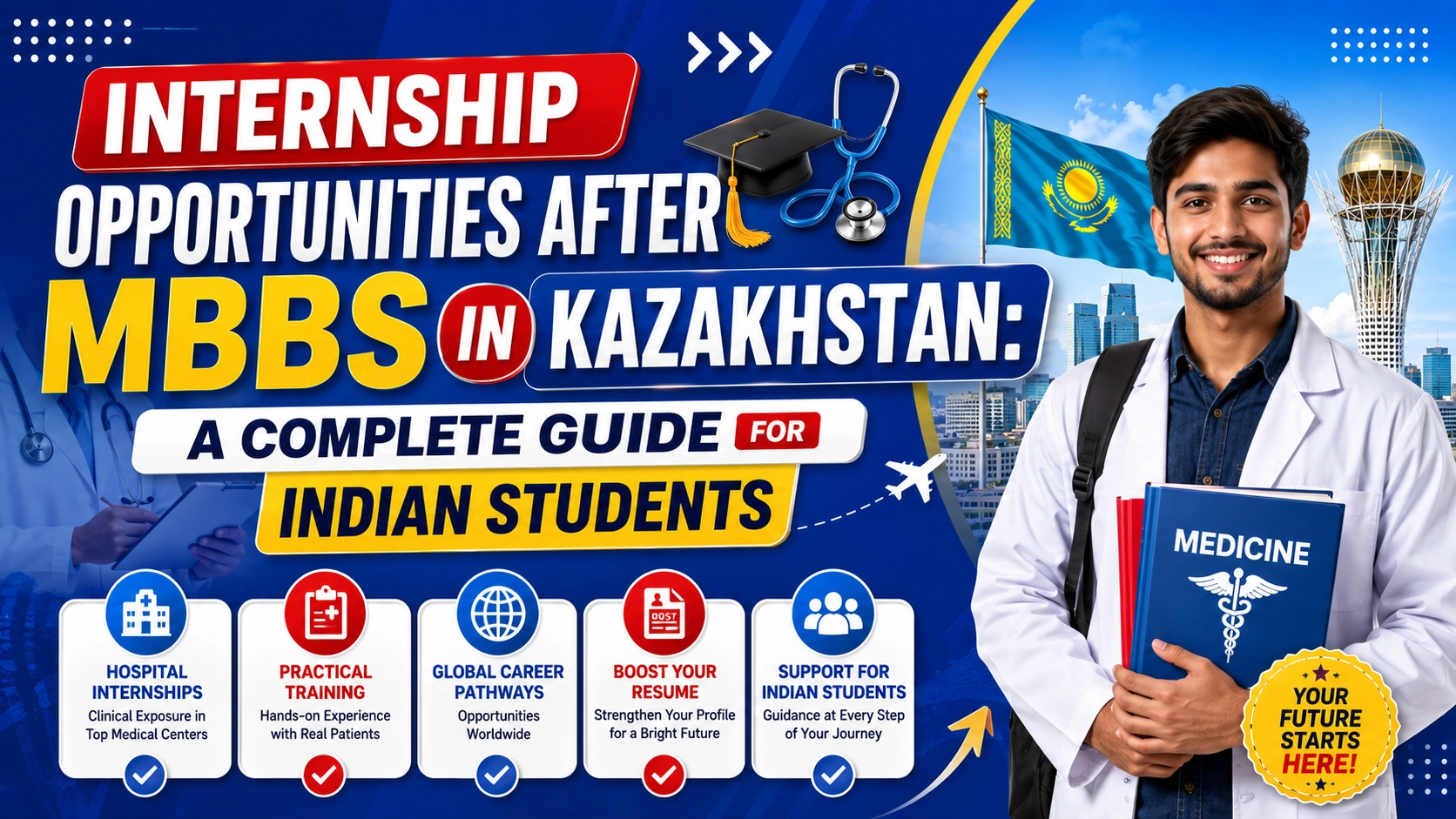
As Indian medical students watch the lectures and do the practicals in their medical schools, the gap with what the doctors in India learn or do is negligible. Indian students are learning MBBS in Kazakhstan because the 6 year (NMC) MBBS courses are cheaper than Indian courses. The question that arises is what happens after MBBS? Where do I go for my internship and what are the available options?
In this blog, we try to explain all the options that the MBBS graduates of Kazakhstan have and where you can do your internship, how it works, the application of the license to India, and the career opportunities available to you.
Useful Information About MBBS In Kazakhstan
MBBS internships support Indian students studying in Kazakhstan to transform their dreams of becoming doctors into reality. An explanation of why Indian students are being accepted to study MBBS in Kazakhstan is also needed. The MBBS degrees from Kazakh medical schools are recognized by the NMC in India and are listed in the WDOMS, and thus are recognized in other countries.
There are many reasons why students are opting to study in Kazakhstan. Some of these are
- Courses are cheaper than private Indian medical institutions.
- There are no capitation fees.
- The teaching language is English from the first year.
- There is advanced modern infrastructure.
- There is an integrated curriculum with an early clinical practice focus.
- There is a safe and welcoming environment for international students.
Although the advantages mentioned previously make pursuing an MBBS in Kazakhstan a feasible option, the degree is not valuable without an internship and a license.
What is a Medical Internship and its Significance?
Internships are mandatory for MBBS graduates as a training practice within the clinical field in order for them to be granted the authority to practice medicine autonomously. This in the learning transition is the segment where learners engage and participate in the clinical realm.
This segment is crucial because it:
- Fosters confidence and enhances the clinical judgment of the candidate.
- Provides the candidate with the opportunity to work on a variety of cases outside the university.
- It is an essential criterion for medical licensing in numerous countries.
- Helps the candidate in identifying their medical domain of choice for their further studies.
As for the 2026 MBBS graduates of Kazakhstan, gaining an early understanding about the internship will facilitate better medical career project planning.
Internship Pathways for MBBS Graduates from Kazakhstan
Based on specific career goals, graduates can choose between two major internship routes.
Kazakhstan offers MBBS students an integrated internship module as part of their final year of medical school. The students are placed in clinical rotations in a hospital that is affiliated to the medical school. These hospitals are usually teaching hospitals, which means the students have the opportunity to do their clinical rotations and interact with patients under the supervision of teaching faculty and senior doctors.
Working as an intern in Kazakhstan has many advantages. They are:
- Familiar with the faculty and the language of instruction
- Able to continue their education in the same academic setting
- Have the opportunity to bolster clinical skills prior to returning to India
- Experience a European clinical and diagnostic environment
Internship in India: Compulsory Rotating Medical Internship
Indian students must undertake the Compulsory Rotating Medical Internship in India, at a National Medical Commission (NMC) recognized hospital, after they complete the licensing examination. This internship is a requirement for 12 months and has to be conducted in India and covers major clinical specializations like Medicine, Surgery, Obstetrics and Gynecology, Pediatrics, Orthopedics, Community Medicine, etc.
This is the most common pathway for graduates of MBBS in Kazakhstan, as the majority of Indian students who pursue this program do so with the intention of registering to practice in India.
Studying MBBS in Kazakhstan makes practicing in India difficult for graduates. Foreign degrees must be validated by the National Medical Commission (NMC) in India. The Foreign Medical Graduate Examination (FMGE) will remain a screening exam for foreign graduates even after 2026. The National Exit Test (NExT) which will replace the FMGE, has been postponed by the NMC for an undetermined period. Students are advised to follow the NMC's website for updates, as the exam format and requirements can be changed with little notice.
Even without the last two requirements, students typically do the following:
- Complete NEET-UG — The NEET exam must be cleared by all Indian students who wish to practice medicine in India, regardless of the country where they studied.
- Complete MBBS from an NMC-recognized and WDOMS-listed university — Students must ensure the university in Kazakhstan is listed in the World Directory of Medical Schools (WDOMS). This is commonly checked during the licensing process.
- FMGE or successor exam — This examination is to check the equivalence of foreign medical education with Indian Medical Education for the purpose of licensing in India.
- Complete a 12-month Compulsory Rotating Internship in an NMC-recognized Indian hospital.
- Complete Registration with the State Medical Council or NMC to practice medicine in India.
With the regulations for foreign medical graduates changing periodically, those thinking about pursuing their MBBS in Kazakhstan in 2026 will have to reach out to official advisors to keep them informed, as well as refer to the NMC announcements for up-to-date information and requirements.
Where Can You Do Your Internship After Completing Your MBBS in Kazakhstan?
Indian Government and Private Hospitals
The majority of graduates doing their NMC-approved compulsory internship do so in government and private hospitals in India. These hospitals are known to provide guided rotations and have a good teaching faculty and mentorship. Therefore, these hospitals provide a good learning and clinical environment for graduates before they pursue higher studies.
University-Affiliated Hospitals in Kazakhstan
Some students look for clinical exposure in Kazakhstan, especially if they are considering employment or further studies in Kazakhstan, Europe, or some other CIS countries. The university affiliated hospitals in the cities that offer the MBBS program in Kazakhstan have teaching hospitals and provide multicultural clinical internship opportunities.
International Internship and Observership Programs
A minority of graduates look for observership opportunities in countries that offer medically recognized internship training programs that are in the WHO list, especially if they are considering licensing exams for the US or UK and are planning to have a career outside of India. These observership and internship training programs, while they do not meet the NMC's requirement for an internship in India, provide excellent clinical training.
Career Opportunities After Completing the Internship
Once the internship is successfully completed and registration formalities are done, a wide range of career paths open up for graduates of MBBS in Kazakhstan for Indian students:
- General Practice — Working as a Resident Medical Officer or as a General Physician in hospitals and clinics in India.
- Postgraduate Specialization — Taking the NEET-PG exam, or equivalent exams, to pursue an MD/MS in a desired specialty.
- Research and Teaching — Working as a researcher or teacher. This is mainly for people who are interested in medical research.
- Practice Abroad — Other licensing exams (for example, the USMLE (USA), the PLAB (UK), etc.) to practice in those countries.
With an MBBS degree from Kazakhstan along with a completed mandatory Internship, you will have a flexible career.
Maximizing Your Internship Year
- Take the chance to choose rotations — Choose rotations you are interested in and those that relate to the specialty you wish to pursue.
- Keep yourself updated on the NMC and the licensing exam — Regulations are constantly changing and you should be on the lookout for official updates from the NMC.
- You should write down anything you think is important regarding this step. Keeping records of this step will help a candidate answer questions in their entrance interviews, so it is good to record this in advance. During your entrance exams, include all applicable procedures you have worked on and cases you have seen.
- Build Mentorship Relationships
- The relationships you build with the faculty will direct your focus during your education, and will help you with your desired specialty as you will get guidance and support on how to get there. Moreover, they will serve as references.
- Neglecting your Soft Skills
The things that people see as "professional skills" will be seen as equally poor as your clinical skills during your internship. This includes your ability to communicate to and with patients, your ability to work as part of a team with the nursing staff, and your ability to manage your time.
Common questions from students
Is the MBBS from Kazakhstan Valid for Practicing in India?
Yes, if you graduated from a university that is listed in the NMC and WDOMS, passed the licensing screening exam and did your internship in India.
Is it possible to go to Kazakhstan to do the MBBS, then do the whole internship there and come back to India for the screening exam?
No. To get your registration to practice in India, you will have to do the Compulsory Rotating Medical Internship in India.
How long does the internship take?
The Compulsory Rotating Medical Internship in India is a year of internship.
What if the NMC changes their regulations while I'm still studying?
Regulations for foreign medical graduates are reviewed periodically. The best course of action while you go through the years of your MBBS, is to rely on official sources and committed admission consultants to verify information and stay compliant.
Conclusion
Studying MBBS in Kazakhstan is only one part of an exhaustive system before one can begin to practice medicine. After the MBBS comes the Internship, which is when the rest of the foundation of a medical career is built. Theoretical knowledge transforms into practice. Based on whether students choose to go to India for the Compulsory Rotating Internship or Intern in the university teaching hospitals in Kazakhstan, having some knowledge to the NMC compliance, endorsement with WDOMS, the changing medical licensing exams, and the medical practice will ease the progression from a medical student to a qualified medical doctor.
For students in the early evaluative stage of where to pursue the MBBS, the most essential thing is to research a competent admissions consultancy that is familiar with the Kazakhstan Education System, the Indian Medical Licensing, which will ultimately help students prepare to focus on what is most important — the core skills of being a medical doctor.