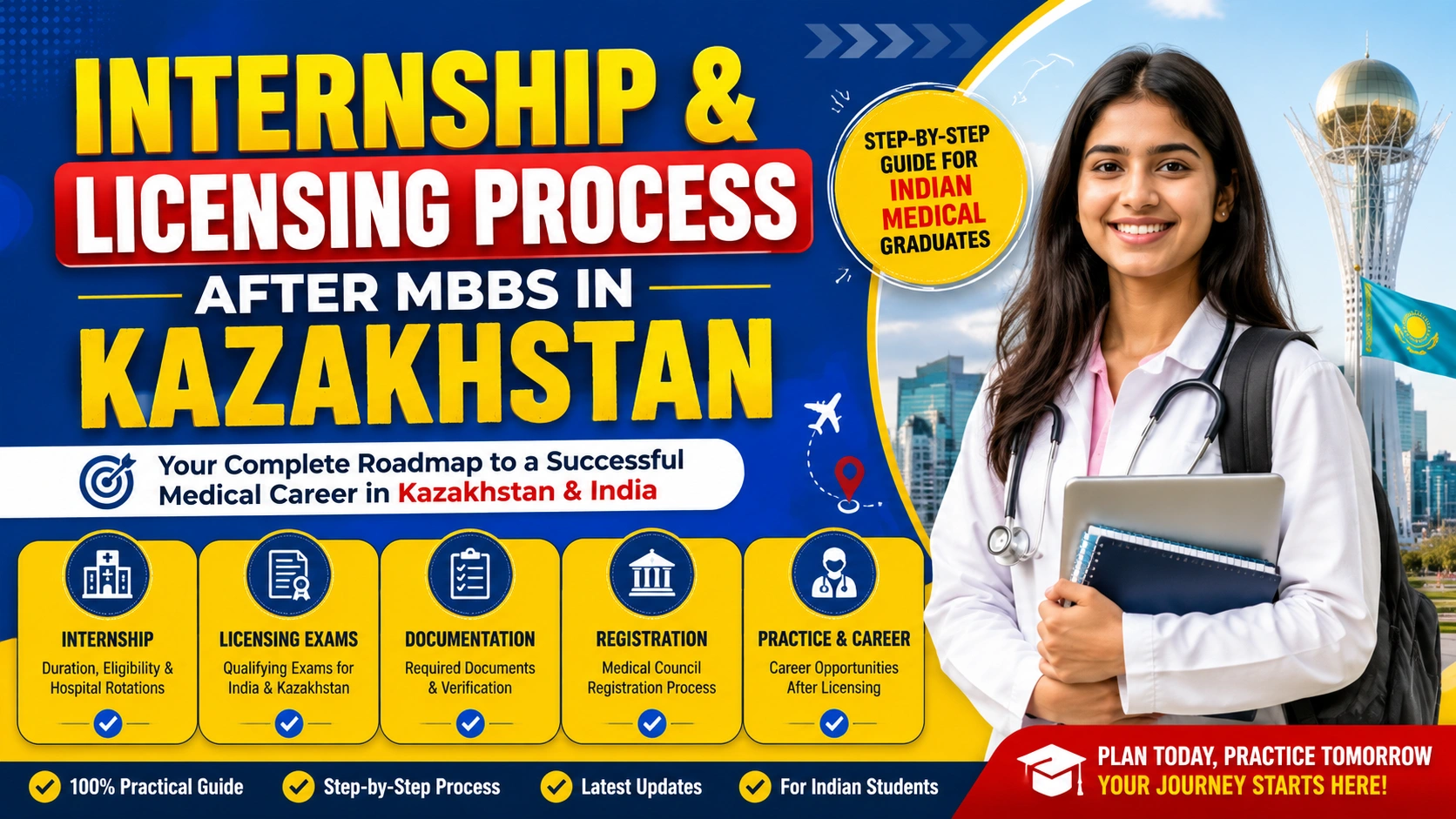
Completing your MBBS is an essential step in a long journey that doesn't end with a degree. The next step is internship and licensing. If you are an Indian student, pursuingv MBBS in Kazakhstan and want to gain insight into what to expect post MBBS, you must research the opportunities offered by the universities as well as what post graduate options you will have. The aim of this document is to educate you regarding the full scope of the internship and licensing process, post completion of the final year in Kazakhstan, until you become a physician in India.
Significance of Knowing This Process
The number of Indian students enrolled in foreign medical universities is substantial. Most will return and be unprepared for post MBBS. This will lead to confusion with the requirements of an internship, a licensing exam, and recognition by regulatory authorities, which could result in a career that is severely impacted with delays of months or years. By knowing the process of internship and licensing, you can plan your final year and the associated costs for the exam, and most importantly, will be free of unnecessary stress.
If you are currently enrolled, or planning to enroll in MBBS in Kazakhstan for Indian students, this process will help you understand what will be required once you graduate.
Step 1. Completion of the MBBS Program in Kazakhstan
Depending on the University and whether a preparatory year is offered, the MBBS program in Kazakhstan is typically between 5 to 6 years. The final year is highly structured, consisting of supervised clinical practice and a university conducted state board exam.
Students must pass all internal examinations, practical tests, and the final state certification exam to obtain an MBBS degree from Kazakh universities. The MBBS is known as a Diploma of Higher Medical Education, and degree recognition from these universities is international as long as the university is listed in international directories.
Step 2: Internship Requirements in Kazakhstan
In most of the medical universities of Kazakhstan, a clinical internship is incorporated into the curriculum as a component of the final year or immediately after graduation. A local internship allows students to:
- Gain practical experience in a hospital or clinic
- Work under supervision of a medical doctor
- Learn about the management of patients and the art of diagnostic procedures
- Complete a practical training requirement of the university curriculum
However, it is important to know that an internship completed in Kazakhstan does not qualify a student to practice medicine in India. Indian students must complete a further internship in India to legally practice medicine in India.
Step 3: Degree Validation via WDOMS
Before students return to India, it is important to check that the medical college and the medical program are listed in the World Directory of Medical Schools (WDOMS). The WDOMS has displaced the previous WHO/AVICENNA list, and is now the globally accepted standard for listing accredited medical schools.
You can check the listing of your university directly at the official WDOMS site. This is a very important step, as Indian authorities will not grant permission to register for the licensing exam unless there is a verifiable listing in WDOMS for your medical school.
Step 4: Screening Test Eligibility — FMGE
When you come back to India after earning your MBBS from Kazakhstan, you will be considered a Foreign Medical Graduate (FMG). To practice in India, you will have to pass the Foreign Medical Graduate Examination (FMGE). The FMGE is a screening test held by the National Board of Examinations.
FMGE eligibility highlights:
- The length of your MBBS course should be in excess of 54 months (internship years excluded) and should be in consonance with the MBBS course in India.
- The university must be in the WDOMS list at the time of your admission and graduation.
- You must have completed the National Eligibility cum Entrance Test (NEET) prior to taking the foreign MBBS course, as per the National Medical Commission (NMC) guidelines.
- Students who originally cleared NEET prior to their foreign MBBS course and fulfill other criteria are eligible to take the FMGE screening test.
Step 5: Registering with the National Medical Commission (NMC)
National Medical Commission (NMC) is the principal regulator of medical education and practice in India. After passing the FMGE, students must register with:
- The State Medical Council of their respective state, or
- The National Medical Register, which is under the NMC
For the registration, you will need to provide your original MBBS degree, certificates of completion of your internship, FMGE scorecard, and other required documents. For the complete guidelines and eligibility criteria, you can refer to the NMC website.
It is important to have both digital and hard copies of all documents related to your academic and internship activities in Kazakhstan. This is because some state verification processes may require extra documents to be verified or to be certified with an apostille.
Step 6: Completing a Compulsory Rotatory Internship in India
After passing the FMGE, all foreign medical graduates are required to complete a 12-month Compulsory Rotatory Medical Internship (CRMI) in an Indian hospital to obtain a full and permanent medical license.
The internship includes the following departments:
- General Medicine
- Surgery
- Pediatrics
- Gynecology and Obstetrics
- Community Medicine
- Emergency and Casualty Care
This step ensures all licensed doctors, irrespective of the country they received their medical education, gain firsthand experience of India's patient population and the healthcare delivery system.
Step 7: Receiving Your Permanent Registration
After successfully completing the CRMI, you may apply for permanent registration with either the State Medical Council or the National Medical Register. This registration allows you to practice medicine in India without any restrictions, and you may also sit for the NEET-PG and other postgraduate entrance examinations.
Understanding Global Recognition: WHO and WDOMS
A large number of students have misconceptions about the WHO and WDOMS, regarding the recognition of medical degrees. Here is the clarification:
- The World Health Organization (WHO) does not have the authority to accredit or approve medical universities and does not evaluate or recognize medical degrees. WHO's focus is on international health, and you may view its other roles in the global health systems on the official WHO website.
- The World Directory of Medical Schools (WDOMS) is the primary directory used to validate whether a medical school is compliant with international standards. This is the database that Indian authorities use to permit FMGE registration.
It is essential to check your university's status on WDOMS before and after your admission, as listings can change due to administrative or accreditation changes.
Common Mistakes Students Make in This Process
- Not confirming NEET eligibility pre-admission. Students that do not take NEET and go abroad for medical studies, FMGE registration is mostly rejected.
- Not verifying WDOMS. Some students think that their university would be recognized and do not check the status of their university in the directory.
- FMGE registration is also delayed if there is gap after graduation to prepare for the exam.
- Missing any document like the internship certificate, or poorly done translations can make registration with the NMC extremely lengthy.
- Thinking that the Kazakhstan internship is counted as the CRMI. The internship completed in Kazakhstan does not satisfy the 12-month Rotatory Internship that is done in India.
Best Practices to Ease the Transition After You Graduate
- Prepare for the FMGE exam in your final year in Kazakhstan while you are keeping up with your regular studies.
- Make sure all your documents are in order. Degrees and transcripts should be augmented along with internship certificates.
- Follow the NMC closely. They may change the exam and licensing requirements and the procedures with short notice.
- Enroll in FMGE preparatory courses and coaching services for foreign graduates.
- Seniors that have first-hand experience of this process are your best resource. Do not hesitate to contact them.
Timeline Summary: Graduation to Practicing Doctor
|
Phase |
Approximate Time Frame |
|
Final Year Clinical Rotations and University Internship |
1 year |
|
Verification of Documents and WDOMS Confirmation |
1 – 2 months |
|
FMGE Preparation |
3 – 6 months |
|
FMGE Exam and Results |
2 – 3 months |
|
NMC/State Council Registration |
1 – 2 months |
|
Compulsory Rotatory Medical Internship (CRMI) |
12 months |
|
Cumulative Total |
Around 2 to 2.5 years |
The estimated timeframe can change based on the number of attempts at the examinations, how quickly the documents are processed, and how quickly the internship is available.
The Importance of Selecting a University in Kazakhstan
The entire licensing procedure is dependent on one critical factor: the recognition and listing of the university where you studied at the time of your enrollment. This is the main reason why you must conduct thorough research before making the decision to study MBBS in Kazakhstan. A university with strong standing in WDOMS, offers transparency in their academic records, and has successful FMGE score outcomes for their alumni, will make the entire post-graduation process easier.
For those hopeful to enroll for their MBBS in Kazakhstan for 2026, universities should be queried regarding their FMGE passage percentages, WDOMS listings, and aid for returning graduate alumni as these are crucial in your ability to practice medicine in India.
Conclusion
Obtaining your MBBS degree from Kazakhstan is a significant milestone, but it is just the beginning in the process of becoming a practicing doctor in India. Understanding the compulsory rotatory internship, the FMGE screening and the NMC registration, and the compulsory rotatory internship will allow students to chart their process with certainty.
Keeping track of WDOMS listings, NEET eligibility, and NMC regulations since day one makes the post graduate process predictable. With proper preparation and the right selection of university, the transition from MBBS graduate of Kazakhstan to licensed practicing doctor in India is clearly planned and achievable instead of a perplexing process.