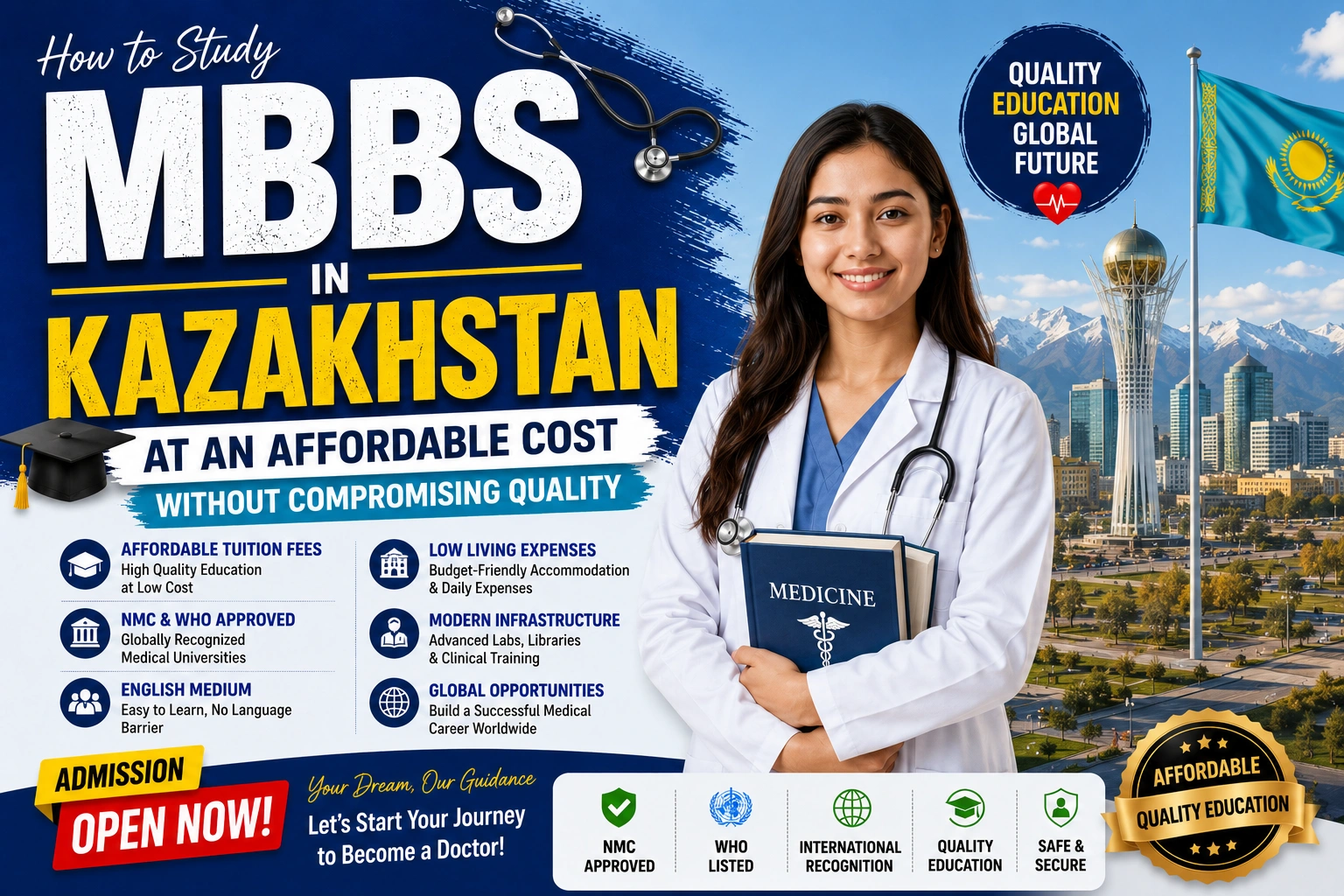
For many Indian students, the dream of earning an MBBS becomes a nightmare due to the unaffordable private medical colleges and limited seats in government medical colleges. This is one of the many reasons why MBBS in Kazakhstan is so popular. This option provides Indian students with the chance to study for a medical degree that is recognized internationally while having less to pay. Affordable does not have to mean compromised. If you plan Kazakhstan right, low costs do not have to mean a lack of quality education.
This guide will show you how to get an affordable MBBS in Kazakhstan.
Why Kazakhstan is so popular for MBBS programs
Kazakhstan is at a major crossroads in more ways than one. It is only a few hours away from India and is home to many universities that provide an MBBS in English. Additionally, its medical education system provides a balanced system of theoretical and clinical education that is built on the Soviet Union Era.
However, the major attraction is the cost. The tuition costs of Kazakhstan medical colleges is much less than that of Private Indian medical colleges and the living costs are low when compared with Western countries. MBBS in Kazakhstan for Indian students provides a great option for students that have done decently in NEET and wanted to study medicine, however missed the majorly filled Indian Government medical colleges.
Step 1: Understand the Regulatory Framework Before You Start
Forget the tuition costs for a bit and confirm what the requirements are for you to be a doctor in India after medical school in Kazakhstan.
This single step decides if your degree will be helpful when you go back to India.
- NEET is mandatory. Any Indian citizen who aims to get a medical degree abroad, even in Kazakhstan, has to pass the National Eligibility cum Entrance Test. You can find details, eligibility, and results on the NEET official website. There is no set rule about the high score to study abroad, but to go to another country to study medicine, the candidate has to meet the minimum qualifying percentile that is set by the exam authority.
- NMC recognition is critical. The National Medical Commission (NMC) controls the standards of medical education in India, and assesses the recognition of foreign medical degrees in India. Before considering any university in Kazakhstan, make sure that it is on the NMC approved list and check the requirements under the Foreign Medical Graduate Licentiate’s framework so that you are aware of what will be required of you on graduating.
- WHO and WDOMS listings enhance credibility. The World Health Organization (WHO) keeps a standard of medical education, and the World Directory of Medical Schools (WDOMS) is the directory of medical schools that meet the accepted quality standards. Studies conducted at a university that is listed in WDOMS give confidence that the degree will be accepted in many countries and not just India.
There is no greater blunder in this process of choosing a university than skipping this step. An uncompliant NMC or WDOMS university may promise low fees and quick admission, but if you aren’t compliant with those standards, you will essentially get a degree that is unusable in India.
Step 2: Look Beyond the Fees when Comparing Universities
After filtering for regulatory compliance, the next step is to compare universities. Don't let tuition fees solely influence your decision.
- Curriculum structure — is the course taught in English? Is there a preparatory language year, or can you commence the MBBS program directly?
- Clinical exposure — is there a teaching hospital connected to the university, or is there a strong relationship with hospitals for practical training?
- Faculty — Are faculty members involved in the full-time practice of teaching as well as the practice of clinical care?
- Hostel and safety infrastructure — this is a major consideration for students who will be going abroad for the first time.
- Alumni outcomes — how successful have the past alumni from India been in the licensing exams in India?
Numerous medical universities in Kazakhstan — which include some well-known medical universities located in Almaty, Shymkent and Semey — offer a great mix of cost and quality. The best way to protect both your career aspirations and financial resources is to compare these options instead of choosing the cheapest option.
Step 3: Budget Realistically — Looking Beyond Tuition
When people refer to the MBBS in Kazakhstan as "affordably priced," most commonly they refer to tuition. However, an actual budget includes:
- Cost of living: When it comes to food and daily necessities, living on or near campus can keep these costs low.
- Health insurance: Health insurance is typically required for international students, and it’s generally affordable.
- Visa and travel expenses: Consider the cost of your visa, student permit renewals, and flights back home during the breaks.
- One-time fees: This includes the admission fee and fees for document translation and notarization.
Even after averaging out the costs for five to six years, studying MBBS in Kazakhstan is more affordable than studying MBBS in private medical colleges in India, and students will acquire an internationally valid and recognized medical degree.
Step 4: Get Your NMC Eligibility Certificate Early
Obtaining the NMC Eligibility Certificate is a prerequisite for all Indian students before getting admission to any foreign medical school and not after. Many students think that this step can be done later, but the NMC does not accept any applications for this in retrospect. You should do this step before getting admission to the medical school and not after you have already enrolled.
Here is a list of other documents that you will need in order to get admission in a foreign medical school:
- NEET result and the admit card
- Mark sheets and certificates of class 10 and class 12
- A valid passport
- A certificate of medical fitness
- A few passport size photographs
- Migration and transfer certificates if applicable
You should keep all these documents in a physical format as well as a digital format. There will be many instances where you will be required to submit these documents to the medical school or to the visa department in Kazakhstan. Having these documents in advance can save a lot of time and ensure that you will not lose an entire year of study.
Step 5: Select Your Ideal Intake and Submit Applications Early
Most Kazakh medical universities have intakes scheduled for September, which coincides with the rest of the school year. Applications submitted early have clear financial advantages. Many universities provide fee discounts for early applicants and scholarships for students who complete the admission process before the deadline. Applications submitted at the last moment often result in having to accept offered seats and remaining fee structures, which can significantly decrease the expected savings.
For students targeting MBBS in Kazakhstan 2026, requirements for university selection and preparation of supporting documentation should start no later than 6 to 8 months before the intake. This provides the necessary time to obtain the Eligibility certificate and complete the visa and travel processes without the need for last minute, hasty decisions.
Step 6: Don't Sacrifice Quality for Lower Fees
It can be time consuming to find the right combination of affordable medical programs, however there are some tips to make the process easier:
- Do not consider schools that are not listed in WDOMS, even if the fees are more attractive.
- If agents tell you that NEET is not required, they are lying, and it is a big warning sign.
- Do not believe marketing brochures. You can request official accreditation documents.
- Avoid reliance on consultancies for information. You can gain more traction by speaking with students that are currently enrolled or have recently graduated.
Recognized medical schools offer an affordable education and ensure your clinical training is practical, and your degree will qualify you to take the licensing exams to practice in India.
Step 7: Plan for Life After Graduation
Affordability during your studies means more than just the tuition fees. After receiving your MBBS in Kazakhstan, you will need to take the licensing exam to practice in India. You should consider NMC compliance and WDOMS membership early to improve your chances of getting to this step. These universities are often more flexible in their curriculum and will allow you to align your studies with the international standards and those of India.
To help ensure quality, you should take a little extra time to plan for and budget for exam prep ahead of time so that the prep for the exam isn't treated as an afterthought. Your prep for the exam is likely to be the most expensive part of your degree in Kazakhstan, but the cost is modest compared to the overall cost you will incur during your studies.
What to Avoid
- The cheapest option is unlikely to satisfy the NMC or WDOMS, so don't assume the cheapest option is best.
- Failure to satisfy the Eligibility Certificate requirement and the licensing exam.
- Underestimating living expenses will likely strain your finances.
- Not researching the ability of a school to offer practical clinical training.
- Using unverified agents instead of consulting official University and Regulatory Sources.
Conclusion
Studying MBBS in Kazakhstan can be an affordable, high quality education, if you make an effort.
First make sure you meet the NEET criteria. Once you’ve checked for NMC compliance, look into WDOMS and WHO recognition. When considering universities, it's important to look beyond the tuition fees and estimate tuition for the full duration of the course, along with getting this all done and prepared well before it is due. All of this combined makes the process an actual, internationally recognized pathway to practicing medicine. If you are interested in more compliant and verified programs, visit mbbsinkazakhstan.in to look at different universities in compliance with the NMC, notice the fee structures, and see the dates for upcoming admissions.