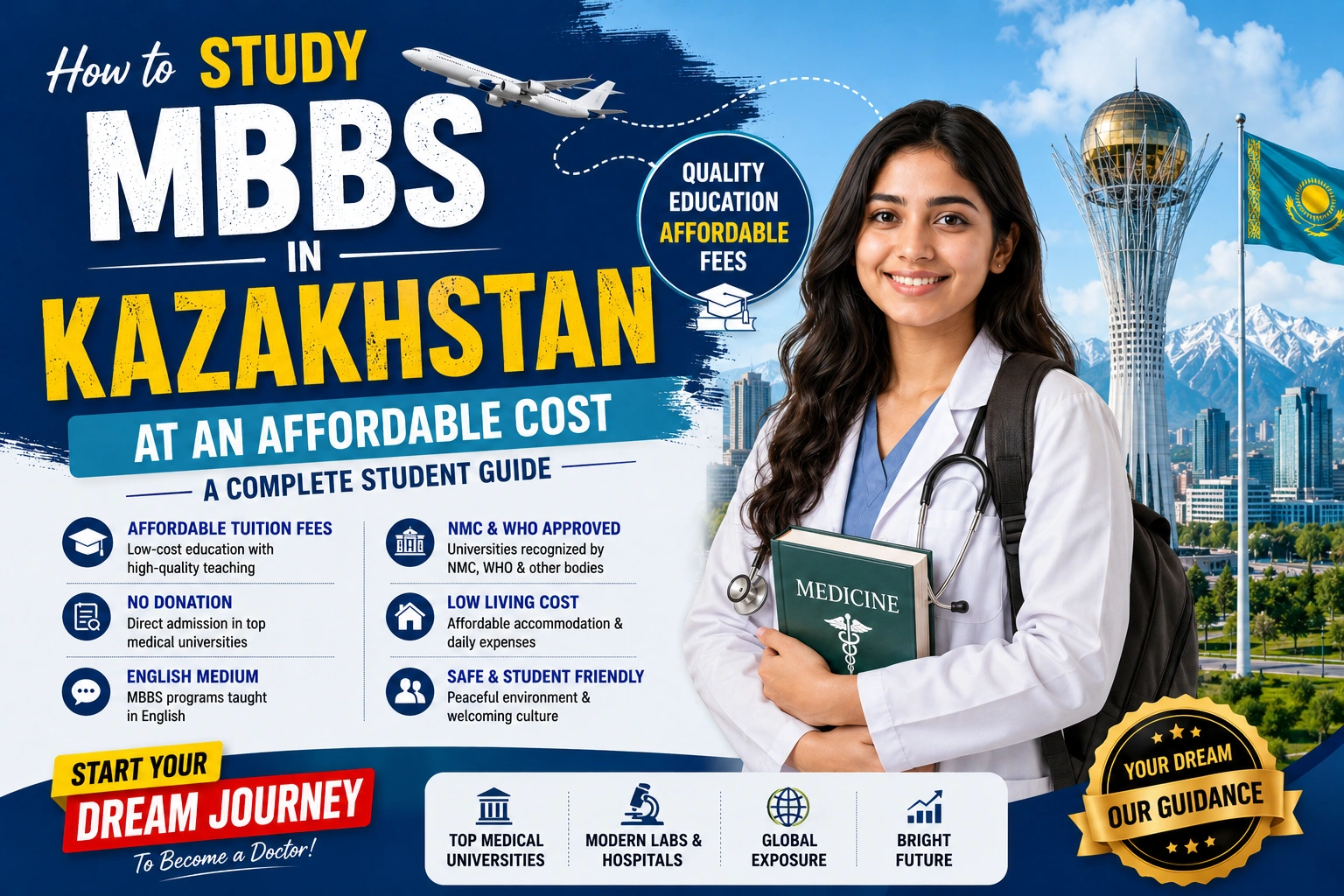
Every year, many Indian students take the NEET exam with the same ambition of working as a doctor, but with such a huge shortage of government seats and considering the fees of private medical colleges, which can exceed 1 crore, this dream seems almost impossible. MBBS in Kazakhstan has become a credible alternative. From the affordable tuition fees to English-medium instruction and the availability of globally accredited universities, it is completely possible to become a doctor, without ruining your family financially for life.
This guide provides you with all the information you need. From budgeting to eligibility and picking the best university for you, you will have a clearer understanding of your options rather than relying on guesswork.
Why Students Are Opting for MBBS in Kazakhstan
More and more Indian students are drawn to MBBS in Kazakhstan and for good reason. Kazakhstan is:
- Cheaper than private colleges in India.
- Affordable compared to other countries like the US, UK, Australia.
- More convenient for Indian students since Kazakhstan has English MBBS programs.
- Kazakhstan is also easily accessible by India with multiple direct and connecting flights.
- Kazakhstan has established communities of Indian students.
- Kazakhstan offers recognized universities with credibility across major regulatory organizations that will influence your practice in the future.
If you have performed well in NEET and are looking for an MBBS program in Kazakhstan because you have missed the cutoff for admission to Indian government medical colleges, it is an excellent opportunity to pursue your ambition for a career in medicine without losing a year.
Step 1: Are You Eligible to Apply?
Before you even try to figure out Kazakhstan MBBS programs in terms of fees or anything else, you need to meet the eligibility requirements.
Most importantly, you need to qualify NEET. This is an eligibility requirement for all Indians who wish to pursue MBBS in any foreign nation. You can check the official NEET website for details about the registration, exam pattern, and results. There is no high cutoff for pursuing MBBS abroad. What is important is that you meet the qualifying percentile for your category.
In terms of academics, you need to have completed your 10+2 with the subjects Physics, Chemistry, and Biology and secured a minimum of approximately 50% of the marks (with some relaxation for reserved categories).
In accordance with medical school admission policies, applicants are expected to be at least 17 years of age at the time of admission.
Age requirement policies must be observed first to be considered a potential candidate for admission. This hurdle is missing when students apply to medical schools, causing a waste of time.
Step 2: Regulatory Endorsement vs. Tuition Fees
Perceiving the importance of this step in the admission process is where most students struggle. Regulatory endorsement will determine if your efforts to study medicine abroad will hold any value after you return to India.
The National Medical Commission (NMC) is India's paramount governmental authority for medical education, and the approval of the NMC is mandatory for all foreign medical schools. Familiarize yourself with the NMC regulations and the requirements for Foreign Medical Graduates’ Licentiate in India before considering your options.
The World Directory of Medical Schools (WDOMS) is the official authoritative list of accredited medical schools around the globe. The presence of a medical school in this directory indicates compliance with the globally accepted baseline standards of medical education. For Indian students, endorsement of the NMC is granted when the medical school is in WDOMS.
While the World Health Organization (WHO) does not approve medical colleges per se, it still originated the system for standards of international medical education, which the WDOMS and other national regulators use. The WHO website has a lot of information on the standards for global health education.
Why this matters: Programs that have very low fees but have no recognition from the NMC or WDOMS can leave you with a degree that is useless for practicing medicine in India. Always check recognition status before investing in any program both emotionally or financially.
Step 3: Get Your NMC Eligibility Certificate Before Admission
This step causes the most issues for students. Indian students must get an Eligibility Certificate from the NMC before enrolling into a foreign medical university, not after. NMC does not accept applications that are retrospective. Hence, you end up wasting your admission if you attempt to sort this after joining.
Try to obtain this certificate as soon as you have decided to pursue MBBS abroad after the NEET exam. This certificate usually requires your NEET score, some academic certificates, and some ID. Try to include this in your schedule so there is no failure in admissions at the last moment.
Step 4: Shortlist Universities Using the Right Criteria
After verifying eligibility and recognition, you can compare the universities. Check lists that go beyond costs to the following factors.
- Medium of instruction -- Confirm that the MBBS program is fully taught in English.
- Clinical training facilities: Finding universities that have their own teaching hospitals or have solid hospital affiliations for students to benefit from practical exposure is really important.
- Faculty credentials: Ensure that your professors have some form of a clinical background and don’t just teach as a form of a side job.
- Hostel and campus safety: Very important for first time international students and their families. Reliable accommodations are essential for peace of mind.
- Track record of Indian graduates: Have the alumni passed the Indian licensing exams and how many attempts did it take?
- University ranking and years of operation: The older the school, the more likely they have a more developed system of clinical training.
There are some amazing medical universities located in Almaty, Karaganda, Semey, and Shymkent. Indian students have attended all of them. The campuses and cities have a various selection of fee structures and are worth comparing to each other.
Step 5: Build a Realistic Budget for the Full Course
Affordability must be evaluated in the context of the overall program cost rather than the first-year rate advertised in brochures. Your budget must include:
- Years of Tuition — Largest savings from Kazakhstan come from the annual tuition cost.
- Hostel Accommodation — Most inexpensive housing for the first few years.
- Food and Daily Expenses — These costs are low if you eat from the local market and student cafeterias.
- Health Insurance — International students are required to buy this insurance; it is affordable.
- Visa Expenses — Factor in the cost of an annual student visa.
- Flights Home — Expected to happen during breaks, usually once or twice a year.
- Other Costs — Include books, lab coats, local transportation, and personal expenses.
Even after considering these estimates, the cost for an MBBS from Kazakhstan, an internationally recognized program, is significantly less than the cost of an Indian private medical college. Studying MBBS in Kazakhstan with a full-course budget helps avoid financial surprises rather than year-one tuition estimates.
Step 6: Time Your Application for the Right Intake
Most of the Kazakh medical universities have their main intake in the month of September. There are numerous benefits for those who apply early, such as:
- Increased chances of getting early admission fee waivers.
- More time to apply for NMC Eligibility Certificate and to process the visa.
- More options for hostel accommodation before it gets fully booked.
- Less chance of making hasty decisions due to time constraints.
If your goal is to pursue MBBS in Kazakhstan 2026, then you should ideally start all your research and shortlisting of universities and documentation at least 6-8 months prior to your planned intake. Early admission always results in better admission processes with lower costs.
Step 7: Common Money and Time-Wasting Mistakes
- Any agents who say NEET is not required should not be trusted, as this is false for Indian students and is a huge red flag regarding the reputation of the agent.
- Do not verify universities that might look appealing and well presented, but actually are unlisted by WDOMS.
- Do not wait for the NMC to start processing your Eligibility Certificate, as they do not provide backdated approvals.
- Do not disregard unexpected costs, and be realistic with how far your budget can stretch.
- Do not base your decision for a university on one review or recommendation by agents, and try to include current students in your research.
Step 8: Plan Ahead for Licensing After Graduation
Affordability is important even after you graduate. The MBBS you earn in Kazakhstan includes follow-up measures once you’re home. For example, Indian graduates must take the NMC licensing exam for them to practice in India legally. If you select a NMC-compliant, WDOMS-listed, and well-known university from the start, this step becomes a lot easier. These universities construct their course programs according to global licensing requirements.
You should allocate time and money for the license exam you will need to take in India. The expenses and effort you put in to procure this education are not for you to waste or put off until you are back in India.
Conclusion
Affordable MBBS programs in Kazakhstan are not about pinpointing the cheapest university on a random list of universities. It is about confirming a lot of factors. First, make sure you are eligible for NEET and academically eligible. After that, check universities for NMC and WDOMS recognition. Then, apply for your Eligibility Certificate early. After this, select the most quality- and cost-effective university, keep in mind the length of the course, and budget for post-graduation licensing.