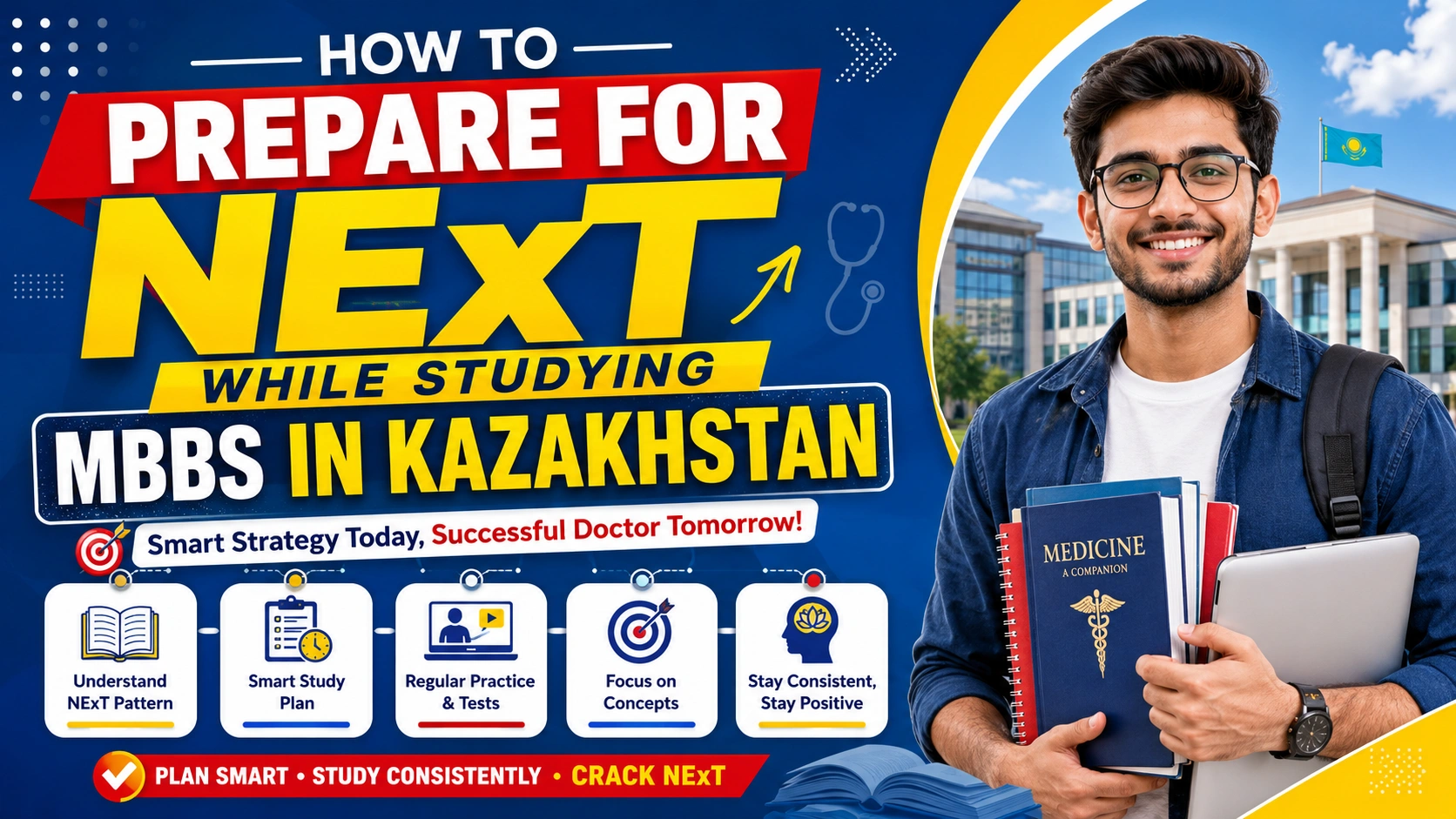
In recent years, pursuing an MBBS in Kazakhstan has become an increasingly popular option for Indian medical aspirants. Options available to Indian medical aspirants have greatly improved over the last several years, but medical education is still out of reach for most. Medical education in Kazakhstan is an obvious option for Indian medical aspirants because of its affordable fees, globally recognized medical education, and universities with an international standard medical curriculum. Unfortunately, after you have enrolled and begun your medical education abroad, another challenge comes into view: the National Exit Test (NExT).
For MBBS students in Kazakhstan, there is no time to waste when it comes to knowing about NExT and formulating a NExT prep strategy early while controlling other studies. Because this exam will determine your ability to practice medicine in India, it deserves the same level of planning and dedication from day one, as you would for any other major medical school exam, as opposed to the final year of your medical school education.
This blog will discuss what is NExT exam, what it means to students returning from Kazakhstan, and how you can effectively NExT prep while leaving your MBBS studies in Kazakhstan, unimpacted.
What is NExT and Why is it Important?
NExT is a common licensing exam that the Indian National Medical Commission (NMC) has made compulsory for all medical practitioners looking to practice in India, including foreign medical graduates. The NExT exam is a two-part exam. It serves as the final qualifying exam for all MBBS graduates, and as a screening exam for the international medical graduates.
Studying MBBS abroad required Indian students to pass the Foreign Medical Graduate Examination (FMGE) for licensure. The National Exit Test (NExT) will replace FMGE and standardize exams for both domestic and foreign medical graduates. Updates and notifications for NExT will be posted on the National Medical Commission (NMC) website, the primary regulatory body for medical education and licensure in India.
For the 2026 MBBS students in Kazakhstan, NExT will likely be the first exam they will face upon return, making it important to be informed in advance.
Why is Kazakhstan a Favorite MBBS Study Destination despite NExT?
- Some students feel that the additional licensing exam will make studying abroad less attractive. However, the medical universities in Kazakhstan are accredited by the WHO, which means that the degree will carry value and be recognized across the world.
- With the WHO accreditation, medical universities in Kazakhstan will ensure that the medical education is at par with the standards of global health education.
- The inclusion in the World Directory of Medical Schools (WDOMS) means that the university is recognized and listed in the majority of countries, which is a requirement for the NMC screening test and for practicing in most countries.
Because of the recognition, students who choose to study MBBS in Kazakhstan are not disadvantaged by NExT—they need to prepare for NExT the same way that every other Indian MBBS graduate will prepare for their licensure exam.
Understanding the Structure of NExT
The examination will occur in two phases:
Step 1: examines knowledge of theory and fundamentals of clinical training in prominent subjects like Medicine, Surgery, Obstetrics and Gynaecology, Paediatrics and other core clinical subjects. This step is primarily knowledge-based and the structure is like a comprehensive final professional MBBS examination.
Step 2: has a different focus. This step examines knowledge of clinical and procedural skills via practical examinations. This examination will include the management of patients, discussions of clinical cases and practical skills.
As policies are subject to change, students should periodically refer to official NMC notifications instead of relying on external sources, as these will provide the most accurate information on exam patterns, eligibility, and timelines.
NExT Preparation Strategy While Studying in Kazakhstan
1. Start preparing early
A common mistake students make is thinking they can begin preparing for the NExT exam after returning to India. Rather, they should try to develop good revise habits during the first few years of clinical training. Since NExT relies heavily on clinical subjects, the bedside clinics, ward postings and case discussions that students participate in while in Kazakhstan will help them build the knowledge that NExT will be testing.
2. NExT and MBBS Subjects Correlation
The medical universities in Kazakhstan use a curriculum that is heavily aligned with the international curriculum. This includes the subjects of Anatomy, Physiology, Biochemistry, Pathology, Pharmacology, Medicine, Surgery and other related fields. Ensure to relate your semester coursework to the NExT syllabus. This will allow you to use your regular studies to prepare for the exam, thus reducing the amount of time you need to study later on.
3. Use Standard Indian Reference Books Alongside Your Kazakhstan Coursework
While your university coursework will help you develop strong conceptual clarity, most NExT aspirants supplement this with medical textbooks published in India, along with Indian licensing exam question banks. Subject-wise texts used in FMGE/NExT preparation will help align your Kazakhstan curriculum with the expectations of Indian exams.
4. Solve Past FMGE Papers and Mock NExT Papers
Since NExT is replacing FMGE, the past years' FMGE papers will be useful to you for many years to come. Solve these papers to learn about the question patterns, important topics, and develop a sense of timing for the exam. Officially released NExT sample papers will be available to you, and these should be the papers you practice the most.
5. Enhance the Learning of Clinical Subjects with Case Discussions
NExT emphasizes clinical reasoning as opposed to memorization. Use your clinical practice postings in Kazakhstan to the fullest by engaging in case discussions and learning to provide differential diagnoses and management. This will help you in both Step 1 and Step 2 of the NExT.
6. Participate in Study Groups and Discussions
Studying with your fellow Indian students going for their MBBS in Kazakhstan for Indian students can be very beneficial. Group study sessions, case discussions, and quizzes offer the opportunity to reinforce knowledge and learn a variety of problem-solving strategies. Many students join online communities and forums for NExT and FMGE preparation.
7. Refresh NEET Foundations
Interestingly, many of the foundational FN subjects assessed in NEET while pursuing an MBBS (the basics of Biology, Physics, and Chemistry) continue to be indirectly useful in developing the conceptual clarity of the preclinical subjects of an MBBS, which further culminate in the NExT. Revisiting the fundamentals you acquired at NEET from time to time can help you develop concepts in Biochemistry and Physiology, if you need them the most.
8. Simulate the Real Exam
Of all the strategies to prepare you to sit an extremely long exam, simulate the actual exam, take as many time constrained mock exams as you possibly can in your last two years of MBBS, more so than in the last few months, than to take the rest of your MBBS years.
9. Check NMC Often
As NExT is a new type of exam, changes of regulations, eligibility, and exam structures can happen at any time. Get into the habit of frequenting the National Medical Commission for their random posts, circulars, and updated ways to keep you from learning the news the hard way.
10. Don't Sacrifice Your Well Being
Exams on top of the MBBS workload abroad can be a great source of stress. Your study habits need to be flexible enough to allow you to dedicate time to regularly exercise and keep you from altering your habits to get less sleep. Your mind needs to be at full rest to study and to retain and apply knowledge of greatest importance to the practice of a branch of medicine.
How Kazakhstan's Medical Education System Supports Preparation for NExT
Kazakhstan's MBBS colleges focus on a robust practical curriculum, and many begin their students' clinical exposure earlier than many other international MBBS options. This early exposure offers a distinct advantage as students prepare for the clinically oriented NExT exam.
Additionally, the WHO recognition of these colleges and their listing in the WDOMS means graduates fulfill the basic criteria for India's licensing exam. This recognition eliminates a major issue students may face if they attend colleges that the WHO does not recognize.
Common Mistakes to Avoid
- Not starting early enough: The vast coverage of the NExT syllabus means that you not only have to begin your preparation several months in advance, but also that cramming for the exam will not work.
- Failing to develop clinical skills: Since Step 2 measures clinical skills, students who focus on theoretical preparation will likely fail.
- Not enough practice of MCQs: Considering that both the FMGE and NExT exams are MCQ and case-based, daily practice is mandatory.
- Ignoring official communications: Outdated information about the exam will create gaps in your preparation. Always refer to the NMC.
Planning the Path: from Admission to License
For those still undecided, checking the MBBS intakes in Kazakhstan for the 2026 session lets you not only plan your admission but also allow you to create your entire academic plan—including your approaches to the NExT from day one. If you plan early, you'll be able to give yourself the advantage of being able to fully integrate your study routines into your daily work.
Conclusion
Studying MBBS abroad while preparing for NExT does not need to be mutually exclusive. They do, in fact, align and should be pursued together. The MBBS in Kazakhstan course offers students strong clinical foundations to NExT which is advantageous because it is a WHO and WDOMS accredited course. The main focus should be early starts and consistency. Keeping the study plan syllabus aligned and tracking the NMC updates is also important.
With a good level of preparation and consistent performance during your MBBS in Kazakhstan, getting NExT and being able to legally practice in India is not an impossible thing to achieve.