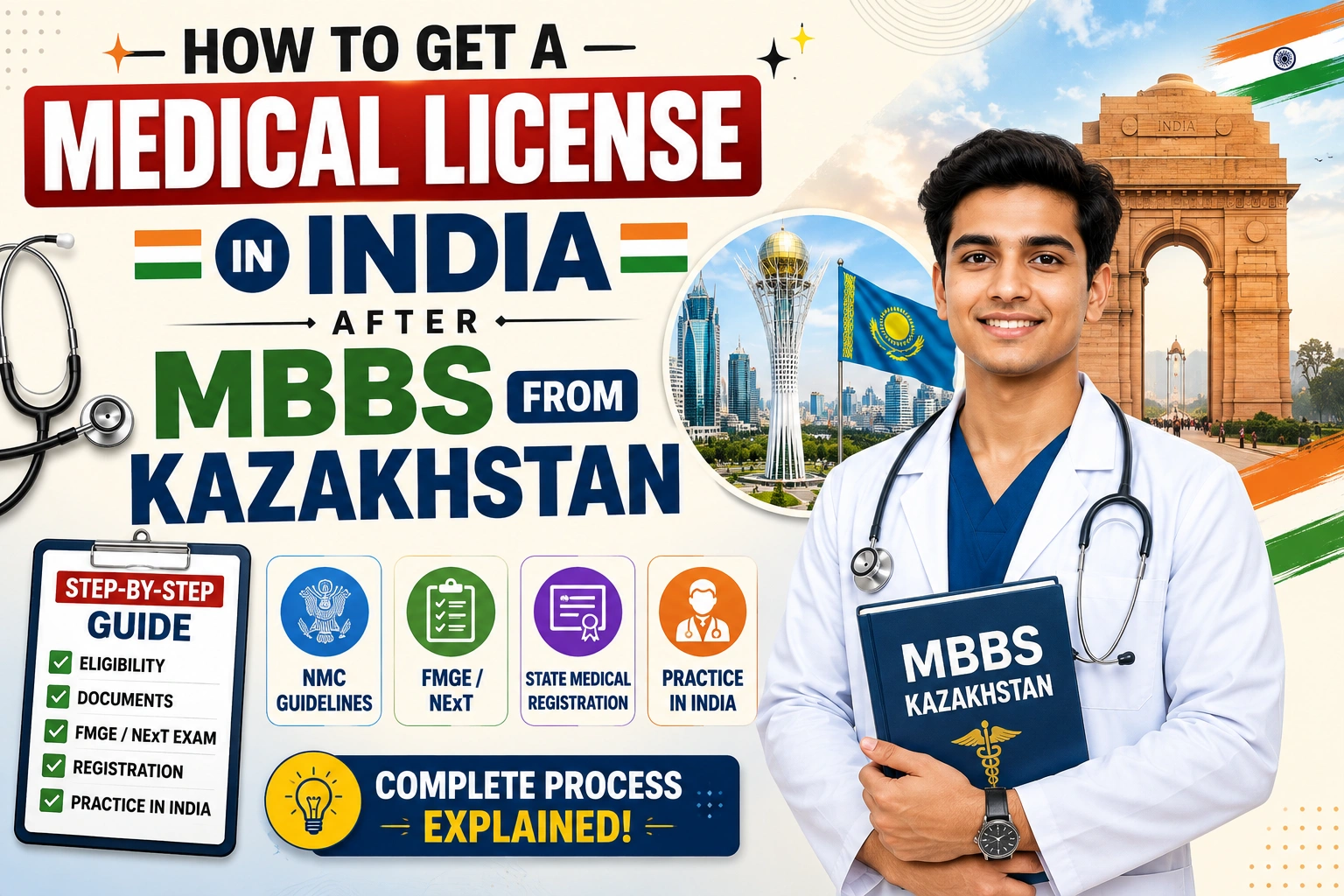
For Indian students looking at the probability of studying medicine at lower costs, getting an MBBS degree in Kazakhstan can be a great option. Even with a foreign degree in medicine, students cannot practice medicine in India. So, after completing the MBBS course in Kazakhstan, Indian students must fulfill the requirements set by the National Medical Commission (NMC) of India and follow the process for the medical license in India to practice as a doctor.
Before taking admission for the course, students must understand all the requirements set by the NMC to practice medicine in India. Students must verify the requirements based on the medical university, the recognition (and) the duration of the course, the medium of instruction, the complete structure of clinical training and the internal training course for which the university must have proper recognition in Kazakhstan, and must be counted in the World Directory of Medical Schools (WDOMS). Students must also ensure that they are updated with the latest drafts and regulations set by the National Medical Commission (NMC) of India, as the regulations for foreign medical graduates may change.
Is an MBBS Degree from Kazakhstan Valid in India?
An MBBS equivalent degree from Kazakhstan can be used to apply for medical registration in India. However, such a degree does not provide practicing rights in India. The graduate needs to satisfy the requirements of Indian Foreign Medical Graduates, and needs to undergo the internship and registration process, and clear the examination to get practicing rights in India.
The National Medical Commission (NMC) does not have a list of foreign Universities from which Indian students can study Medicine.
Students studying abroad should confirm the foreign institution, the length of the course and the curriculum, the availability of an internship, the medium of instruction, and all the requirements for admission by themselves. Indian students should not opt for a medical university in Kazakhstan simply because an agent claims the university as “NMC approved”.
Before admission, students should confirm the university’s position, its status in Kazakhstan and in WDOMS, and assess whether the offered medical program fulfills the requirements of the NMC.
What are the primary requirements after MBBS in Kazakhstan?
The requirements for licensing depend on the regulations applicable to the student and the date the student began the foreign medical course. For students governed by the Foreign Medical Graduate Licentiate (FMGL) Regulations, 2021, the NMC framework includes provisions regarding the duration of the medical education, internship, English-medium instruction, required subjects, registration in the country of the qualification, and the prescribed internship and licensing examination in India.
The NMC’s FMGL Regulations state, inter alia, a foreign medical course of at least 54 months and a one-year internship in the same foreign medical institution. The regulations also require the foreign medical graduate to be registered with the appropriate professional regulatory body in the country where the degree was awarded, as per the applicable regulations.
For this reason, choosing the right university before studying MBBS in Kazakhstan is of paramount importance for students. One should not automatically assume that all foreign medical programs fulfill the Indian licensing requirements.
Step 1: Complete Your MBBS in Kazakhstan
First, you must finish your entire medical education according to the criteria set by the NMC. To be eligible and for record-keeping purposes, students must retain all the official records of their studies from each semester. This includes, but is not limited to, semester mark sheets, transcripts, degrees, internship completion certificates, and other official university records.
Clinical rotations are key elements of medical education. Students must ensure their university provides sufficient clinical rotations and not overload the students with a heavy provision of theory. You must keep all your clinical rotation records, training records at an affiliated hospital, and internship completion records as you may need these during the licensing process.
The NMC has also answered some of the frequently asked questions related to medical education provided online to international medical students. According to the FMGL framework, online education is allowed for theory-based learning, but there needs to be practical and clinical learning offline. Therefore, you must confirm the education process of your university, and keep the required records.
Step 2: Complete the Required Internship in Kazakhstan
Internship is a crucial part of the licensing process. As per the FMGL Regulations, students under these regulations must complete a 12-month internship in the same foreign medical institution post completion of the qualifying medical education.
This internship must not be confused with clinical postings done as a part of the MBBS. The NMC has clearly distinguished clinical postings done as part of a medical education degree from the internship done post completion of the medical degree in their FAQs.
To complete this process, students must procure an internship completion certificate issued by their university or medical institution, and preserve all associated documentation.
Step 3: Registration in Kazakhstan, Wherever Required
Students must also register with the appropriate professional regulatory body in the country for which the medical qualification was awarded, as per the Indian regulations.
This typically requires the student to determine whether a local medical license or registration in Kazakhstan is required upon completion of the academic and professional requirements of the degree and internship. The relevant registration should, as required, be in accordance with the Indian regulations and enable students to practice medicine in Kazakhstan.
This is one of the primary reasons students should not solely base their choice of university on low fees. Other factors such as evaluation of the academic standards and clinical training offered; the opportunities offered upon the completion of the degree; and the potential for a future career should be considered.
Step 4: Qualify the Needed Licensing Examination in India
After completion of MBBS abroad, a Foreign Medical Graduate must pass the examination conducted by the Indian medical regulator for registration. The regulatory system is moving towards the National Exit Test (NExT), and therefore, students should confirm from the latest notifications issued by the NMC the examination and implementation details applicable to them.
For a number of years, the Foreign Medical Graduate Examination (FMGE) was the major examination through which foreign medical graduates were able to obtain registration in India. However students are advised not to rely on old information.
The NMC's current regulations state that a foreign medical graduate must pass the National Exit Test or another exam prescribed by the Commission, as per the circumstances.
Step 5: Apply for the Required Internship in India
Clearance of the required licensing examination is not the final step under the current FMGL framework. Eligible foreign medical graduates are required to undergo supervised internship in India as a part of permanent registration.
In the NMC's FAQ, it is stated that foreign medical graduates subject to the FMGL Regulations must undergo a 12 month supervised internship in India in addition to the foreign internship for which applications are made through the relevant State Medical Council through the NMC process as per the prescribed norms.
The NMC has further made it clear in March 2026 that those students who joined after 18 November 2021 are required to undergo a 1 year mandatory internship in India, while certain students who joined before the FMGL Regulations came into force may be treated differently based on their individual circumstances.
Therefore, Kazakhstan graduates must identify the regulations applicable to their admission batch and not assume the same pathway for every graduate.
Step 6: Obtain Provisional Registration
Provisional registration is granted by a State Medical Council to eligible foreign medical graduates to undertake the mandatory internship in India once all the examinations and criteria are fulfilled.
The State Medical Council may need the foreign medical degree, academic transcripts, internship certificate, exam results, identity and passport related documents and other supporting certificates.
Documentation requirements may vary as per the applicable regulations and the State Medical Council’s procedure. Therefore applicants are advised to regularly check the latest instructions.
Step 7: Complete the Indian Internship
Foreign medical graduates require a supervised internship to get exposure to the Indian health care system. During which, graduates get hands-on experience in patient care, clinical procedures, hospital and other health care facilities protocols and the health care service and system in India, under the guidance and supervision of a senior practitioner.
The internship is a prerequisite to being allowed to practice medicine on one’s own. The NMC regulation prevents a foreign medical graduate from practicing in India until permanent registration has been granted.
Step 8: Apply for Permanent Medical Registration
When the Indian internship is completed and all other requirements have been met, the graduate can now apply for permanent medical registration with the appropriate State Medical Council or the competent registration authority in accordance with the existing laws.
Permanent registration entitles the foreign medical graduate to practice medicine in India in accordance with the laws and regulations of India.
The NMC provides official information on registration of medical practitioners on its website. It is advisable for graduates to use information on official websites rather than relying on information provided on consultancy websites or social media.
Role of NEET for Indian Students going to Kazakhstan
NEET is required for Indian students aspiring to pursue an undergraduate degree in medicine abroad.
Students need to meet the NEET eligibility criteria for the academic session relevant to their foreign medical admission.
NEET qualification is neither a pre-licensure exam nor a substitute for it. NEET is relevant to admissions to medical colleges and the license to practice as a medical doctor in India.
An Indian student looking at an MBBS in Kazakhstan should assess his/her eligibility for both: admission to the foreign medical college and medical regulation in India in the future.
Why WHO and WDOMS Status are Important
Students look for a ‘WHO approved’ medical college, but the term should be understood correctly. WHO individual approvals for medical practice in India are not offered.
WDOMS is an important global directory of medical schools. Appearing in WDOMS should neither be perceived as not a guarantee to medical registration in India.
Students should cross check the university’s status in WDOMS and check the NMC’s requirements and Kazakhstan’s recognition. The eligibility should be confirmed without a doubt before paying the admission fee.
Documents to be retained by students for MBBS in Kazakhstan
Students should keep a complete record of their academic and professional documents from the first year.
- Admission records
- passports
- university identification documents
- semester marksheets
- transcripts
- attendance records (wherever applicable)
- clinical training records
- internship records/documents
- degree Certificate
- local registration documents will have to be submitted.
We advise our graduates to retain hospital training certificates and other records of their practical education. Gaps in documentation will create hassles when a graduate applies for an examination, internship, or registration.
Common Mistakes Kazakhstan MBBS Graduates Should Avoid
One of the biggest mistakes is thinking that a foreign medical degree will provide the right to practice in India. Selecting a university because of the low tuition fee is another common mistake.
Students should avoid relying on statements such as "100% NMC approved," "no licensing exam required" or "direct registration in India." The NMC advises students to verify foreign medical universities very carefully.
Another mistake is failure to consider the internship structure. The foreign internship, Indian supervised internship, and clinical training during the degree are different components of the applicable framework. Students should know all the requirements before they join the course.
Conclusion
A foreign medical degree from Kazakhstan is only the first step for students aspiring to practice medicine in India. They are required to complete an admitted medical course, fulfill the NMC criteria, complete the foreign internship, fulfill the examination requirement, undergo the prescribed internship in India, and obtain a medical registration from the correct medical authority.
For students aiming for MBBS in Kazakhstan, they should evaluate the licensing criteria before joining so that they are not taken by surprise after graduation.
Check if the university has recognition, is listed in WDOMS, has English medium education, offers clinical training and internships, and is in line with the latest NMC regulations.
Since the NMC regulations and examinations may change, candidates should always check the latest official notifications before applying for admission and license. Official NMC rules and regulations should be the only trusted source for regulations and adherence.