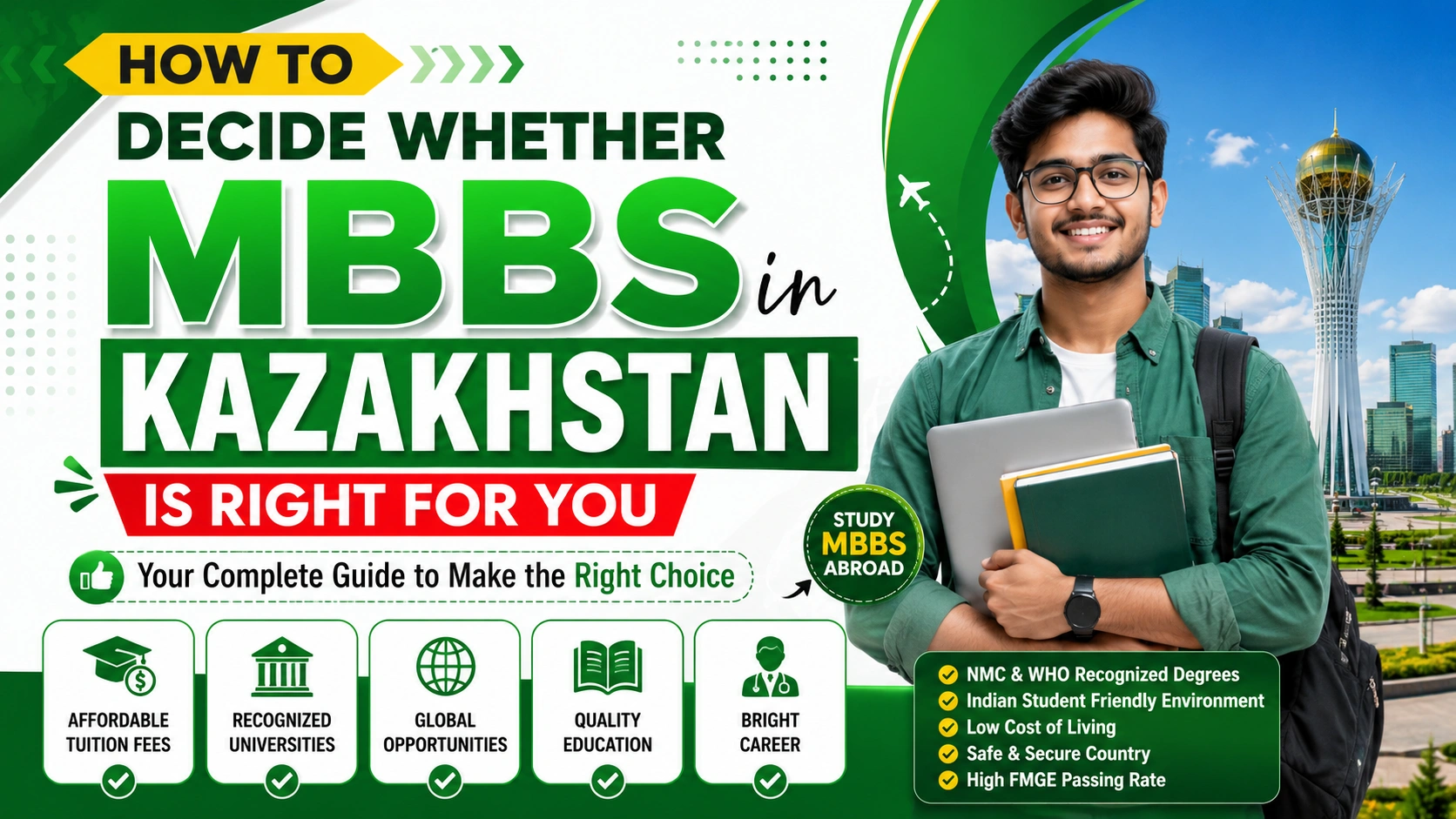
For medical students, where to study medicine is perhaps the biggest decision. For many Indian students, MBBS in Kazakhstan may become a viable alternative to expensive private Indian medical schools and expensive private medical schools in Western countries. However, just because this option is popular, does not make it the right choice for you. Before accepting an offer, think carefully about this option the same way you would any decision that would commit you for six years to a choice, and consider the facts instead of just the forum opinions.
Kazakhstan as an MBBS Destination
Kazakhstan has many favorable attributes as a medical study destination. It is just a 4-5 hour flight away from India and has a good cultural fit as an international student hub. Its medical schools have decades of experience hosting foreign medical students. Here are Kazakhstan's most appealing attributes for Indian students:
- Less expensive medical education compared to private Indian medical colleges and the US, UK, and Australian MBBS programs.
- No capitation fees or donations.
- English language MBBS programs for international students.
- Admission is based on qualifying marks without an entrance exam.
- The universities are part of the major international medical education assessment boards.
Comparative analysis of fee structures, eligibility criteria, hostel facilities, etc. is often not available. However, an initiative based on MBBS in Kazakhstan for Indian Students provides some of this information and can be helpful in your cost comparison.
Step 1: Are You NEET Eligible?
Before you consider any of the medical schools in Kazakhstan, you should determine your eligibility to pursue medicine. The first consideration is NEET-UG. As per Indian regulations, qualifying NEET-UG is mandatory for any Indian student who wants to be a licensed medical practitioner in India. This is regardless of whether the student enrolled in an Indian or foreign medical school.
A few reminders:
- You don't need an exceptionally high NEET score to do MBBS abroad. For most universities in Kazakhstan, you just need to have passed your NEET exam; there's no minimum score requirement.
- NEET scorecards are typically valid for a few years, so you can plan your timeline accordingly.
- There are several problems that come with not qualifying NEET, opting to do MBBS abroad, and assuming it's going to turn out in your favor. This is one of the most common mistakes students make, and your degree won't be recognized for practice in India.
If you haven't qualified NEET, just stop reading here. Everything that follows in this guide assumes you have completed that step.
Step 2: What does 'NMC Compliance' mean?
This is the most important concept you need to know when considering Study MBBS in Kazakhstan or any other foreign medical degrees. The National Medical Commission (NMC) is the regulatory authority that decides if your medical degree from abroad will allow you to practice, do your internship or be licensed to practice in India.
- The NMC has done away with their "approved list" of foreign universities. Now, under the FMGL Regulations, we assess your degree with the following deal breakers.
- Course duration: Must be at least 54 months of taught degree + a 12 month internship at the same university.
- Medium of instruction: Must be an English-only degree with no bilingual or partial English programs.
- No mid-course transfers: Must not transfer universities or countries while pursuing the MBBS.
- Continuous education: Must not include any hybrid, online, or distance education of core clinical training.
- Licensing exam: Graduates must return to India and pass the licensing exam (FMGE, currently being phased in with the NExT) to receive permanent registration.
When considering a university in Kazakhstan, confirm that the structure, duration, and language of instruction, of the program, meet all of the aforementioned deal breakers. A university may seem reputable, but if they meet even one of these deal breakers, the value of your degree in India may be wasted no matter how high the education quality was. MBBS programs offered in Kazakhstan for Indian students generally align with the NMC, but they should be considered on a case-by-case basis to confirm the course length and language are acceptable before any payments are made.
Step 3: Verify the University's Global Recognition
In addition to Indian standards, your degree must also be recognized globally, especially if you wish to study or work outside of India. It is also useful to have evidence outside of India that the university is not a diploma mill.
There are two resources to check.
- World Directory of Medical Schools: This is a definitive resource and an authoritative registry of medical schools that have met the standards of an international listing, supported by the World Federation for Medical Education and the Foundation for the Advancement of International Medical Education and Research. You will find that the medical school you are interested in is available and has a listing that is neither inactive nor restricted.
- World Health Organization: Currently, the WHO does not administer a school listing. That duty has effectively been transferred to the WDOMS. That said, it is still useful to understand the WHO's role in standards of medical education and in what context a university or agent are referring to "WHO Recognition" as it is often a vague phrase in promotional materials.
- A five-minute check of WDOMS prior to your commitment is a good way to avoid significant issues later. If a university or a consultant is not able to show their WDOMS listing, it is a good reason to be concerned.
Step 4: Look Beyond the Tuition Costs
MBBS in Kazakhstan appeals to many for its affordability. However, what does affordable really mean and how does it compare to your family's budget? The total cost of studying abroad can include:
- Tuition (can vary greatly depending on university and city)
- Cost of accommodation
- Cost of food and other daily living expenses
- One-time costs for visa, insurance, and other documents
- Costs for return flights (generally 1-2 trips per year)
- Cost of books, lab coats, local transport, etc.
After factoring in more costs your choice may turn against you opting for a private Indian medical college. However, Kazakhstan's medical colleges can appear more affordable compared to other options for studying abroad. Instead of the "starting from" tuition figure mentioned by the agents, request the university to issue a comprehensive yearly cost breakdown.
Step 5: Consider Climate and Culture
Most underestimate this step. It's often true that fulfilling the academic and legal requirements to study abroad can be the easiest part of the process, while students can fail to adapt to the new environment surrounding them on a daily basis. Here, cold winters are not an insignificant detail if you've to this point lived year-round in the warm climate of India.
Do you think you can handle being away from home for long periods? Most students can't afford to fly back home for a visit every few months.
What are your thoughts on a smaller Indian community? Some cities in Kazakhstan that have Indian students focus on education, food, temples, and support networks while others have less established communities. Do some research on the community and support networks of the location you will be studying.
Are you mature enough for independent living? You have to face the burden yourself for most of the responsibilities that are manageable if you study in your home country, like budgeting and documenting, not to mention having to navigate a foreign country.
You shouldn't let any of these points alone dissuade you from applying, but you should consider them as importantly as you would tuition fees.
Step 6: Talk to Current Students and Alumni — Not Just Agents
Education consultants and agents are quite often interested monetarily in your enrollment. While this doesn't invalidate what they say, it does mean what they say has to be taken with a pinch of salt. Before you actually consider a location:
- Talk to the current Indian students at the universities you have shortlisted via student groups or alumni networks.
- Obtain information regarding the actual class sizes, the available teaching hospitals for clinical years, and how proficient the local faculty are in English.
- Ask whether any of their courses or internships were online and how that was dealt with for NMC regulations.
- Make sure the fee structure they were paying and the fee structure you were quoted are the same.
Step 7: Outline Your Plans Post-Graduation
The 5+ years spent studying abroad should be planned well. Note the following:
- You will have to take the FMGE license exam (currently transitioning to NExT) to get the medical license in India.
- You may have to complete an additional period of supervised practical training in India to get permanent registration, depending on how the regulations change during your course.
- You should also look into the licensing exams for foreign graduates from Kazakhstan for the country where you plan to practice medicine, as you may want to practice outside of India.
Those who go abroad with a well-planned route for post-graduation tend to have a much more seamless experience adapting to life after graduation than those who go abroad without a plan for life after graduation and only think of it after coming back.
A Quick Decision Checklist
- I have confirmed I meet the qualifications for NEET-UG. I know the validity period for my score.
- The courses from my shortlisted universities are 54+12 months and taught in English. They meet NMC's FMGL.
- I have confirmed the University is listed on WDOMS.
- I have reviewed a full year-by-year breakdown of costs.
- I have spoken to at least one former student and one former trainee (not an agent).
- I have taken the climate, community size, and my country's level of Independence into account.
- I know the steps for the licensing exam and what I need to do after I return.
If you can confirm all of these, then MBBS in Kazakhstan is likely a great choice for your career. If you can't confirm two or more of these, then do a little more research before you invest your time and money.
Conclusion
There is no "best country" for MBBS abroad. Cost, your country's regulations, and your personal comfort living away from home all play a part of your "best" university. Kazakhstan offers affordability, English instruction, and international recognition which attract serious Indian students every year. Successful students almost never choose the cheapest option. Rather than the option that an agent pushed hardest, they choose the option that meets the criteria in the above checklist. Successful students do their work on NMC compliance, spotting an NMC recognition country from a mile away, talking to students who have been there, and actually opening their eyes to the reality of life in a foreign country and what it is really like. Doing this will help you decide whether this is the right path for you.