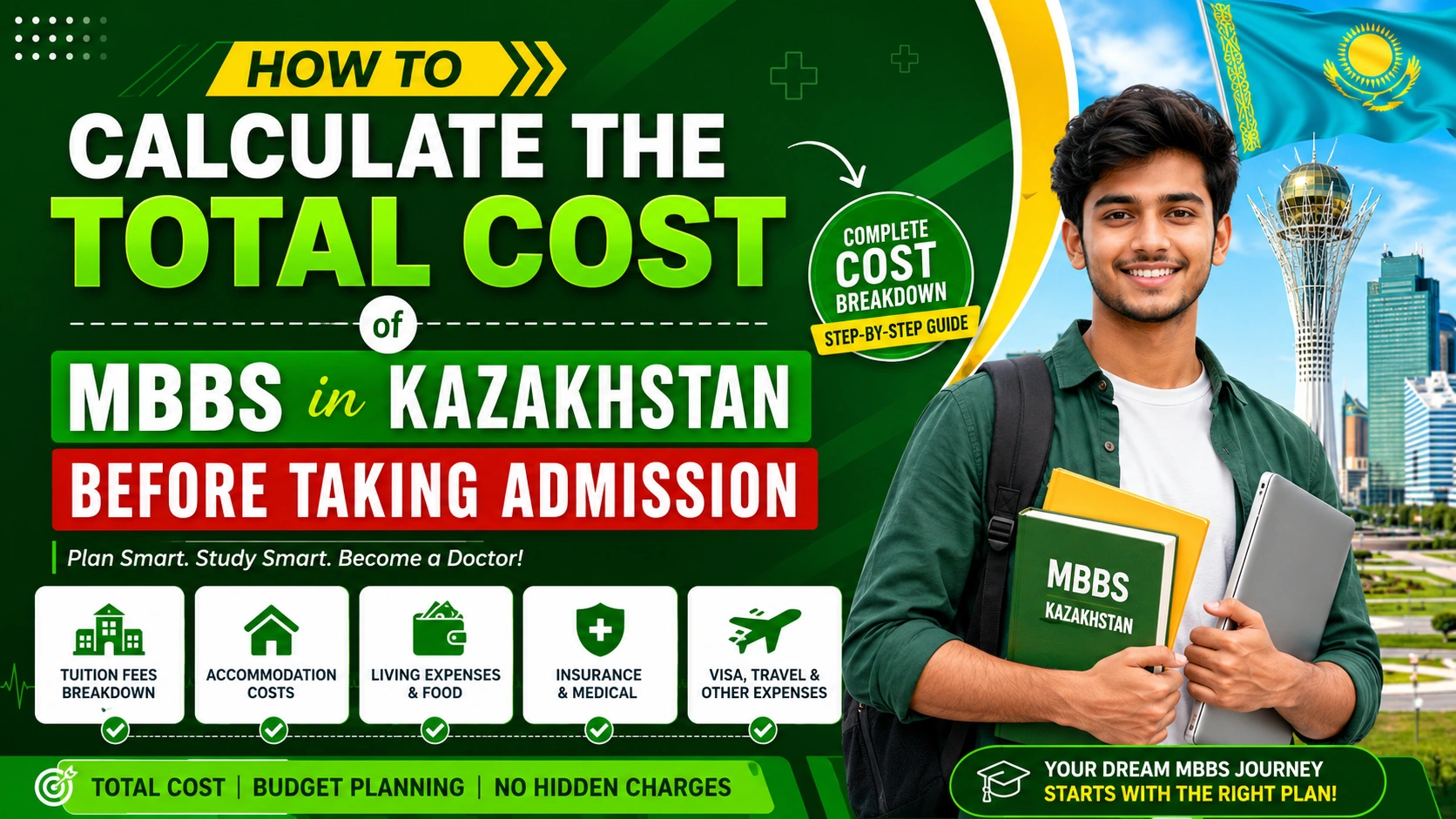
Cost is one of the major factors why Indian students prefer studying medicine in Kazakhstan rather than opting for private medical colleges in India. However, "affordable" doesn't have the same meaning for all families. Quite a few students end up incurring unplanned, unexpected expenses; such as hostel mess charges, visa renewals, insurance, and the budget being eaten away by currency exchange issues during the course.
Before you sign the admission letter for a medical college in Kazakhstan, you are advised to work out the actual, not the estimated, total cost for the 6-year MBBS course in Kazakhstan. This guide has explained, in detail, the different components of fees so that you can decide and build your comprehensive budget before you finalize your admission.
Why You Must Calculate the Total Cost, Not Just the Tuition
University brochures and consultancy websites prefer to lead with the most eye-catching numbers, and that is most likely the tuition fee. However, tuition covers only part of a student's total cost. The total cost a family must cover generally includes:
- Tuition for the entire six years
- Accommodation and boarding charges
- The first year's compulsory Indian mess fees at most of the universities
- Living and food expenses for the entire duration of the stay
- Medical insurance for international students
- Visa expenses and annual visa extension or renewal costs
- Registration, document attestation, and airfare, which are all one-time expenses
- A contingency buffer for currency fluctuation and emergencies
When all these costs are considered, the total amount an Indian student will spend on MBBS in Kazakhstan will average between ₹22 lakh and ₹36 lakh for the entire six-year program, which is still much lower than the ₹80 lakh to ₹1.2 crore that Indian private colleges will charge, but only if it is done correctly from the beginning.
Step 1: Find Out the Exact Tuition Fee.
Since tuition is the largest expense, start with this cost. Across the medical universities in Kazakhstan, the annual tuition fees can be between $3,000 and $7,000 USD (about ₹2.5 Lakh to ₹5.5 Lakh depending on the exchange rate), and this will vary based on the university's ranking and the city where the university is located.
Keep these things in mind for these calculations:
- Fees are quoted and paid in US Dollars. Fees paid in Kazakhstani Tenge or Indian Rupees have some protection from the local currency falling; however you are then exposed to the USD-INR rate.
- Multiply the USD annual tuition by 6 years (or 5 years tuition + 1 year work placement) to get the total tuition you would have to pay.
- Some schools charge the same tuition for subsequent years after initial enrollment; others will raise tuition after you enroll. Make sure you have this information before you enroll.
- Make sure to find out if the fees for the placement year are the same as the tuition year, less than the tuition year, or waived. This can significantly affect your total costs at the university.
The total tuition cost in INR is calculated as follows: USD Annual Tuition × Current USD-INR Rate × Number of Years.
Step 2: What about Hostel and Accommodation Fees?
In the majority of Kazakh medical universities, hostels are available and are the best option if you are trying to minimize costs of living.
- Prices for hostel accommodations vary each year between $600 and $1,000 USD, or approximately ₹50, 000 to ₹85, 000.
- Usually, hostels have the following amenities included in the price: Wi-Fi, access to a kitchen and laundry, and heating (very helpful in the colder months in Kazakhstan).
- Opting to live in a private apartment will most likely incur greater costs and should only be selected if you have a particular reason to prefer a private apartment over a hostel.
To Calculate Total Accommodation Cost: Annual Cost of Hostel in USD × the Current Exchange Rate × the Number of Years.
Step 3: Include the Mandatory Indian Mess Fee
Most people overlook this cost. The majority of medical universities in Kazakhstan require first year international students to use the Indian Mess for the first year.
Costs for the Indian Mess are between $1,000 and $1,400 USD.
After the first year, students are free to either continue to use the mess facilities, which are now optional, or use the hostel kitchen to prepare their own meals, which brings down the cost of food significantly.
To Calculate Total Accommodation Cost (YearN): Include the first year Indian Mess fee, since this fee is paid once unless you continue to use the Indian Mess in the subsequent years.
Step 4: Estimate Your Living Costs
Apart from mess and hostel fees, you will have a personal monthly budget that covers groceries, local travel, phone and internet, and other living expenses. You will also have to consider costs associated with daily living.
Self-catering students in Kazakhstan typically spend about $100-$120 USD (around ₹8,500 to ₹10,500) a month
Of course, that depends on what you do in your free time. Eating out and going on frequent trips around the city will increase your costs
You'll need to do those calculations for how many years you will be living off your own cooking. Its typically years 2 to 6, since year 1 is usually with the compulsory mess.
Total living expense = Monthly living costs (USD) x 12 x (self-catering years) x (exchange rate)
Step 5: Add Mandatory Medical Insurance
If you're an international student in Kazakhstan, you have to have health insurance for your whole stay. The premiums are about $200 USD a year, which aren't too bad, but they do add up since you have to pay for all six years.
Total insurance cost = (yearly insurance cost x 6) x (exchange rate)
Step 6: Add Visa, Registration and Extension Costs
For the first year, visa, registration, and administration fees are usually combined, but keep in mind that the student visa has to be renewed every year.
Starting from the second year, it typically costs $100 to $200 USD to extend a Visa each year.
You can usually expect a separate, smaller, one-time cost for first-year registration and local documentation fees. Be sure to check with the university to see if those fees are included in the quoted tuition, or if they are paid separately.
Just a simple addition: Add the annual Visa extension costs for years 2 through 6 to the first year registration fees for a one-time cost.
Step 7: Don't Forget About the One-Time and Irregular Costs
Here are the costs that students typically forget to plan for:
Airfare: Round-trip tickets to and from Kazakhstan and regular trips to and from your home country during holidays.
Document attestation and apostille: The documents will need to legally verified to be used outside India.
Kazakhstan's harsh winters cost students who are coming from the warmer parts of India for the first time to purchase winter clothing and hostel essentials.
FMGE/NExT Materials: Students need to prepare for final year licensing exams and need to purchase coaching, books or online courses. This is usually a 5th or 6th year expense, but should really be planned ahead.
Step 8: Add a Buffer for Currency Fluctuations
Since tuition is quoted in USD but you're paying from India in INR, over the 6 year period, the USD/INR exchange rate will determine your total cost. If the rupee weakens against the dollar, your costs will increase, even though the university will still be charging the same tuition in USD.
It is recommended that a 5–10% contingency buffer should be added to your calculated total to provide a buffer against currency fluctuations and additional unexpected costs, to avoid being blindsided by these mid-course.
Example Total Cost Calculation
An approximate example of what the total could roughly look like over 6 years at a mid-range university (these numbers are for example purposes only — always check these numbers with the university of your choice):
|
Cost Component |
Approximate Total (6 Years) |
|
Tuition (avg. ₹4,05,000/year × 6) |
₹24,30,000 |
|
Hostel (avg. ₹72,000/year × 6) |
₹4,32,000 |
|
First-year Indian mess (one-off) |
₹1,08,000 |
|
Living expenses for years 2–6 (self-cooking) |
₹4,25,000 |
|
Medical insurance (₹18,000/year × 6) |
₹1,08,000 |
|
Visa renewal (years 2–6) |
₹67,500 |
|
Airfare, attestation, and other one-off costs |
₹1,50,000 |
|
Estimated Total (before buffer) |
≈ ₹37,20,000 |
A 5–10% contingency buffer should be added, bringing the realistic planning figure to ₹39–41 lakh, to fully budget for the 6-year period. This will put the figure in perspective and show that the lower end of the budget (₹22–36 lakh) refers to the three main costs of tuition, hostel, and insurance.
Recognition Verification Pre-Cost Calculation
Before making any cost calculations, it is prudent to confirm that the university is a worthwhile investment. If the degree will not be recognized when you return to India, a low fee means nothing. Always check:
- The university is listed in the World Directory of Medical Schools (WDOMS).
- The program meets National Medical Commission (NMC) requirements of a minimum of 54 months of study and a 12-month internship at the same institution and is taught completely in English.
- In the past, the university has aligned with the international recognition frameworks of the World Health Organization.
- You have qualified for the NEET-UG, as this is an absolute requirement for any Indian intending to pursue MBBS abroad and who eventually wants to practice in India.
Money and time spent making a precise budget for a university with no decent recognition is a lost cause. Recognition status should always be confirmed, and then cost calculated.
Advice to Control Your Total Cost
- Unless you have a good reason to not book a hostel, book a hostel. This is a generally cheaper and safer practice.
- If you have the option to, cook for yourself. This is a great way to lower the total cost of your food for the month.
- Request a complete list of the fees with the final rate and the fees they expect to rise to. This way, you know what to expect.
- Don't exchange small amounts of USD to INR. Allot a larger amount when the rates are favorable.
- Look for scholarships that reward students with high academic performance. This decreases the total amount spent.
Conclusion
The total cost to study medicine in Kazakhstan is low enough that many people can afford it. For Indian citizens, it is one of the most affordable options. However, it is really important to know how much everything will cost to avoid being blindsided. The hostel and food are just the start of getting a realistic six year estimate, you should also consider your insurance, visa renewals and a currency buffer. If you really need a complete list of how much everything will cost every single year in order to pick the right school, take a look at some other guides for how to study MBBS in Kazakhstan and the MBBS in Kazakhstan 2026 fee structures.