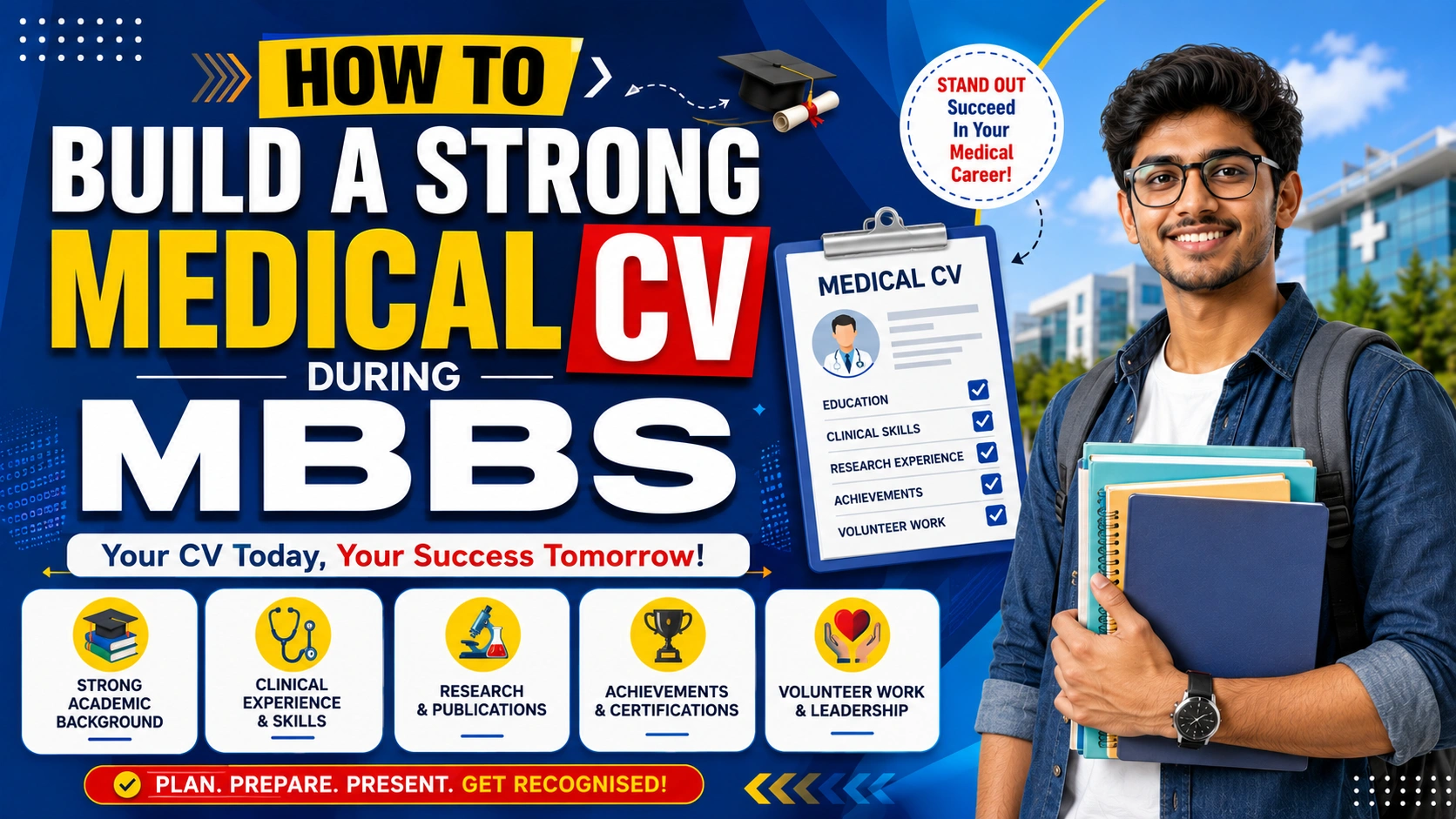
There’s a common misconception that a Medical CV is only a concern when applying for residencies or making the first job application. Their assumption is understandable, as most candidates will start to write their CV’s as they finish their medical degree. The reality is, a CV needs to be built years in advance. The application that you submit post-graduation should not be your first attempt. Instead, it should be a collection of 6 years of work.
Here, we have outlined how to start building a credible MD CV and ensure that what you include on your CV is a true reflection of what you have accomplished. It does not matter if you are doing your MBBS in India, Kazakhstan or a different country.
Building your CV from Year 1
One of the biggest misconceptions of building a CV is that it only starts during the clinical years. The most impressive CV’s are a result of effort taken during the pre-clinical years. Join a research project in Year 2, attend your first conference in Year 3, or get a certification during semester break. You should aim to build your CV early for the following reasons:
- Gain Depth – Instead of a long list of activities, gain depth in a maximum of 2 or 3 areas.
- Get Real Letters of Recommendation – You will be able to get letters that are truly reflective of your skills and relate to you as a person, and not just as a student.
- Have a Narrative – A CV is not a series of unrelated activities. It should look like a well constructed narrative.
- The most important part of building your CV is knowing that a CV is not something that you simply write. It is a reflection of all your decisions throughout medical school.
Section 1: Academic Foundation — Focus Here First
An academic foundation is the first and most important thing that should come with a CV.
- Steady semester performance over years
- Confirmation of your university and course — check if your medical school is in the World Directory of Medical Schools (WDOMS). This directory is a joint effort of the World Federation for Medical Education, and FAIMER. This is often cited in residency and licensing applications worldwide.
- Ensure alignment for Indian students — make sure your MBBS course is aligned with the National Medical Commission (NMC). This course will determine if you will be able to practice in India after your MBBS.
These requirements are not just for show. These details are confirmed by prospective employers, residency panels, and licensing authorities. Make sure you get the foundation correct before you work on the more elaborate and impressive details of your CV.
Section 2: Research Experience
- Research adds tremendous value to a medical CV, and it need not even start with the publication of a paper.
- Assisting a faculty member in a data collection exercise or a literature review
- Presentation of a poster at an intramural symposium
- Writing a case report in your clinical years as a co-author
- Participation in a medical school organized research elective
Practical tip: Keep a detailed personal record of all research activities done, no matter how petty or small, with the date on which it was carried out, and a description of what was done. This will be a very useful addition while writing your CV, as it will serve as a record of details which are otherwise difficult to recollect after a lapse of time.
Section 3: Clinical Skills and Rotations
This section of your CV shows evidence of your competence. Start developing this section by:
- Going beyond the basic requirements and selecting rotations in the areas that interest you
- Asking your supervisors for feedback and documenting the skills you gained and the procedures you learned to perform
- Doing additional clinical work during your free time and participating in clinical camps, especially in settings with limited resources. These activities reflect work and care that exceed what is expected from your academic schedule
Wherever possible, document exact figures and be specific about the number of procedures you either observed or of which you had the opportunity to partake, the variety of patient cases you dealt with, and the length of your specialized rotations. Statements like “gained clinical experience” will convey less meaning than descriptive statements containing actual numbers.
Section 4: Certifications and Skill Building
Engaging in certifications during MBBS is a great way to demonstrate your self-motivation and your area of knowledge and skills. Some certifications that you can consider during MBBS are:
- Basic Life Support (BLS) and Advanced Cardiac Life Support (ACLS)
- Suturing Workshops, Introductory Workshops to Ultrasound and Point of Care (POC) Workshops
- Short Courses in Biostatistics, Medical Writing, and Research Methodology
- Language Certifications, especially for study abroad sessions where language proficiency documentation is required
The aim of having certifications in your CV should demonstrate your areas of self-interest and should correspond with the field or area of specialty you want to pursue. Thus, avoid unrelated certifications.
Section 5: Extracurricular and Leadership Roles
Medical schools and residency programs look for leadership and communication skills, and the ability to work well in a team along with, for example, clinical skills and knowledge. Here are some examples of what would be a valued contribution in this category:
- A leadership position in a student medical association or college council
- Organization or volunteering in health promotion camps
- Tutoring or mentoring others
- Participation in medical quizzes competitions or health policy simulations
These examples would help you show that you can work outside of the wards. This ability has much more value now, and with the development and evolution of the healthcare system, it is becoming more collaborative and more communication intensive.
Section 6: Publications and Presentations
If your work does research and develops into a publication, you should treat it as a primary item in your CV. Contributions also include the following examples:
- Case reports in indexed or university journals
- Letters to the editor
- Conference abstracts and poster presentations
- Contributions to review articles under faculty guidance
When you include these, be sure to include your role in this work. Consistent academic citation format should also be used and applied accurately, as these details are often checked during your residency or job applications.
Section 7: Volunteering and Community Health Work
This section demonstrates your commitment to the community and caring nature, which the other sections of your CV cannot show you meet the requirements of the quantifiable metrics. Examples of meaningful work are:
- Rural or underserved area health camps
- Collaboration with NGOs to promote health education
- Blood donation or vaccination drives
- Mental health initiatives on campus
For these examples, be sure to document your role along with the impact, such as the number of people screened. Simply stating the activity name is not enough.
Section 8: Licensing and Eligibility Requirements
Having a strong CV also means having a strong understanding of the regulations. These obligations and restrictions should be well known by students prior to the last year of studies, and should not be learned in the last year.
- Indian students must take and pass the NEET (National Eligibility cum Entrance Test) organized by the National Testing Agency, in order to qualify for MBBS admissions in India and internationally.
- Graduates of foreign medical schools generally have to take and pass the Foreign Medical Graduate Examination (FMGE) or an equivalent examination if they wish to practice in India.
- When medical schools and licensing authorities examine the credibility of medical schools, they usually rely on the evaluation of several international accrediting agencies, which have used evaluation frameworks historically associated with the World Health Organization (WHO).
Scholarship and residency panel reviewers will see that you have an understanding of the pathways and have taken early steps to prepare for them as a sign of maturity and foresight.
Section 9: The Right Way to Format Your CV
Your CV's content is the most important element, but how you format your CV can have an impact on how quickly and positively a reviewer will evaluate your CV. Look for the following:
- Maintain professional and uniform formatting throughout your CV, avoiding over use of color, and font styles, or distracting graphics
- Section your CV into Education, Clinical Experience, Research, Certifications, Leadership, and Extracurricular Activities in that order
- During the MBBS years, keep your CV to a maximum of 1–2 pages. Longer CVs can be submitted for your residency and later career stages
- A medical CV will have a professional appearance, but a poor entry in the spelling and formatting of the CV will have a negative impact on a positive and strong profile
- Revise your CV every 6 months not once a year to ensure details are not omitted that you want to be included
Section 10: CV Building While Studying Abroad
Building your CV while pursuing an MBBS in Kazakhstan for Indian students includes the following:
- Details related to your university’s listing in the WDOMS and accreditation need to be included, as they are commonly required for your residency or licensing applications
- International exposure to clinical work and experience with multicultural patients can be seen as a strength, as residency programs are valuing this experience more
- Keep organized records, as you will be required to provide NMC related documentation and your eligibility to undertake screening tests. Gather these records during your course, rather than at the end of your course
- Skills developed during your International program related to language, and other forms of communication, as well as your adaptability will be valued
For those who want to pursue the MBBS in Kazakhstan in 2026, consider directly asking the universities for the quality of their clinical rotations and the existence of mentorship support, and how those will impact opportunities for research. The answers will determine how the university will impact the strength of your CV after six years.
Most common errors
- Building a CV in only the final year shows a lot of CV gaps. Do not let that happen.
- Describing activities in general terms CVs that lack specifics are difficult to evaluate and uninterpretable.
- Failing to keep important records- important documents like certificates and letters should be kept organized. Trying to collect everything important years after is not fun.
- Having a long CV with only miscellaneous activities- a long and unorganized CV is way less important than a focused and organized one.
- Ignoring the requirements of the profession- lack of knowledge of the NMC, NEET, and other licensing requirements spells trouble during the period that an unprepared person would have dealt with the same requirements.
Conclusion
A good medical CV shows your work during all the years of the MBBS course and also shows your involvement and interest in studying, documenting, and keeping records. To achieve this, you should start documenting early and keep records. Know the requirements of the profession and be aware of the NMC, NEET, and the WDOMS in regards to university accreditation and the licensing of medical practitioners.
If you have plans to study MBBS in Kazakhstan to fulfill your goals of studying medicine, you should select a university with ample research, clinical, and mentoring opportunities to assist you in producing a medical CV that stands out prior to the completion of your studies.