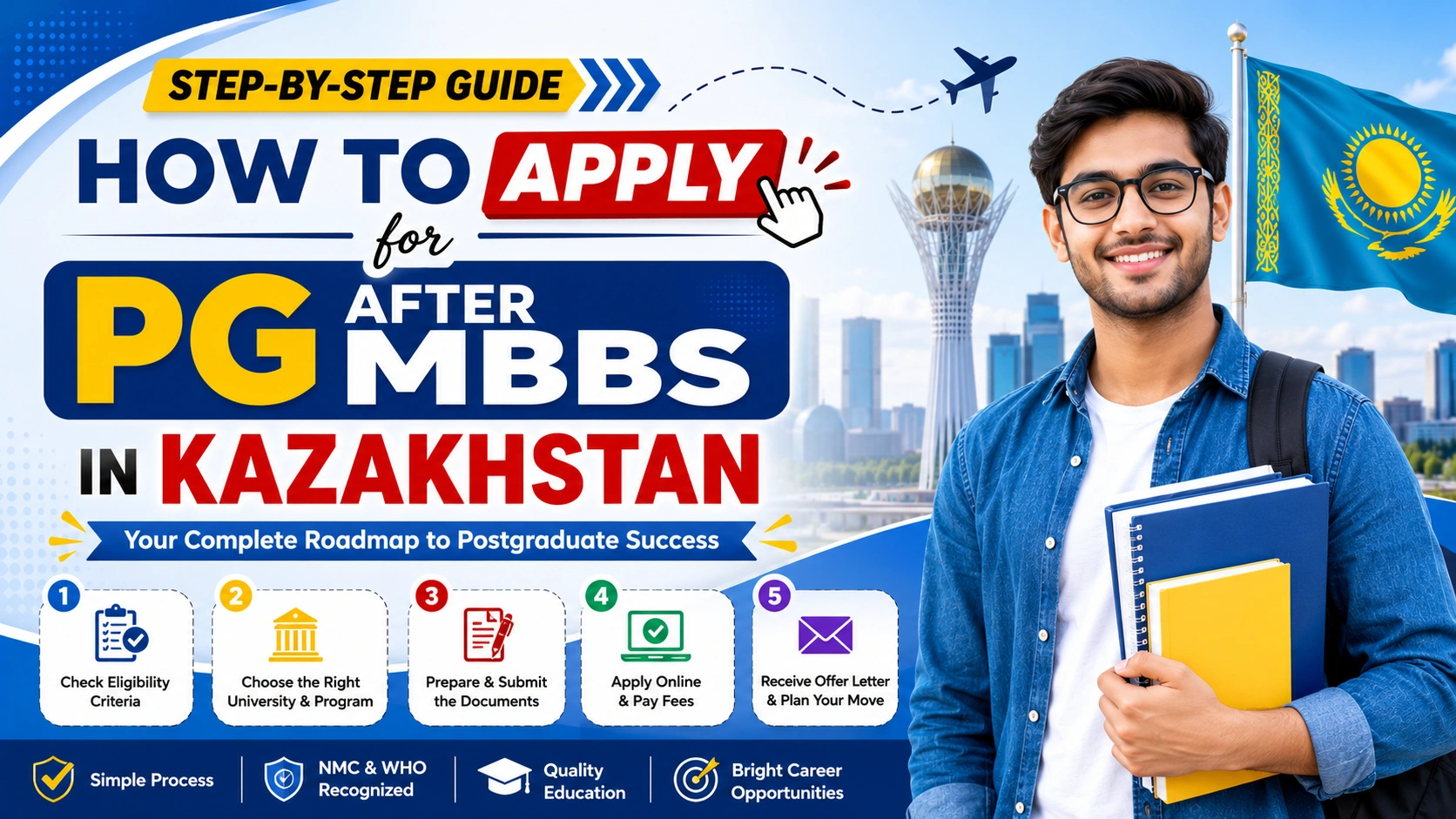
Getting an MBBS/MD in Kazakhstan opens up opportunities, it is not the end of the journey. Most students completing MBBS in Kazakhstan have a common question, what is next? Postgraduate specialization in Kazakhstan is not a straightforward process as in India. Indian MBBS graduates have a linear process for attaining a PG seat, while foreign medical graduates have many options, all of which are associated with their own challenges, exams, and paperwork.
This guide provides you with the realistic options available after MBBS/MD from Kazakhstan. These options include going back to India, staying in Kazakhstan, or moving to a different country. This guide provides you with the information to help you plan for your future years in advance.
Your PG Options are Divided into Three Main Categories
Before going into the specifics of each process, you should have a general understanding of the wide variety of options available. After MBBS/MD in Kazakhstan, you have three general avenues for your postgraduate education. All of these paths include a unique process.
- Option 1: Return to India for MD/MS/DNB via NEET PG and complete the FMGE/NExT licensing exam.
- Option 2: Stay in Kazakhstan (or the region) and complete a Master's, residency, or PhD.
- Option 3: Go International. This includes a residency in the USA via USMLE or UK via PLAB/UKMLA or similar options in Australia, Canada, and the Gulf.
Make your choice based on where you want to work in the future.
Pathway 1: Returning to India for PG (MD/MS/DNB via NEET PG)
This is the most common route for Indian students who complete MBBS in Kazakhstan for Indian students, and it involves a specific, non-negotiable sequence of steps.
Step 1: Complete your Internship
You must first complete your one-year rotating internship. You will have done this either in Kazakhstan or in India, depending on what the regulations say at the time of your graduation. Confirm this early with your university and the NMC, as the internship location has frequently changed.
Step 2: Clear FMGE/NExT
Indian foreign medical graduates must take a licensing screening exam. Presently, the Foreign Medical Graduate Examination (FMGE) is administered by the National Board of Examinations. The NExT is gradually replacing the FMGE as the licensing exam of choice for foreign medical graduates during subsequent exam cycles. Irrespective of which exam applies during your graduation year, this exam is compulsory to pursue post-graduate studies in India, as you will not receive the necessary pass certificate to register with the NMC or the State Medical Council.
It is also for this reason that certain forward-thinking universities that offer the Study MBBS in Kazakhstan have started to incorporate FMGE/NExT-preparatory coursework into the curriculum during the 3rd year of the program. Starting exam prep after graduation puts you at a real disadvantage compared to your peers who prepared during their studies.
Step 3: Register With the NMC or State Medical Council
After passing FMGE (or NExT), the next step is registration with the National Medical Commission (NMC) or the State Medical Council. To secure this registration, you must have the FMGE/NExT pass certificate, degree certificate, and certificate of completion of the internship. This registration step makes it legal for you to practice medicine in India and is also a prerequisite for NEET PG.
Step 4: Apply for NEET PG
You can initiate the application for NEET PG, the test conducted by the National Board of Examinations for admission to postgraduate studies, after you secure registration with the NMC/SMC. As a foreign medical graduate, consider the following: On the exam day, you must carry the original FMGE/NExT pass and registration certificates. As indicated in the NEET PG information brochure for that year, you must complete the one year internship by the designated date. As a foreign medical graduate, you have the benefit of no upper age limit and no restrictions on the number of attempts. The exam is a computer-based test of the entire MBBS syllabus and your eligibility for MD, MS, PG Diploma, and DNB courses is determined by your score.
Step 5: Participate in Counselling
Once the results are out, admission to the MD/MS/DNB seats occurs via a centralised counselling process facilitated by the Medical Counselling Committee (MCC) for All India Quota seats. State-level counselling is conducted for state quota seats (with the application of domicile rules). Foreign medical graduates usually work in the same merit-based counselling system as domestic graduates. Thus, a good NEET PG score for a foreign medical graduate is of the same value as that of an Indian MBBS graduate.
A Realistic Timeline for This Pathway
|
Stage |
Approximate Timing |
|
Complete MBBS/MD + internship |
Year 6 (or Year 5 + 1 internship year) |
|
FMGE/NExT preparation |
Ideally starts in Year 3–4, intensifies after graduation |
|
FMGE/NExT exam |
Conducted twice yearly by the exam body |
|
NMC/SMC registration |
After clearing FMGE/NExT |
|
NEET PG application |
Opens mid-year; registration and dates announced then |
|
NEET PG exam |
Typically around August–September |
|
Counselling and seat allotment |
In the following months, across multiple rounds |
Due to the annual cycles of FMGE/NExT and NEET PG, timing the completion of your internship and exam scheduling is critical — missing your timing can set you back a full year.
Pathway 2: Pursuing PG Within Kazakhstan
There are several reasons a student may choose not to return to India and do their postgraduate studies in Kazakhstan. Not only does Kazakhstan have a functioning postgraduate ecosystem, but there are also several universities that offer MBBS programs in Kazakhstan 2026, and who also offer:
- Master's programs (MD/MS equivalents) in specialties such as Internal Medicine, Surgery, Paediatrics, Obstetrics & Gynaecology, Cardiology, and Neurology
- Residency programs and trainings
- PhD tracks for students interested in academic medicine or research careers
If one wants to practice in Kazakhstan after completing their PG studies, they would need to learn either Kazakh or Russian. This is because the language of instruction shifts from English to Kazakh or Russian during the practice. This particular pathway is for students who are interested in building a career in the region, or are looking for cheaper postgraduate studies and are uncertain on their future after that.
Pathway 3: Pursuing PG or Residency Internationally
Students who complete their MBBS/MD in Kazakhstan have opportunities that extend beyond India and Kazakhstan. For example, since a lot of the prestigious universities are part of the World Directory of Medical Schools, students are eligible to take licensing examinations in a number of countries such as:
- USA: Complete the USMLE (all 3 steps) in order to be eligible for the residency program and participate in the NRMP Match.
- UK: Complete the PLAB exam (or the new UKMLA) to obtain GMC registration and pursue training posts in the NHS.
- Australia: Complete the AMC exam pathway for registration and residency.
- Canada: Complete the MCCQE exam for licensing and residency.
- Germany and parts of the EU - Approbation requires both language skills and successful completion of designated tests.
Each of these routes comes with its own benefits, exams, duration, and costs. Students dedicated to an international career must begin their research regarding the country of their choice at least by the 3rd or 4th year of MBBS and not after their graduation.
The Recognition Checks that Make Each Route Work
There is no PG pathway that you can pursue if your MBBS/MD is not recognised. This is the first thing you should check before you decide on a university.
- World Directory of Medical Schools (WDOMS): Verify that the university has a listing in the WDOMS, the global database medical regulatory and licensing authorities use to verify the legitimacy of medical schools.
- World Health Organization (WHO): Verify that your university's curriculum is in alignment with the higher standards in education set by the WHO.
- National Medical Commission (NMC): Verify the status Compliance NMC Recognition is what enables you to sit FMGE/NExT and therefore NEET PG.
- NEET: Your eligibility for MBBS is based on NEET-UG conducted by the National Testing Agency. Keep the documents because they are validated during your MBBS and your PG admission process.
Not conducting these checks during admission is the biggest reason students find their PG plans in other countries or in India frustrating due to blocked recognition that could have easily been addressed earlier.
Better Preparing Yourself for PG
- Aim to begin FMGE/NExT preparations by year 3 at the latest. If your university includes FMGE prep in the curriculum, consider yourself lucky.
- The earlier the better when it comes to deciding what pathway you want to pursue. If you plan to take NEET PG, USMLE, and PLAB, doing all three is possible, but you must have the ability to focus primarily on one to benefit the most. Most students are best served by deciding on one primary pathway by years 4 or 5.
- From day one, keep every single document organized. You are going to be asked for proof of your internship, FMGE results, and proof you have your medical degree and are certified to practice. If you do not have all of these, you will be waiting much longer to take your exams.
- The most valuable information about the horrible PG experience that is to come will come from an individual who has experienced it. Talk to seniors who have gone through this process.
- You shouldn't be leaving your research on this process until your final year, you need to start as early as possible. The scope and expense of USMLE and PLAB particularly will better serve you when taken with the knowledge that you've done early prep.
Conclusion
The term "PG after Kazakhstan MBBS" covers three legitimate pathways, all of which draw on the practices of the country where you intend to work. If you return to India, the process is fairly straightforward prior to the FMGE/NExT: internship, NMC registration, NEET PG, and counselling. If you choose to remain in Kazakhstan, you will enter the local system of postgraduate medical training. If you choose the third option, you will need to commit to the USMLE, PLAB or an equivalent pathway, early on. All three pathways, which are available to you, share the same foundational requirements: a WDOMS and NMC recognised medical school, with an accredited MBBS programme for which admission is granted on the basis of a valid NEET.