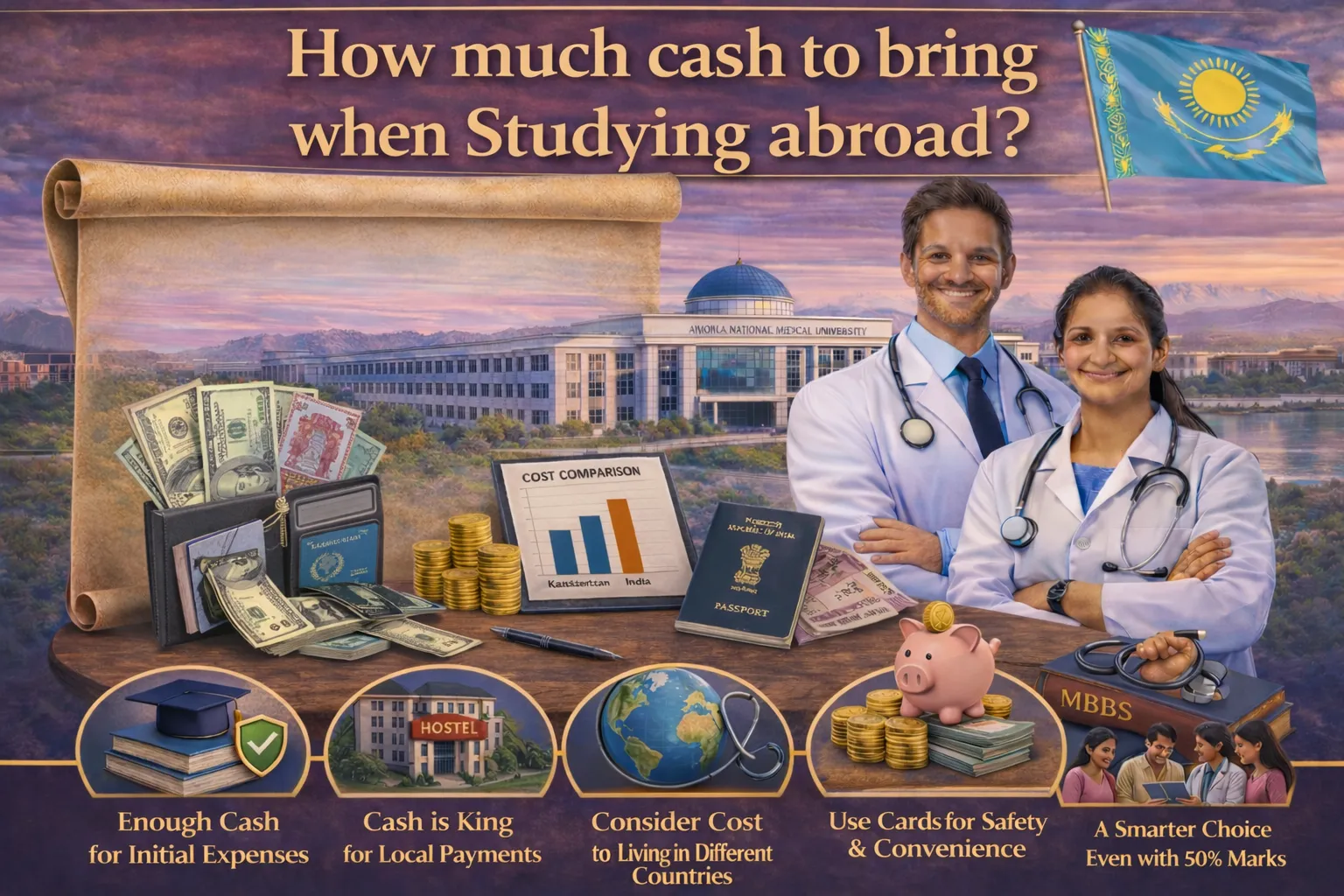
Beginning MBBS in Kazakhstan, students and parents often ask one of the most common questions: How much cash to carry while studying abroad? For all the students who have qualified NEET and are about to board a flight towards medical education, proper planning of finances is one way to ensure a smooth transition from one country to another.
Tuition fee payments are typically done by direct bank transfer, but students should still take a reasonable amount of cash with them to get through initial expenses after arriving. If students are looking to study at universities that Nmc has approved and are under Wdoms, also Who accredited generally provides a lot of information regarding preparing finances.
The Importance of Carrying Cash When Traveling Abroad
Upon arrival in a new country, students may not have immediate access to local banking facilities. Allocation of a bank account, international cards and university registration might take a few days to complete.
Some early expenses that can be managed with cash are:
- Airport transportation
- Temporary accommodation (if required)
- Food and groceries
- SIM card purchase
- Local transportation
- Initial hostel or utility payments
Here are nine ways to earn money: Students traveling for MBBS in Kazakhstan require money an initial few days until their financial arrangements are updated.
How Much Cash Should Students Carry When Studying Abroad?
The precise amount varies with personal expenses and the nation where you are pursuing MBBS in Kazakhstan, but however it is advised for students to take about:
- Between US$300-$800(Or equivalent currency) cash.
That's usually enough to cover you for your first 1–2 weeks (when you arrive) in terms of expenses.
Students should be careful how much cash they carry due to:
- It increases the risk of loss
- Most payments can be made digitally
- There are plenty of banks and ATMs
This amount is practical and safe for initial settlement needs for students travelling from India.
Common Costs When Arriving in Kazakhstan
Students are spending cash on essentials in the first few days.
Common early expenses include:
- Airport to Hostel Transportation
Students typically prepaid for taxi or university arranged transport upon arrival.
- Local SIM Card Purchase
SIM card — Min 100MB prepaid is necessary for communicating with university staff and family.
- Food and Groceries
Students can buy snacks, bottled water and other basic groceries.
- Temporary Expenses
Certain students have to pay minimal administrative or registration fees during the initial days.
Kazakhstan is also not that expensive overall, and daily expenses like Kazakhstan water bottle price or groceries are very cheap.
Monthly Living Cost Considerations
Cash is needed immediately, but students are also going to need long-term monthly expenses.
Kazakhstan cost of living per month typically covers:
- Hostel accommodation
- Food expenses
- Transportation
- Internet and mobile services
- Study materials
Students of Kazakhstan who plan their expenses from India often see that we have an overall expense on the lower side compared to many other countries.
Most comparisons tend to show Kazakhstan budget friendly for Indian students, answering the folks asking is Kazakhstan cheap for Indian students or is Kazakhstan expensive than India.
That Does Not Involve Cash: Safe Ways to Carry Money Abroad
Students should not have to depend on cash alone. Multiple payment methods can be set up to ensure safety and convenience.
Recommended financial methods include:
Cash (Limited Amount)
There is nothing - Carry only funds for initial expenses.
International Debit or Forex Card
These cards facilitate withdrawals from ATMs abroad.
Bank Transfers
International bank transfer is the common way to pay tuition fees and major payments.
Digital Payment Methods
With many cities accepting card payments in stores and restaurants.
It is advised to the students undergoing MBBS in Kazakhstan, should pay through multiple payment options for convenience and safety.
Currency Exchange Tips for Students
Prior to traveling students should convert a small amount of currency into US Dollars or the local currency used within Kazakhstan.
Useful currency tips include:
- Exchange currency from authorized centers
- Only change money at airports if you have to
- Maintain small denominations for your daily transactions
- Keep money in separate locations for safekeeping
Academic shortages are expensive but can be avoided by carefully planning currency exchange for the student.
Before Traveling: The Importance of Financial Planning
Before leaving, financial preparation should begin weeks in advance.
The below is the estimated cost for MBBBS in Kazakhstan, students planning their MBBS in Kazakhstan can consider:
- Tuition fees
- Hostel fees
- Travel expenses
- Medical insurance
- Personal expenses
The MBBS fees in Kazakhstan in Indian currency are significantly lesser than that of private medical colleges in India which reduces the overall financial burden on families.
Especially parents calculating total Kazakhstan cost to make this affordable in the long-run.
NEET and Admission Preparation Neet
Before going abroad to study in the medical field, candidates must satisfy admission formalities along with qualified NEET, which is a necessary exam for Indian students who want to pursue medical education overseas.
Students frequently ask:
- How many Years is neet score Valid?
- neet validity
- neet score validity
- validity of neet exam
Generally, the neet score is valid for three years to study abroad.
Be Compliant With Eligibility Guidelines For NMC Regulations Training
So it helps to choose a University.
You will not be surprised with additional payments in case of choosing recognized universities.
Here is the list of universities where MBBS can be pursued in Kazakhstan:
- Approved by NMC
- Listed in WDOMS
- Aligned with WHO standards
Popular institutions include:
- Karaganda Medical University
- Kazakh National Medical University
- South Kazakhstan Medical Academy
- Semey Medical University
- Marat Ospanov Medical University of West Kazakhstan
- Astana Medical University
Reputed institutions maintain transparency in fee structures and payment systems.
Emergency Funds: Every Student Should Have One
Besides starting cash, students need to have rainy-day funds available in bank accounts or cards.
Emergency funds help cover:
- Medical emergencies
- Unexpected travel costs
- Additional academic expenses
- Personal emergencies
MBBS in Kazakhstan– Keep backup finance Students pursuing their MBBS study in Kazakhstan should always keep back finance to cope up with emergency situations.
Lifestyle and First-Month Adjustment Costs
The first month abroad tends to come with a bit of added expenses, due to the settling-in process.
Students often purchase:
- Winter clothing
- Study materials
- Basic kitchen items
- Personal supplies
In fact, most students start searching about Kazakhstan temperature in May before their personal travel to pack the right kind of outfit.
Kazakhstan is also a place where beautiful places like Lake Balkhash are available, which can be an opportunity to relax in the holidays.
These experiences help students build rapport and grow as an individual.
Things to Avoid When Carrying Cash Overseas
Sometimes, student mistakes lead to needless financial hazards.
Common mistakes include:
- Carrying too much cash
- Focus All Money in One Place
- Ignoring currency exchange rates
- Not notifying banks of foreign travel
Avoiding these missteps can keep your money safe when you travel.
Why Kazakhstan Is a Useful Place for Cutting a Budget Plan
Kazakhstan continues to be a popular choice due to its reasonable costs and organized education system.
Cost comparison: Students wonder if Kazakhstan is an expensive or cheap city overall.
Various Kazakhstan MBBS fees in Indian rupees, on the affordable side and budgeted monthly living cost accommodation make studying in Kazakhstan econometrically feasible.
About NMC approved Colleges: Universities that are recognized by NMC, listed in WDOMS and aligned with WHO standards will ensure a reliable plan academically as well as financially.
Final Thoughts: How Much Cash to Take Studying Abroad?
Students who go for MBBS in Kazakhstan far away should not bring more than $300 to $800 USD, cash as the money that you cannot afford without running out for the first few days of your arrival. It's enough to cover transport, food, communication set up and minor administrative overheads.
Students need to have international debit cards, forex cards and bank transfers along with cash that they can safely use as a means to handle finances. Let your medical university abroad get recognition in NMC (Nursing & Midwifery Council), registered with the World Directory of Medical Schools(WDOMS) and follows all standards of WHO (World Health Organisation).
With the right planning, sensible budgeting and responsible financial management on their part, students pursuing MBBS in Kazakhstan need not feel financially stressed as they embark upon their medical journey.