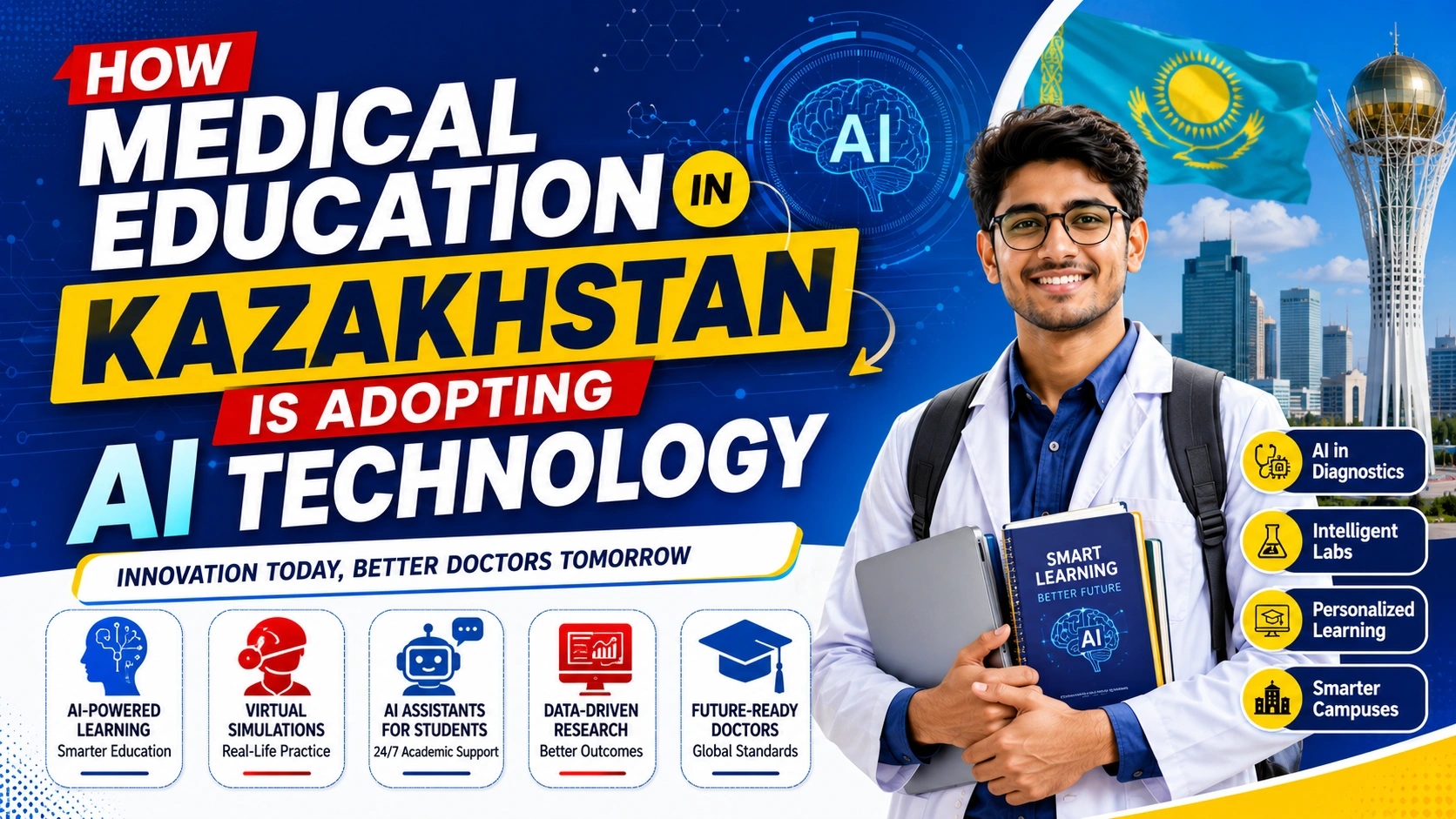
AI is no longer detached from reality, and is now a part of everyday career-building processes for medical students. With MBBS in Kazakhstan, schools are updating teaching, clinical practice, and evaluation methods to reflect the global integration of medical education and technology. AI tools are a part of that integration.
For aspiring students, especially those targeting an education such as MBBS in Kazakhstan for Indian students, seeing AI tools in the classroom and understanding their placement in educational frameworks are important as they highlight opportunities students can take advantage of in the classroom.
Integration of AI in Kazakhstan's Medical Education System
With AI's capabilities being a perfect match for the key skills the medical domain is centered on—continuity, precision, and pattern discernment—AI tools are becoming a larger part of the Medical Education System. The healthcare sector won't be the same, with AI being used for diagnostics, imaging, and even the management of patients, and it's important to train students to adapt and develop with these tools.
This is the new norm, and developing the skills to complement these tools will be required of every healthcare practitioner, especially as the domain of healthcare becomes further integrated with technology.
AI-Powered Learning Tools in Kazakhstan's Medical Universities
3D Anatomy and Simulation
Learning anatomy from cadavers is no longer the only way to teach anatomy. AI and 3D anatomy simulators allow anatomy students to interact with skeletons and models. Computer models and skeletons can be reset and viewed from multiple orientations without the constraints of a physical cadaver. Structures can even be explored more thoroughly in more flexible and convenient ways and multiple times.
Intelligent Tutoring Systems
Adaptive learning is beginning to make its way into universities. These systems employ AI to determine what issues a student has the most based on test scores and study habits. After determining where the student is lacking, systems will suggest particular study materials that teach the student about the specific topic. Unlike traditional educative systems, these systems provide autonomy toward the students' learning.
AI Diagnostics Training
AI will be used more in the practice of diagnosing issues in medicine. Radiology and pathology will be more reliant on AI to assist in diagnostics. Medical students training to be doctors will learn to practice medicine using AI to find problems with radiology. This will be important for practice in any country that has advanced clinical practice.
AI and Clinical Training
Simulated Patient Interactions
Clinical training is aided by the use of AI in virtual patient simulators. These systems allow students to begin the practice of diagnostic skills and clinical decision making in a safe environment. These systems also portray a patient that verbally responds to the clinician (student) in a realistic fashion. This builds confidence for soon to be healthcare professionals that will deal with patients in everyday life.
Surgical Simulation Technology
For advanced students, AI-integrated surgical simulators offer an opportunity to practice techniques in a safe environment. Many of these simulators utilize machine learning to evaluate technique, accuracy, and even judgment, and provide feedback to aid the development of skills.
How AI Supports Exam Preparation
Since a good proportion of study MBBS in Kazakhstan 2026 will require the Indian licensing examinations (NExT) to practice, AI-based platforms will be a great help in their study. Some of these features include:
- dynamically changing level of difficulty in a question bank, based on the results
- advanced analytics prioritizing study subjects
- automatic progress logs after practice tests
- performance of conceptual doubt clearing with AI, minimizing the need for constant faculty presence
This helps in rapidly and efficiently closing gaps with preliminary study, and reduces the likelihood of unpleasant surprises with gaps in knowledge just before a major examination. Giving the basics learned during the NEET preparation strong retention is of utmost importance. Also, AI tools can strengthen and integrate clinical skills with fundamental concepts.
AI in Research and Academic Work
Medical universities have become more open to the use of AI for extensive literature reviews and data analyses. For denser research projects and case studies, these tools can also help students with academia. Although these tools cannot replace independent original thought and analyses, they help to better cope with the volume of medical literature, and faster extraction of relevant data for medical research and better structuring of academia.
Naturally, universities want to uphold standards of academic integrity. Encouraging students to use AI to assist with research, rather than using it as a substitute for understanding and originality, checks this concern.
Global Alignment: Why This Matters for International Recognition
The inclusion of AI in medical curricula is proof of a global trend that international regulatory authorities of medical education recognize. Medical schools in Kazakhstan, offering MBBS courses and recognized by the World Health Organization, enjoy being part of a global community that helps support a network of flexible and up to date medical education.
- The World Health Organization has identified the emerging role of digital health and AI in the future of health care and the influence of these on the shaping of curricula of medical education.
- The World Directory of Medical Schools (WDOMS) recognizes that, as a medical school, you have successfully met the criteria of modern teaching and learning that is aligned with the use of technology.
- For Indian students, them National Medical Commission, has been monitoring and revising the recognition of medical education for practice in India. Following official channels will ensure your qualification will allow you to practice as a doctor in India.
Benefits of AI Integration for Students
Encouraging Understanding
AI tools that have integrated visual and interactive aides can assist students in understanding and engaging with previously difficult online resources and learning.
Self-Paced Learning
Students do not all progress with the same learning pace. AI tools that promote individualized learning ensure the student can progress at an appropriate learning speed and are given the time necessary to learn on the more challenging aspects of learning.
The Value of Early Exposure to AI Clinical Tools
AI is becoming integrated into clinical settings throughout the world. Students in medical school who have early exposure to such tools will have a smoother integration into the medical profession where such tools will be commonplace.
Better Prepared for Exams
AI tools in medical education use data to provide insights into levels of focus and effort in students, which can lead to improved scores in both medical school and licensing examinations.
Implications
The integration of AI tools into medical education will improve the learning experience of students. However, students must keep the following in mind:
- Learning to use AI tools must be in addition to learning the basics. Clinical skills such as history taking, physical examination, and patient management will always be the cornerstone of medical practice.
- Critical thinking must be at the forefront. In the long run, relying on AI for answers and a subsistence understanding of concepts will lead to a deterioration of diagnostic skills.
- Understanding the privacy of data and the ethics of AI will be a valuable part of medical education. AI tools in the classroom and clinical practice will use data of a sensitive nature. Learning the ethics of AI and responsible use will be especially important.
Guide to Optimal Use of AI Tools for Students
- Use AI tools to supplement classroom learning and clinical teaching. Use AI to create quizzes and simulations to enhance learning. Always attend classes and teaching sessions to learn the theory and clinical skills.
- Use AI practice tools along with traditional study methods. AI tools provide time efficiency, while older study methods provide depth.
- Use AI with the intent to learn. Be inquisitive regarding how AI tools are used in clinical practice to enhance the learning of skills that will be used in the workplace.
- Using Artificial Intelligence for research can be useful when used at the beginning of a lit review. AI has the potential to further engage researchers but information should still be confirmed and cited.
How AI is Changing Medical Education
The evolving presence of AI technologies is the beginning of what we can expect within the medical training field. AI has the potential of including real-time support during medical training and new VR experiences. However, healthcare training will be reliant on how adaptable medical schools will be to the new technologies.
Conclusion
The integration of AI within medical schools signals the attempt to keep training methods relevant and in sync with the future of healthcare. For students attempting to gain their medical degree from Kazakhstan, advanced and cutting-edge medical teaching will be available within a WHO and WDOMS certified, internationally recognized healthcare educational system.
With these new modern teaching methods, students of these schools will be more equipped to enter the 21st century medical workplace. Using AI and other new teaching methods will aid students to not only gain the knowledge, but also the skills to pass licensing boards needed to legally practice.